


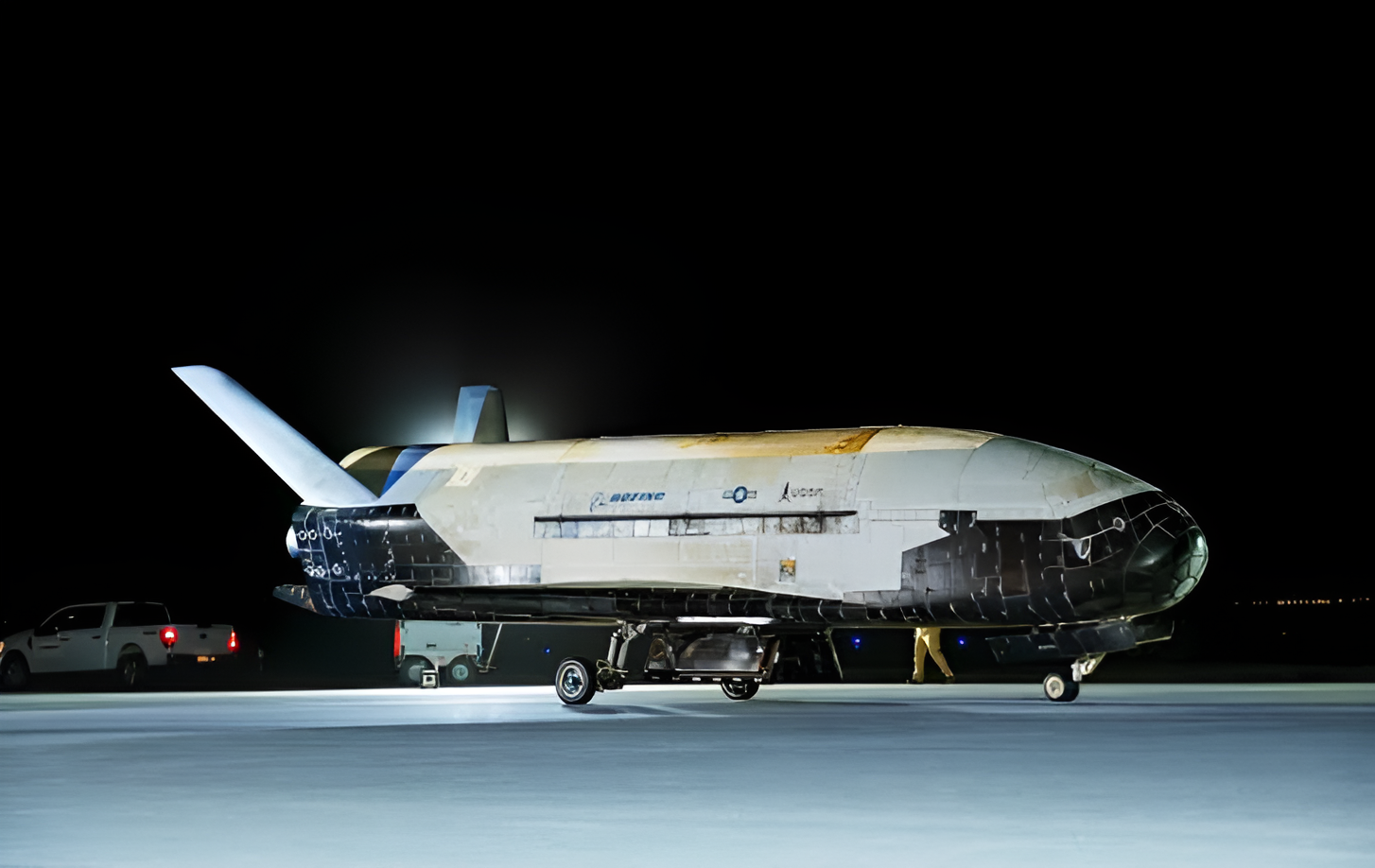
Pentagon Image Reveals Shenlong’s Apparent Cargo Bay After Four Missions
A newly published Pentagon assessment provides the clearest public orbital image yet of Shenlong, China’s secretive uncrewed space plane. The 2024 commercial-satellite image shows a winged spacecraft with apparent cargo-bay doors, offering physical clues about how the reusable vehicle may carry and release objects in orbit. It does not provide evidence that Shenlong carries weapons.
The American satellite-imaging company Vantor, formerly Maxar, captured the picture in 2024. The Defense Intelligence Agency made the full-resolution version publicly available on October 26, 2026, as part of a new assessment of space-security threats, according to FlightGlobal’s account of the disclosure.
What can actually be established from the image? Shenlong has a compact, winged configuration broadly resembling the U.S. Space Force’s Boeing X-37B. Visible features include a dark thermal-protection surface on the vehicle’s underside, a large vertical tail and stub wings. White structures protruding from the upper fuselage appear consistent with open clamshell cargo doors. An external module with two deployed solar arrays is attached near the rear, although the DIA does not identify its purpose.
A payload bay expands the mission set
A reusable spacecraft with an accessible bay could transport experiments, small satellites or other hardware into orbit and return selected payloads to Earth. Shenlong has previously released objects during missions, but the purpose of those deployments has not been publicly established. They could support technology demonstrations, satellite deployment or other operations.
The design also buys operational flexibility at a substantial engineering cost. A vehicle that returns through the atmosphere needs thermal protection, aerodynamic control and landing hardware that an expendable satellite does not. Its wings and related structures become mass that must first be carried into orbit. In return, recovery allows hardware, experiments and potentially the spacecraft itself to be inspected, refurbished and flown again.
Shenlong has launched on four known orbital missions since 2020. Its first three flights accumulated 546 days in orbit, while the fourth launched in February 2026 and was believed to remain underway when the DIA assessment appeared. Missions have typically lasted around nine months, making the craft more than a short-duration reentry demonstrator.
The closer approach is the more consequential clue
The mission record adds another capability that the photograph alone cannot establish. The DIA says that in November 2022 Shenlong appeared to maneuver with a companion satellite and maintain a separation of roughly one kilometre. At one point, the objects apparently came within 100 metres. The agency assessed that they possibly rendezvoused before the companion satellite was released again.
Close-proximity flight is demanding because two spacecraft must manage their relative position and motion, rather than merely occupy broadly similar orbits. It depends on guidance, navigation, control and propulsion working together with sufficient precision. As NASA’s overview of rendezvous and proximity systems explains, such missions require trajectory design, navigation sensors, maneuver planning and collision-avoidance provisions.
Those skills have peaceful and military applications. They can support docking, inspection, servicing, cargo transfer and the deployment or retrieval of spacecraft. The reported 2022 behavior therefore suggests a useful orbital-operations capability, but it does not reveal the mission’s purpose or show that Shenlong interacted with an uncooperative spacecraft.
The weapons question remains unresolved but bounded
The DIA places Shenlong inside a wider discussion of Chinese counterspace development, including systems intended to disrupt, damage or destroy satellites. That broader assessment is not a finding that the space plane carries any such system. No weapon is identified in the image, and no available mission result establishes that Shenlong has deployed one.
The closest public analogue is the U.S. Space Force’s X-37B, another reusable robotic space plane used for long-duration missions whose details are largely classified. Seven X-37B missions were completed after its first flight in 2010, and an eighth launched in August 2025. The comparison helps establish the vehicle class, not identical missions or equipment.
Shenlong’s fourth flight is now the next source of evidence. Its eventual duration, the objects associated with it and the configuration in which the craft returns could clarify whether China is emphasizing experimentation, payload deployment, proximity operations or a combination of those roles. For now, the newly public image confirms a reusable winged vehicle with an apparent working cargo bay; its full purpose remains out of view.
| More aerospace and engineering stories, right in your MSN feed. Follow AMI on MSN |
By David Whitaker — Associate editor for AMI’s aerospace and drone systems desk, translating flight systems, aircraft programs, spaceflight, and UAV developments into accessible technical stories.



