


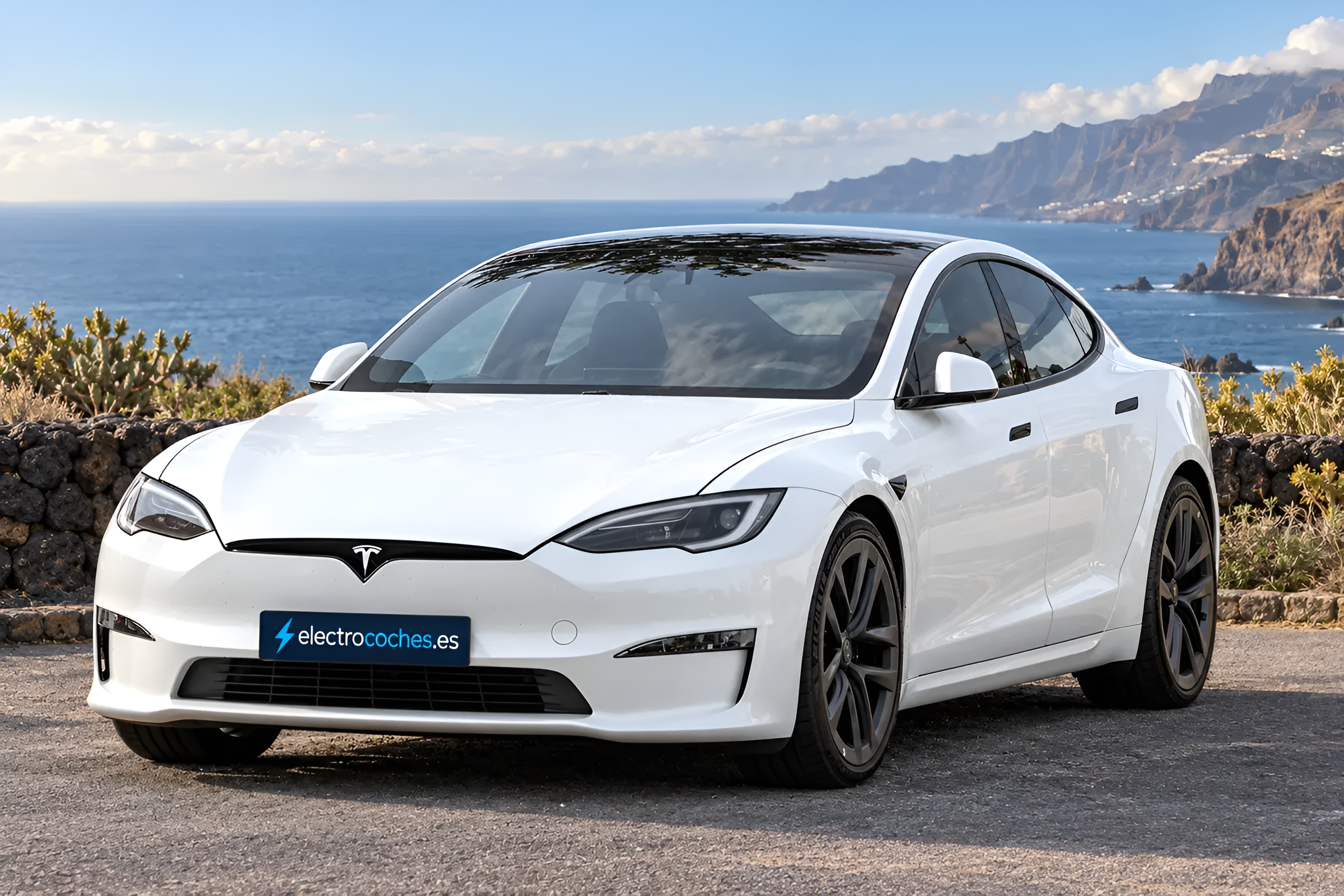
135,000-Mile Tesla Model S Goes 221 Miles but Carries Repair Risk
A battery that still provides useful driving range does not make the rest of an aging electric car young again. Edmunds’ sub-$13,000 Tesla Model S demonstrated both sides of that equation: After 135,000 miles, it traveled 221 miles in the Edmunds EV range test, while motor noise, display damage and a weakening powered tailgate pointed toward potentially costly work without warranty protection.

The completed range test is encouraging because 221 miles remains practical for many daily driving patterns. It also challenges the assumption that a high-mileage electric car must have lost so much battery capacity that it is no longer useful. This result belongs to one vehicle, however, and the car’s uncertain configuration prevents a reliable calculation of how much capacity its battery has lost.
Its original battery specification remains unclear
Edmunds cited a $69,900 original price, which matches the base Model S 60. That version carried a 208-mile EPA range rating when new and a claimed zero-to-60-mph time of 5.9 seconds. The larger-battery Model S 85 started at $79,900, had a 265-mile EPA rating and offered stronger performance.
The tested car’s range and acceleration led to the suggestion that it may be a Model S 85, but that identification has not been confirmed. Without knowing whether the car began with the smaller or larger battery, the 221-mile result cannot be translated into a dependable percentage of retained usable capacity. If it is a 60, the measured distance exceeds that version’s original EPA figure; if it is an 85, it represents a meaningful reduction from the original rating. Test conditions and EPA certification figures are also different measures, so neither comparison independently establishes battery health.
Performance has remained substantial. The single-motor, rear-wheel-drive sedan reached 60 mph in five seconds and completed the quarter-mile in 13.3 seconds. It did so on old, mismatched tires that struggled to transmit its power. Its air suspension still worked, the cabin had no obvious creaks or rattles, and the car remained quiet and enjoyable through corners during the initial assessment.
Range is only one part of the ownership equation
The rear motor’s whine is the most consequential unresolved symptom because it involves the propulsion system, although no diagnosis or repair requirement has been established. Damage to the driver’s display and a tired powered tailgate add separate electronic and electromechanical concerns. None prevented normal use during the initial evaluation, but together they show why remaining battery range is an incomplete measure of an older EV’s condition.
Warranty exposure sharpens that distinction. Tesla’s current warranty information lists separate limits for basic vehicle coverage and battery-and-drive-unit coverage, while advising owners to consult the warranty issued with their specific vehicle. Edmunds says this car has no warranty safety net, leaving it responsible for repair expenses.
That exposure is significant in light of Edmunds’ experience with its earlier 2013 Model S. That vehicle required three drive-unit replacements and one battery replacement, with warranty coverage reducing the financial impact. The history does not predict the same failures for the newly acquired car, but it demonstrates how warranty status can change the economics of major component work.
Charging performance is the next major test
Other high-mileage Model S examples offer context rather than direct comparisons. A separate 2015 P85D with about 160,000 miles reportedly provided roughly 200 miles of real-world range on its original battery. Another Model S with 250,000 miles covered 206 miles in an Out of Spec test conducted at roughly 70 mph, though it could not maintain that speed near the end.
The 250,000-mile car also needed about 47 minutes to charge from 10% to 80%. Its complete charge from empty took two hours and 41 minutes, with recalibration and cell balancing extending the final stage. Those figures illustrate why an aging EV can retain adequate range yet deliver a less convenient long-distance experience: battery capacity determines how far it can go, while charging behavior determines how quickly that range can be restored.
Edmunds plans to measure the 135,000-mile car’s charging performance and continue using it regularly. Those tests should reveal whether its 221-mile result is supported by acceptable charging behavior and dependable operation or offset by the accumulating costs of an aging motor, suspension, electronics and body hardware.
| More aerospace and engineering stories, right in your MSN feed. Follow AMI on MSN |
By Thomas Caldwell — AMI’s senior editor for mechanical and mobility engineering, covering vehicle electronics, systems integration, electrification, chassis systems, propulsion, and safety policy.



