NASA Holds Artemis III to 2027 as Commercial Launch Risks Mount
NASA still targets 2027 for Artemis III, but the mission’s schedule is no longer governed principally by one rocket and one spacecraft. The planned low-Earth-orbit rehearsal requires NASA, SpaceX and Blue Origin to coordinate three launches, two commercial lander test articles and successive docking demonstrations. Damage to Blue Origin’s only New Glenn launch pad has added another constraint to an integration campaign already exposed to lander delays.

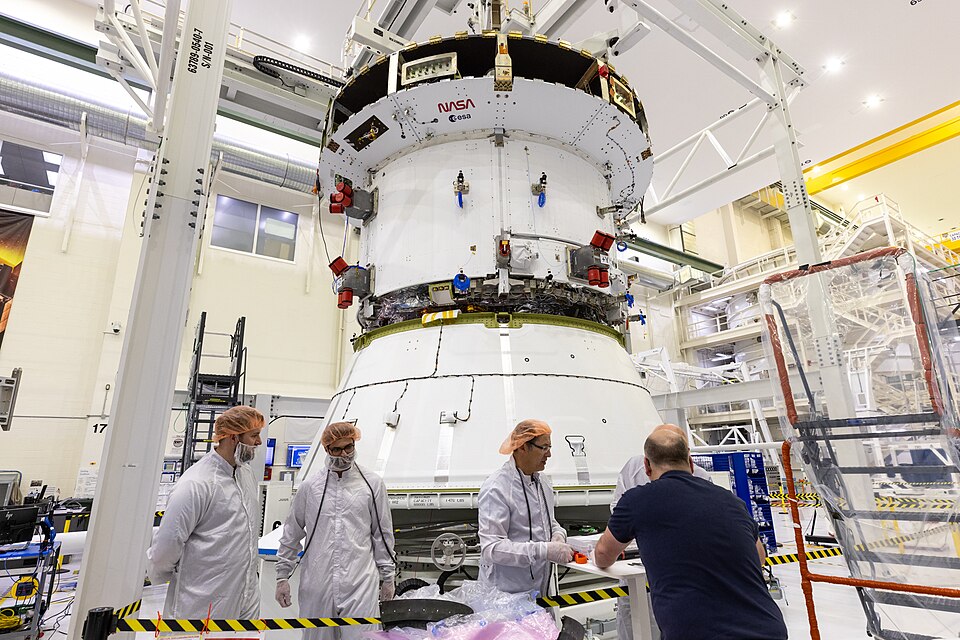
NASA Administrator Jared Isaacman said the agency is “still very much planning for” the 2027 mission. He characterized the Space Launch System rocket and Lockheed Martin-built Orion capsule as progressing well. NASA’s own latest Artemis III hardware update provides a concrete marker: engineers joined Orion’s crew and service modules on July 30, 2026, and are preparing to power up the combined spacecraft for integrated testing.
The schedule tension sits outside that relatively mature NASA-managed stack. Artemis III is designed to place four astronauts aboard Orion and practice rendezvous and docking with test versions of SpaceX’s Starship Human Landing System and Blue Origin’s Blue Moon lander. Both commercial lander programs have encountered delays, and each must arrive with compatible hardware, software and safety controls not merely reach orbit.
Artemis III is an integration test, not a lunar landing
The revised mission is a rehearsal for later crewed lunar operations rather than a landing attempt. According to NASA’s Artemis III lander-test plan, the commercial vehicles would launch separately before conducting back-to-back rendezvous and docking exercises with Orion in a circular Earth orbit.
Blue Origin’s test article is planned to launch first and can remain in orbit for up to 30 days while teams conduct checkouts. Orion would act as the active “chaser” spacecraft during docking, and up to two astronauts would enter the Blue Moon cabin. The test vehicle is based on the company’s Mark 2 crew-lander architecture and is intended to carry major avionics, flight software and control systems relevant to later lunar missions.
SpaceX would subsequently launch a Starship Version 3 test article fitted with a nose docking system. Orion and Starship would dock nose-to-nose, but the astronauts would not enter Starship during this mission. NASA and SpaceX plan to evaluate controllability, communications and the behavior of the combined spacecraft. Software authority also changes between demonstrations: Orion would control the docked Blue Moon combination, while the Starship test article would control the second integrated stack.
Those differences make Artemis III more than two repetitions of the same maneuver. NASA must verify two docking geometries, two control arrangements and two independently developed spacecraft architectures while protecting the Orion crew throughout both phases. Ground processing, control centers, communications networks and launch opportunities also have to align within a relatively compressed campaign.
New Glenn repairs now sit on the critical path
Blue Origin’s launch infrastructure became a larger schedule concern after a New Glenn rocket exploded during a May 28 hot-fire test, severely damaging the company’s sole orbital launch site in Florida. Blue Origin later traced the event to a main oxygen valve in one of the first stage’s seven BE-4 engines. The company has described small valve modifications that can be retrofitted to existing engines while it completes the remaining fault-tree analysis.
Blue Origin says it aims to rebuild the pad and return New Glenn to flight by the end of 2026. Isaacman said New Glenn remains NASA’s preferred launcher for Blue Origin’s Artemis III hardware: “Plan A is launching on New Glenn, and they have a year to do that. So I’m very confident they’ll be able to achieve it.” He also said NASA has contingency plans if further delays threaten the schedule, but did not disclose launch vehicles, hardware assignments or other details. Those alternatives therefore cannot yet be treated as established mission architecture.
SpaceX presents a different set of open milestones. NASA is monitoring the next Starship flight test, including Raptor engine and heat-shield performance. Those tests concern the broader maturation of a vehicle intended for reuse, while Artemis III additionally requires a flight-ready docking installation and verified interoperability with Orion.
NASA’s rocket hardware is advancing: solid-rocket-booster stacking has begun, all four Artemis III main engines have reached Kennedy Space Center, and the agency is using a non-propulsive spacer in place of an upper stage not required for this Earth-orbit mission. But the 2027 date ultimately depends on the slowest connected element. Before Artemis can use this rehearsal to reduce risk for a planned 2028 lunar return, Blue Origin must restore its only New Glenn pad, both commercial vehicles must mature, and three launch campaigns must converge around one crewed Orion flight.
By David Whitaker — Associate editor for AMI’s aerospace and drone systems desk, translating flight systems, aircraft programs, spaceflight, and UAV developments into accessible technical stories.