August Lunar Eclipse Will Cover 96% of Moon Across North America
About 96% of the Moon’s visible face will enter Earth’s dark central shadow during a partial lunar eclipse on Aug. 27-28, 2026. The event will be visible across most of North America, although moonrise will prevent some western observers from seeing its early stages. NASA’s August skywatching guide also lists visibility across much of South America and parts of Europe and Africa.

Maximum eclipse is expected at 12:12 a.m. EDT on Aug. 28. That corresponds to 11:12 p.m. CDT, 10:12 p.m. MDT and 9:12 p.m. PDT on Aug. 27. At that point, only a narrow portion of the lunar disk will remain outside the umbra, giving viewers a scene that approaches but does not reach a total lunar eclipse.
Why 96% coverage is still a partial eclipse
A lunar eclipse occurs when Earth passes between the Sun and a full Moon. Earth then casts its shadow across the lunar surface. The umbra is the shadow’s darkest central region, where Earth blocks direct sunlight from reaching the Moon.
The 96% figure describes the approximate share of the Moon’s face covered at maximum. NASA describes the same geometry another way, saying about 93% of the Moon’s diameter will be inside the umbra. Those percentages measure different aspects of the lunar disk, but both indicate an unusually deep partial eclipse with a thin directly illuminated section remaining.
The complete eclipse sequence will last more than five hours, while the principal viewing phase will run for about 3 hours and 18 minutes. That long progression gives observers time to watch Earth’s curved shadow advance across the Moon rather than treating maximum eclipse as the only worthwhile moment.
Moonrise limits the western view
Most of North America should be able to see the eclipse at maximum, with northwestern Canada and Alaska outside the main viewing area. Local weather and horizon obstructions will still determine whether the Moon is actually visible from a given location.
Timing presents a separate constraint in parts of the West. In sections of Washington, Oregon and Northern California, the partial eclipse will already be underway when the Moon rises. An unobstructed eastern horizon will therefore matter more than specialized observing equipment. Buildings, terrain or trees could hide the low Moon and shorten the usable viewing window.
Hawaii faces a more pronounced timing limit. The Moon is expected to rise after maximum eclipse has passed, with roughly two-thirds of its face still covered. Viewers there can see part of the event, but not its deepest stage.
Color depends on Earth’s atmosphere
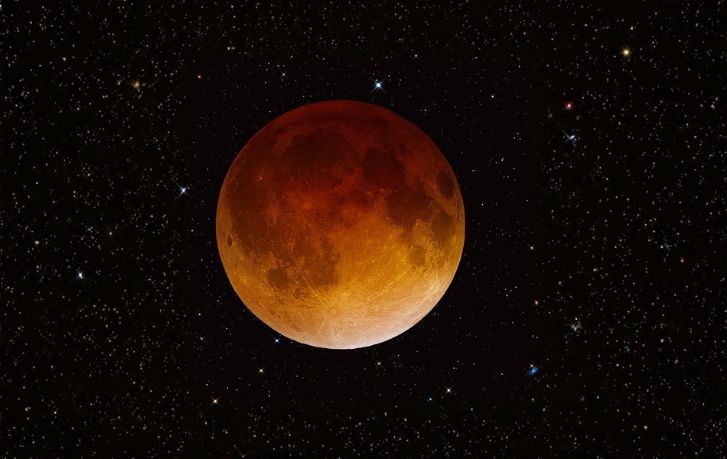
The shadowed area may appear orange-yellow, coppery red, chocolate brown or ashen gray. Atmospheric dust, volcanic activity and other conditions can change how sunlight is filtered and redirected through Earth’s atmosphere before reaching the Moon. No particular color is guaranteed, so descriptions of the event as a “blood moon” should not be read as a firm visual forecast.
Unlike a solar eclipse, this lunar eclipse requires no protective eyewear. NASA confirms that it is safe to view the Moon with unprotected eyes or through a telescope during every stage of a lunar eclipse. Binoculars or a small telescope are optional, but they can make the boundary of Earth’s shadow, surface contrast and any atmospheric color easier to distinguish.
For most viewers, preparation comes down to checking the local forecast, finding a clear view toward the Moon and accounting for the relevant time zone. Eastern and central observers should have the strongest opportunity to follow the event through maximum, while western observers will need to treat moonrise not the eclipse clock alone as the defining limit.
By David Whitaker — Associate editor for AMI’s aerospace and drone systems desk, translating flight systems, aircraft programs, spaceflight, and UAV developments into accessible technical stories.