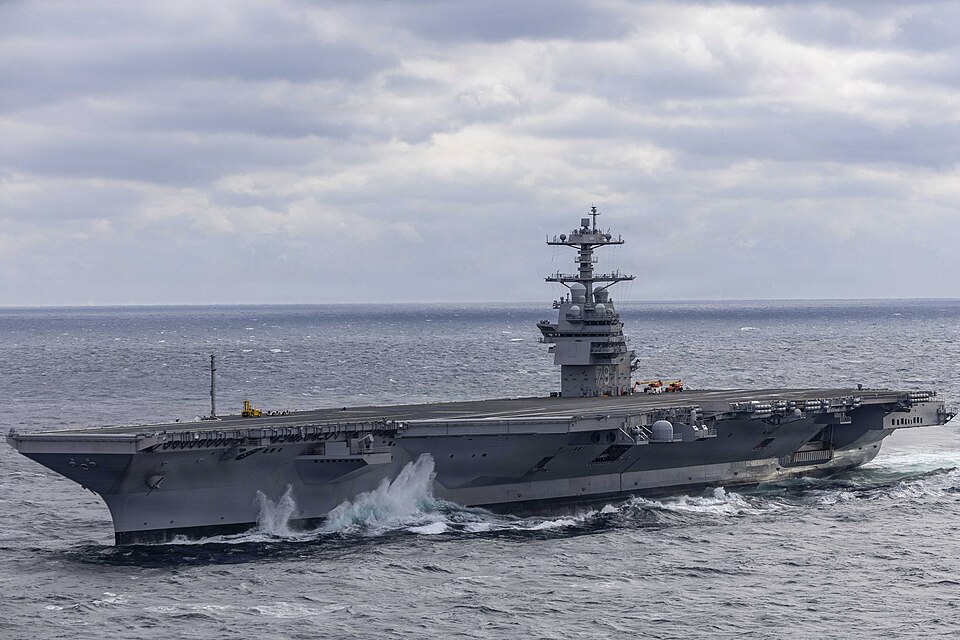
USS John F. Kennedy Starts Navy Tests Ahead of March 2027 Delivery
USS John F. Kennedy has reached a critical test without yet reaching fleet readiness. The Navy’s newest aircraft carrier departed Newport News, Virginia, on August 12 to begin acceptance sea trials, a Navy-led evaluation that will help determine whether the ship can proceed toward preliminary acceptance and its reported March 2027 delivery target.

The distinction matters for a roughly 100,000-ton carrier with an adjusted cost-limitation baseline of approximately $13.529 billion. Getting underway confirms that the ship and crew were prepared to enter this test phase. It does not demonstrate that every system meets contract requirements, that all remaining construction is finished or that the carrier is ready for operational service.
A ship-wide engineering examination
Acceptance trials move the evaluation from the pier to an operating marine environment. Evaluators are expected to examine the carrier’s two A1B nuclear reactors and propulsion plant, electrical distribution, steering, navigation and communications. Radar operation, aviation support, damage control, habitability and combat-system integration are also part of the broader assessment.
That scope reflects the defining engineering challenge of a modern carrier: individual subsystems cannot be judged only in isolation. Propulsion and electrical generation must support ship movement and major electrical loads. Navigation, communications and radar must operate as an integrated command system. Flight-deck equipment must function alongside the machinery that moves aircraft and weapons through the ship. Acceptance trials test whether those elements behave as a complete platform under realistic operating conditions.
John F. Kennedy, the second Ford-class nuclear-powered carrier, previously completed builder’s sea trials from January 28 through February 4. Those earlier trials covered propulsion, navigation, habitability, combat systems and the Enterprise Air Surveillance Radar. The ship then returned to Newport News for construction work, discrepancy correction, certification and further system integration.
Four weapons elevators remain a visible schedule issue
The carrier was reported to be about 97 percent complete by April, but that percentage alone cannot establish delivery maturity. Four of its 11 Advanced Weapons Elevators remained unfinished. The seven completed elevators provided access to every weapons magazine, allowing training and certification work to proceed, but completion of the remaining units is still part of the ship’s broader delivery picture.
These elevators are intended to move weapons within the carrier, making them part of both the ship’s mechanical architecture and its aviation workflow. Their status is especially important because elevator installation and integration also complicated completion of the lead ship, USS Gerald R. Ford. Advanced Arresting Gear certification and jet-blast-deflector work were among the other unresolved items identified ahead of Kennedy’s planned delivery.
The Navy’s fiscal 2026 budget justification tied the shift to March 2027 to continued weapons-elevator work and certification of the Advanced Arresting Gear, the system used to stop aircraft during carrier landings. Supply-chain and workforce pressures have added further schedule scrutiny. Acceptance trials can therefore protect the delivery date if systems perform as required, but they can also expose discrepancies that need correction and verification back at the shipyard.
New systems raise the integration burden
Kennedy incorporates four electromagnetic aircraft launch systems, Advanced Arresting Gear and the Enterprise Air Surveillance Radar, which uses fixed AN/SPY-6(V)3 arrays to provide 360-degree coverage. It also includes aviation modifications intended to support the F-35C from delivery rather than through a later retrofit.
Each addition brings a separate certification or integration burden. The launch and arresting systems must support aircraft handling reliably. The radar must function within the carrier’s larger sensor and combat-system architecture. Jet-blast deflectors and associated deck equipment must be compatible with the intended air wing. Acceptance trials are a major opportunity to evaluate these systems together, although some aviation certifications and construction tasks can continue beyond the time at sea.
The Ford-class design targets about 160 sustained aircraft sorties per day, compared with roughly 120 for a Nimitz-class carrier. Those are design projections, not performance demonstrated merely by beginning acceptance trials. Actual output depends on system reliability, air-wing composition, maintenance, weather, weapons availability and crew endurance.
If the ship completes its evaluations successfully, it can move closer to preliminary acceptance and delivery. Commissioning and later operational certification would still follow. For Kennedy, the decisive result from this trial period will not be that the carrier sailed, but whether the Navy returns with a manageable discrepancy list and whether the shipyard can close it without moving the March 2027 target again.
By David Whitaker — Associate editor for AMI’s aerospace and drone systems desk, translating flight systems, aircraft programs, spaceflight, and UAV developments into accessible technical stories.