


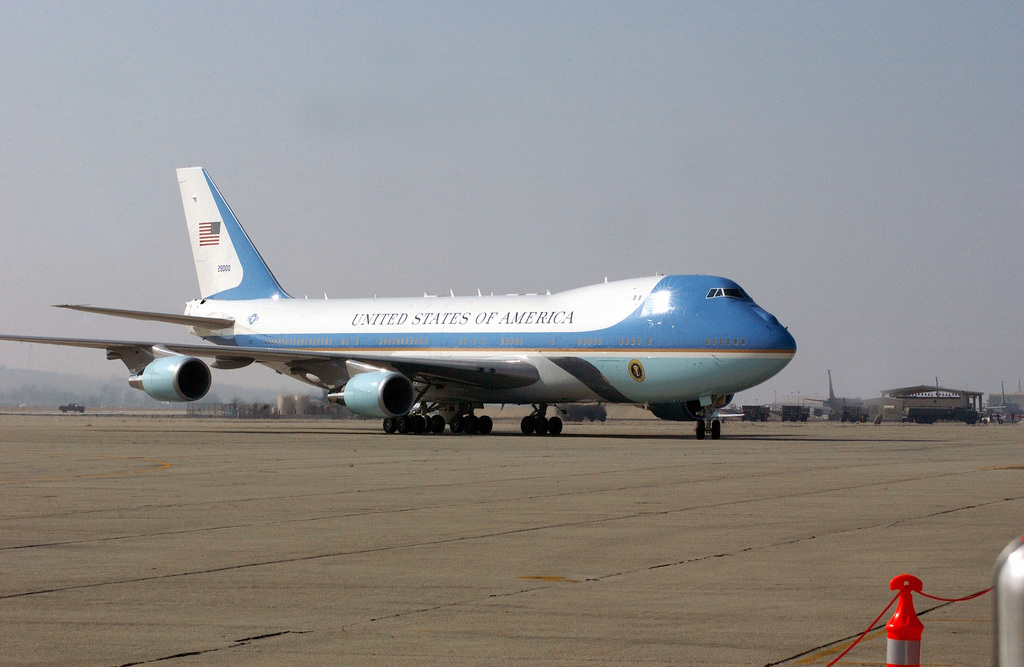
Boeing’s Two Delayed Presidential Jets Reach $4.49 Billion After Parts Award
Boeing’s contract for two replacement presidential aircraft has reached $4.49 billion even though the jets are not projected to arrive until 2028 and 2029. A new $75 million Air Force modification covers initial spare parts, raising the cumulative contract value from $4.42 billion while the fleet transition remains roughly four years behind its original first-delivery target.

The award, modification P00187 to contract FA8625-16-C-6599, supports two fully mission-capable VC-25B aircraft and is separate from the firm-fixed-price engineering and manufacturing development work. The Air Force obligated $30 million in fiscal 2026 research, development, test and evaluation funding when it made the award. Work will be performed in San Antonio, Texas.
A 747 conversion on a much larger scale
The program is not purchasing two ordinary production 747s. Boeing is converting two 747-8 airframes into specialized aircraft capable of supporting the presidential airlift mission. The jets were originally built for Russian airline Transaero, which went bankrupt before taking delivery, allowing the Air Force to acquire existing airframes at a reduced cost.
That acquisition saved the time and expense of starting with newly built commercial aircraft, but it did not remove the difficult conversion work. A presidential aircraft requires extensive structural changes, specialized wiring, communications equipment, cabin modifications and airworthiness certification. Each change must work as part of an integrated aircraft rather than as an isolated upgrade.
Wiring is a particularly consequential part of that process because it cuts across the airframe. Boeing attributed earlier setbacks partly to wiring defects, alongside workforce shortages, pandemic disruption, subcontractor bankruptcies and delays in obtaining security clearances for personnel. The company also terminated original cabin-interior supplier GDC Technics in 2021, forcing another adjustment in an already specialized supply chain.
Security requirements add an industrial constraint not found on a normal airliner modification. It is not enough to hire qualified technicians or move work between suppliers quickly; personnel working in sensitive areas may also need appropriate clearances. That limits how rapidly labor can be added when the schedule slips. Supplier replacement can likewise require more than finding another company because designs, documentation, manufacturing responsibility and certification evidence must be transferred or rebuilt.
The $4.49 billion figure needs context
Boeing signed the original $3.9 billion fixed-price agreement in 2018. Under that structure, Boeing is responsible for overruns within the covered development effort rather than automatically passing every additional internal cost to the Air Force. The company recently recorded another $280 million charge associated with higher estimated costs for structural and wiring installation and airworthiness certification.
The new $75 million award is different: It buys initial spare parts outside the fixed-price engineering and manufacturing development work. That distinction matters because the cumulative contract value is not the same as Boeing’s cost to execute the core conversion. It does show, however, that the government’s contractual commitment continues to expand as support requirements are added around the two-aircraft fleet.
Buying spares before delivery is not inherently unusual for a small, mission-critical fleet. With only two aircraft, parts availability can directly affect whether one jet is ready when the other is undergoing maintenance. Initial spares also reduce dependence on commercial 747 supply channels for components specific to the presidential configuration. The timing is notable because taxpayers are funding that support base while the aircraft themselves remain years from operational service.
Delay keeps the older fleet in service longer
The first VC-25B was initially due by the end of 2024. The Air Force now projects delivery in mid-2028, followed by the second aircraft in mid-2029. Boeing has said engineering is complete, aircraft modification is underway and testing of the first jet is intended to begin in 2027. Testing and certification now form the next major schedule boundary.
Until the transition is completed, the mission continues to depend on aircraft based on the older 747-200B. The two current VC-25A jets entered service in 1990 and remain assigned to the Presidential Airlift Group at Joint Base Andrews, according to the Air Force’s VC-25 fact sheet. Keeping them available longer means sustaining a low-volume, highly customized fleet well beyond the replacement program’s original timetable.
The next decisive milestone is therefore not another contract increase but the start of testing. The conversion must demonstrate that its structural, electrical, communications and cabin systems function together and satisfy airworthiness requirements. Until that work moves through test and certification, the Air Force will carry both a $4.49 billion replacement contract and the operational burden of presidential aircraft that first entered service nearly four decades earlier.
By David Whitaker — Associate editor for AMI’s aerospace and drone systems desk, translating flight systems, aircraft programs, spaceflight, and UAV developments into accessible technical stories.



