


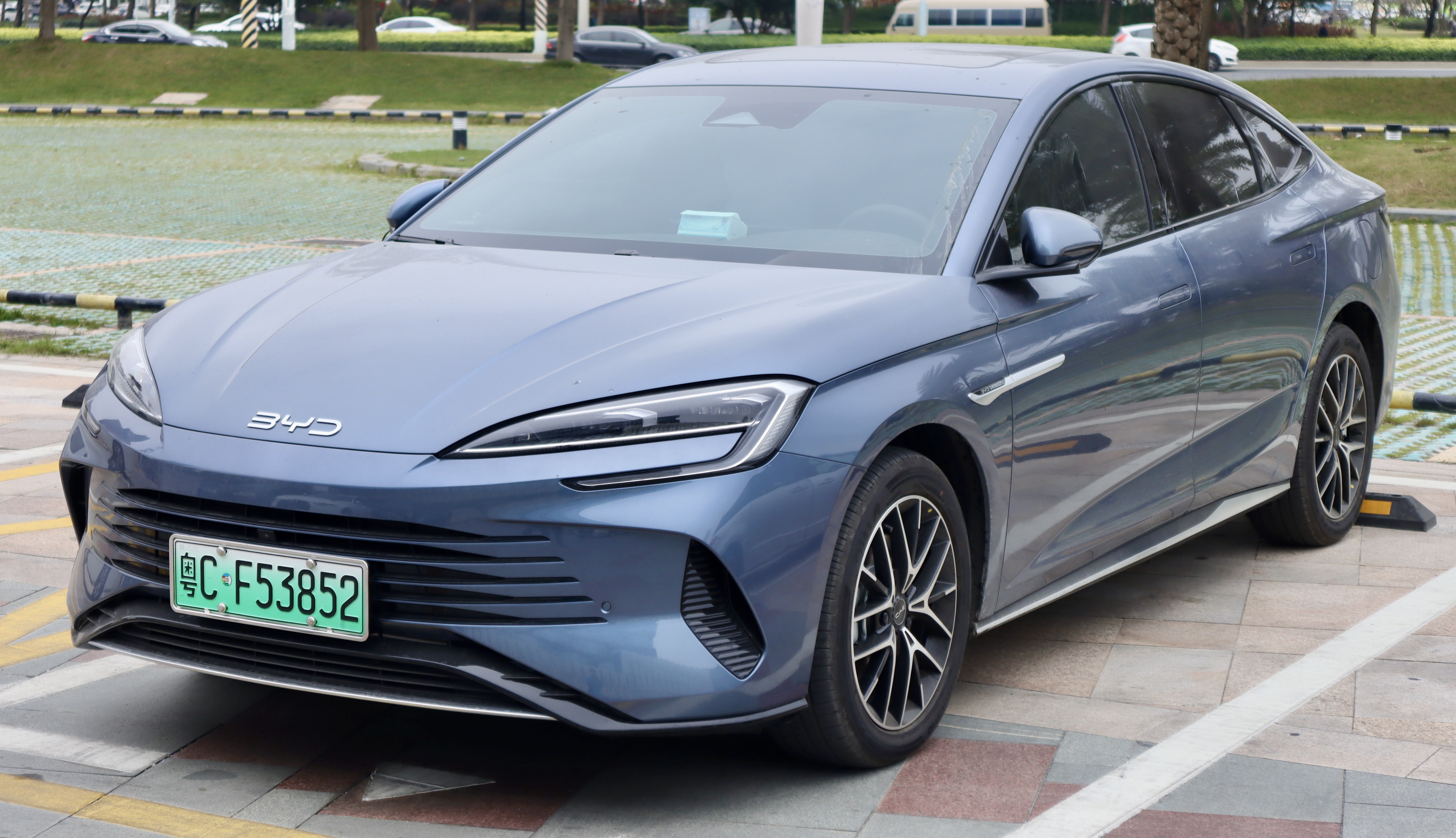
BYD Says $24,600 Seal 07 Reached 97% Charge in Nine Minutes
BYD says its updated Seal 07 electric sedan charged from 10% to 97% in eight minutes and 44 seconds at one of the company’s Flash charging stations in Shenzhen. The car starts at 169,900 yuan, reported as about $24,600, creating a striking proposition: charging that approaches the duration of a gasoline stop in a comparatively inexpensive electric sedan.

The demonstration is not yet an independent charging test, however, and a critical measurement remains undisclosed. BYD’s station can provide as much as 1,500 kilowatts, but the company did not state the Seal 07’s peak accepted power or publish the complete charging curve. The charger’s maximum output therefore should not be treated as the power that entered the vehicle.
What the demonstration established and what it did not
During the company-run session, the Seal 07 reportedly moved from 10% to 70% in four minutes and 51 seconds. Its displayed range rose from about 73 kilometers to 495 kilometers over that interval. The car reached 97% after eight minutes and 44 seconds, with 686 kilometers displayed.
Those results suggest that the 69-kilowatt-hour second-generation Blade lithium-iron-phosphate battery sustained rapid charging well beyond the middle of its state-of-charge range. That is technically important because charging normally slows as a battery approaches full charge. Battery controls must limit current as cell voltage rises and manage temperature and cell-to-cell variation. Reaching 97% so quickly could therefore be more consequential than a brief headline peak, provided the result can be reproduced under controlled conditions.
The missing charging curve prevents a fuller assessment. Peak input, average input, battery temperature, ambient conditions, preconditioning and the power taper near full charge would show how the system produced the result. Repeated sessions would also help establish whether the performance is representative rather than an optimized demonstration. None of those missing details disproves BYD’s claim, but they define what an independent test must measure.
Displayed range is not U.S. driving range
BYD states a maximum range of 705 kilometers, or 438 miles, using China’s CLTC test cycle. The 686-kilometer figure displayed at 97% belongs to that same relatively optimistic framework; it is not a measurement of miles added during real-world driving.
An estimate places the car at roughly 300 miles under the U.S. Environmental Protection Agency method, but the Seal 07 has no official EPA rating. Temperature, speed, climate-control use and wheel selection could all alter practical range, while charging time can vary with the battery’s starting temperature and charger conditions.
The price comparison also needs a geographic boundary. In China, the Seal 07’s 169,900-yuan starting price is about 65,600 yuan below the approximately 235,500-yuan price listed for a base rear-wheel-drive Tesla Model 3. That is roughly a $10,000 difference at the exchange rates used for the reported prices, but it is not a controlled vehicle comparison. Equipment, test cycles, taxes and market-specific pricing differ.
Fast charging is a vehicle-and-grid system
The battery cannot deliver this experience by itself. It requires a compatible high-power charger, an electrical connection capable of supplying it and thermal controls that keep the battery and charging hardware within operating limits. A 1,500-kilowatt station rating describes substantial infrastructure, even when a connected car draws only part of that capacity. Site power, simultaneous vehicle demand, installation cost and utility interconnection will determine where such charging can be deployed economically.
BYD says it intends to expand Flash charging technology into Europe, the Middle East, Africa, Latin America and the Asia-Pacific region. That plan makes charger deployment and interoperability as important as the cell chemistry. A rapid charge available only at a limited set of proprietary sites does not produce the same consumer benefit as one supported across a broad travel network.
U.S. buyers are unlikely to receive this particular package soon. Tariffs on Chinese electric vehicles and restrictions involving Chinese-origin connected-vehicle software create barriers beyond normal vehicle certification and charging compatibility. The Seal 07 also combines lidar-supported driver assistance, phone-as-key functions and other software-dependent features, so market entry would involve both automotive compliance and connected-system policy.
Independent testing now needs to establish the Seal 07’s actual peak and average input power, temperature behavior and repeatability. Until then, the verified product specifications and reported stopwatch result make BYD’s demonstration notable but the undisclosed charging curve remains the measurement that would show how the sub-nine-minute result was achieved.
By Thomas Caldwell — AMI’s senior editor for mechanical and mobility engineering, covering vehicle electronics, systems integration, electrification, chassis systems, propulsion, and safety policy.




