Ukraine Says Russia Accelerates Rassvet to 292 Satellites by 2027
Russia’s Rassvet satellite-internet network sits at a sharp divide between ambition and demonstrated capability. The system reportedly has only 16 operational satellites today, producing intermittent coverage when one passes overhead, yet Ukrainian military intelligence says Russia is accelerating toward a 292-satellite constellation in 2027.
Major General Vadym Skibitskyi, deputy chief of Ukraine’s GUR military intelligence service, described the accelerated schedule on August 14. He said Russia intends to continue launching spacecraft and expand Rassvet further to 924 satellites by 2035. Those targets, and the assessment that deployment is moving faster than originally planned, remain attributed Ukrainian intelligence claims rather than independently verified results.
The significance is less about matching Starlink satellite for satellite than about crossing from occasional access toward more persistent connectivity. A low-Earth-orbit communications satellite moves rapidly across the sky relative to a user on the ground. With only a small number in orbit, service is available during limited passes and disappears until another suitable spacecraft enters view.
Adding satellites can shorten those gaps, but the final result depends on more than the fleet total. Orbital altitude, inclination, the number and spacing of orbital planes, spacecraft availability, terminal visibility and network routing all determine whether a user receives continuous service. The available information does not establish Rassvet’s completed orbital configuration or show at what deployment level uninterrupted regional coverage becomes possible.
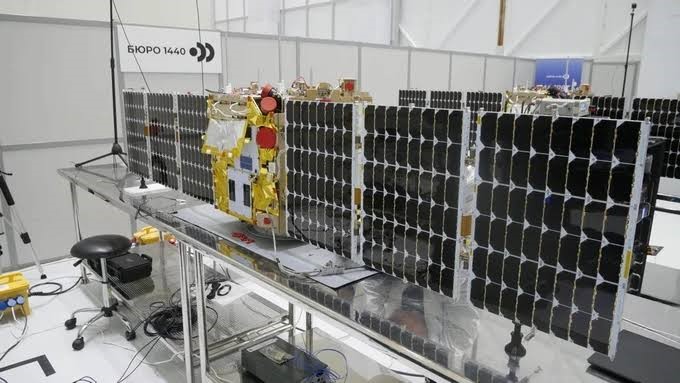
Rassvet is being developed by Russian aerospace company Bureau 1440, which describes its project as a low-Earth-orbit broadband system connecting orbital constellations with terrestrial public networks. The company says its planned spacecraft use laser links between satellites and that its terminals are intended for stationary and mobile platforms. It advertises speeds of up to 1 gigabit per second and latency below 70 milliseconds, but those are company-stated design goals, not independently established performance for the current 16-satellite fleet.
Laser crosslinks could become important as the constellation grows because they allow traffic to move between satellites before reaching a ground gateway. That can reduce dependence on having a gateway within sight of every spacecraft carrying user data. It does not eliminate the need for ground infrastructure, user terminals, network management and sufficient capacity across the constellation.
The reported 292-satellite objective is substantial, but it would still leave Rassvet far below Starlink’s scale. Starlink has more than 10,000 working satellites in orbit, giving SpaceX a much larger base for coverage, capacity, redundancy and fleet replacement. Satellite count alone does not provide a complete service comparison, but the roughly 34-to-one difference between more than 10,000 Starlink spacecraft and 292 planned Rassvet satellites shows why calling the Russian network a direct equivalent would be premature.
A more useful near-term comparison is Eutelsat’s OneWeb constellation, which operates more than 600 satellites in 12 synchronized orbital planes. OneWeb demonstrates that a broadband network can provide broad service with hundreds rather than thousands of spacecraft when its orbital layout, terminals and market requirements are designed around that scale. It does not prove that Rassvet’s proposed 292 satellites would deliver the same coverage or capacity.
For Russia, an independently controlled network would reduce reliance on foreign satellite services. Starlink is banned in Russia but has been widely used in Ukraine for communications. Russian forces previously obtained grey-market terminals, according to the account, before SpaceX disabled them after lobbying by Kyiv. The relevant change is therefore one of communications control: Rassvet could give Russia authority over its own spacecraft, terminals and service policies rather than dependence on a U.S. operator.
Deployment remains the central constraint. Moving from 16 satellites to 292 requires repeated launches, serial spacecraft production, ground-segment expansion, terminal manufacturing and sustained constellation operations. Reaching 924 by 2035 would also require replenishing satellites that fail or reach retirement while new spacecraft are still being added.
The next meaningful milestone is not simply another launch announcement. It is evidence that Rassvet has filled enough orbital positions to reduce its present coverage gaps and support repeatable service. Until deployment records and operating data demonstrate that transition, 292 satellites by 2027 remains an accelerated target not a completed Starlink-like capability.
By David Whitaker — Associate editor for AMI’s aerospace and drone systems desk, translating flight systems, aircraft programs, spaceflight, and UAV developments into accessible technical stories.