Apophis Will Safely Pass 20,000 Miles Above Earth for Gravity Study
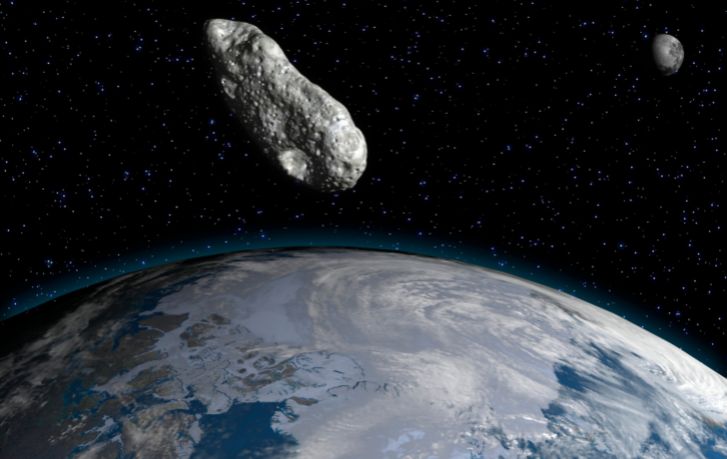
About 20,000 miles will separate asteroid 99942 Apophis from Earth’s surface on April 13, 2029. That is closer than many satellites in geosynchronous orbit, yet the encounter is not an expected impact: NASA says Apophis will pass safely and poses no impact risk for at least 100 years.

The distance makes this more than a striking skywatching event. Earth’s gravity will turn the flyby into a rare natural experiment, changing the asteroid’s path and probably its rotation while potentially shifting material across its surface. Ground observatories and spacecraft will try to measure those changes before, during and after the encounter.
A large asteroid inside geosynchronous altitude
Apophis has a mean diameter of about 1,115 feet, or 340 meters, and an elongated shape with a long axis of at least 1,480 feet. NASA describes the 2029 encounter as the closest approach by an asteroid of this size that scientists have known about in advance.
The roughly 20,000-mile altitude is less than the approximately 22,236-mile altitude associated with geosynchronous orbit. That comparison describes altitude, not a predicted collision with a satellite. NASA explicitly says the flyby presents no danger to people, astronauts or satellites.
Observers in parts of the Eastern Hemisphere may be able to see Apophis without a telescope or binoculars, weather permitting. Its potential viewing route includes parts of Australia, Asia, Africa, Europe and eastern South America. Actual visibility will depend on location, local darkness, cloud cover and the asteroid’s brightness and position at a given time, so the geographic route should not be treated as a count of people who will see it.
Earth supplies the force for the experiment
The flyby’s main scientific value comes from tidal forces. The side of Apophis nearer Earth will experience a slightly stronger gravitational pull than the far side, stretching and squeezing the asteroid as it passes. Earth’s overall pull will also widen Apophis’s orbit around the Sun and lengthen its orbital period from slightly less than an Earth year to slightly more than one.
Scientists expect the encounter to alter Apophis’s spin state, although the direction and size of that change remain subjects for measurement. Surface material could also move in small landslides or other disturbances, particularly on steep slopes. Those possibilities are not predictions that Apophis will break apart. Instead, its response could reveal information about its internal structure, surface strength and composition.
Telescopes will track the asteroid’s path and monitor changes in brightness as it rotates. Radar observations can help refine its shape and orientation. Comparing measurements from before and after closest approach should allow researchers to separate gravitationally induced changes from Apophis’s normal motion.
NASA repurposed a proven spacecraft
NASA redirected the former OSIRIS-REx spacecraft after it delivered a sample from asteroid Bennu to Earth in September 2023. Renamed OSIRIS-APEX, the spacecraft is scheduled to rendezvous with Apophis shortly after the close approach and conduct an extended investigation.
The reuse matters from a mission-design standpoint. NASA is sending an already operating spacecraft with a flight-proven instrument suite toward a second asteroid rather than building a new probe solely for this encounter. OSIRIS-APEX cannot return another sample, but it can map Apophis, characterize its rotation and composition, and measure its mass and gravity field. Later in the campaign, the spacecraft is planned to approach the surface and use its thrusters to expose subsurface material for observation.
The European Space Agency also plans its Rapid Apophis Mission for Space Safety, or Ramses, to accompany the asteroid through the flyby. If carried out as planned, its observations would provide a view spanning the encounter, while OSIRIS-APEX would concentrate on the aftermath. Combining spacecraft data with worldwide telescope and radar measurements would give researchers a before-and-after record that no single platform could collect alone.
Apophis was once associated with possible future impacts after its 2004 discovery, but improved optical and radar tracking removed those scenarios from current risk calculations. Its 2029 passage is now a scheduled planetary-science test: a 340-meter asteroid passing inside geosynchronous altitude while Earth itself supplies the force researchers want to measure.
| More aerospace and engineering stories, right in your MSN feed. Follow AMI on MSN |
By David Whitaker — Associate editor for AMI’s aerospace and drone systems desk, translating flight systems, aircraft programs, spaceflight, and UAV developments into accessible technical stories.