Clemson’s 1,700-Cell Solar EV Shows Modeled Surplus, Not Road-Test Proof
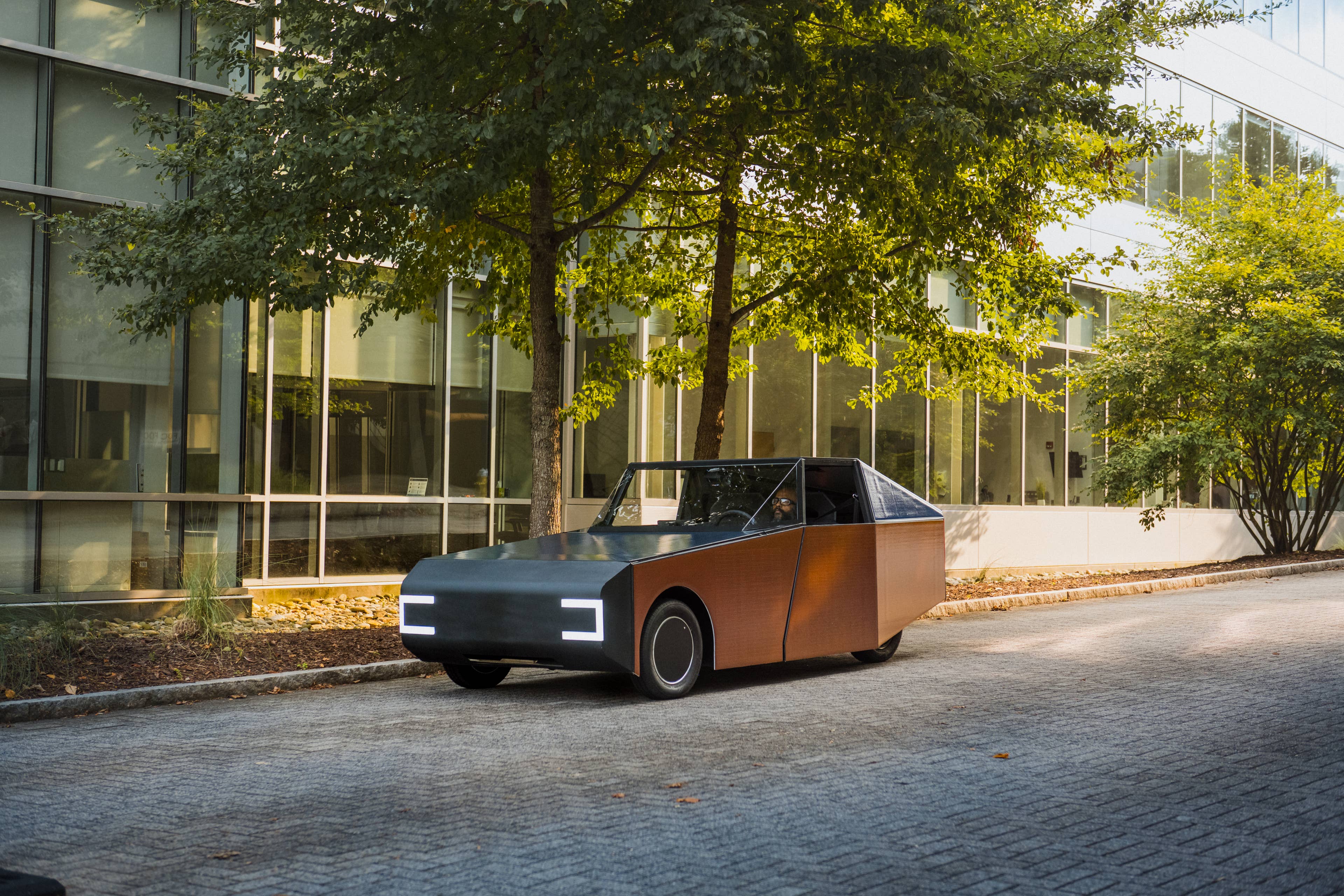
Deep Orange 17 starts with an unusual systems decision: Its solar bodywork is part of the propulsion-energy strategy, not merely an accessory intended to run cabin electronics. More than 1,700 photovoltaic cells collect energy while the electric coupe is parked or moving, according to Clemson University’s unveiling of the prototype. The engineering objective is to offset enough traction energy to create a daily surplus under short-commute conditions.
That surplus has not yet been established through disclosed road testing. Clemson’s 16-student automotive engineering team modeled sunlight and environmental conditions in Greenville, South Carolina; Frankfurt, Germany; Madrid, Spain; and Mumbai, India. With a daily commute of 12 miles, the model indicated an average surplus equivalent to 31 miles of additional driving range across the four locations.
This is a potentially useful result, but its boundary matters. Clemson has not disclosed the photovoltaic system’s rated output, battery capacity, aerodynamic coefficients, propulsion efficiency, test protocols or the period over which the additional range accumulates. Without those figures, the 31-mile result cannot yet be independently compared with production electric vehicles or treated as a verified road-test measurement.
Solar output depends on the whole vehicle
Body-integrated photovoltaics face conditions that fixed solar arrays generally avoid. Vehicle surfaces point in different directions, move through changing light and are frequently shaded by buildings, trees or parts of the car itself. Deep Orange 17’s panels, developed with the Fraunhofer Institute for Solar Energy Systems ISE, are designed to continue producing power when portions are shaded. A protective outer film covers the solar surfaces.
The partial-shading design is important because weak output from one section can otherwise constrain the useful energy harvested from a larger interconnected array. Clemson has not provided the electrical architecture or measured shading performance, so the magnitude of that benefit remains unspecified. Still, designing around uneven illumination addresses a fundamental difference between photovoltaics installed on vehicles and panels placed in a consistently exposed stationary array.
The prototype’s second major lever is mass. Deep Orange 17, also called Luminetta, weighs 1,212 pounds, or 550 kilograms. Its chassis combines structural steel, aluminum components, carbon-fiber structural members and 3D-printed metal joints. That multi-material approach lets engineers place materials according to structural and manufacturing requirements rather than asking one material to satisfy every load, joining and packaging constraint.
For an urban vehicle, low mass reduces the energy needed for acceleration and lowers the amount that must be recovered or replaced after each trip. It also makes a limited-area solar array more consequential. The tradeoff is production complexity: Steel, aluminum, carbon fiber and printed metal parts require different forming, joining, repair and quality-control methods. Clemson presents Deep Orange 17 as a functional concept, not a production-ready manufacturing solution, and no cost, durability or repairability data have been released.
Controls connect generation and consumption
The project also combines regenerative braking, intelligent torque distribution, optimized drivetrain controls, power electronics and aerodynamic work. Coordinating these systems is essential because an energy-positive result cannot come from cell count alone. The vehicle must minimize conversion and motion losses while deciding how generated and recovered energy is stored and used.
A custom human-machine interface displays real-time vehicle telemetry and includes Apple CarPlay and Android Auto. The telemetry could eventually help document how solar generation, propulsion demand and stored energy vary across operating conditions, although no validation dataset has been published.
Deep Orange 17 was developed with BMW’s research and development team after a fall 2024 challenge to examine whether a vehicle could generate more energy than it consumes in everyday driving. Research is planned to continue at the Clemson University International Center for Automotive Research in Greenville, and the prototype is scheduled to appear at the 2027 Consumer Electronics Show in Las Vegas.
The next meaningful step is not adding more solar cells. It is publishing measured energy flows under defined weather, parking, route and driving conditions. Those results would show whether the prototype’s 1,700-cell body and 550-kilogram structure can move the energy-positive claim from a promising model into a repeatable vehicle test.
| More aerospace and engineering stories, right in your MSN feed. Follow AMI on MSN |
By Robert McKinney — Editor-in-Chief for AMI’s automotive and mobility coverage, with a mechanical engineering background and a decade reporting on powertrain systems, EV innovation, and global vehicle manufacturing.