S301 Reaches 25,000 Kilometers Per Second, Could Reveal Black Hole’s Spin
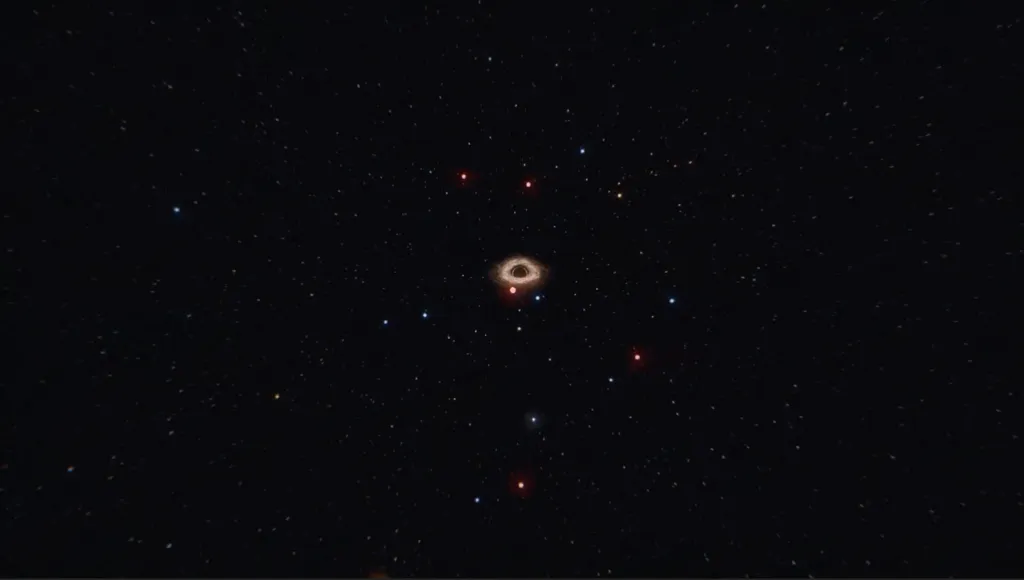
At roughly 25,000 kilometers per second, S301 is the fastest star reported in the Milky Way. That peak velocity more than 8% of the speed of light comes as the star swings around Sagittarius A*, the supermassive black hole at the center of our galaxy. Its compact orbit could give astronomers a shorter route to measuring the black hole’s rotation, according to a study published in Nature on August 19.
The speed is striking, but the orbit is the more important result. S301 completes a revolution in 8.7 years and passes within about 1.78 billion kilometers of Sagittarius A*, roughly the distance from the Sun to Saturn. That combination of a short period, high eccentricity and close approach makes the star unusually sensitive to how the black hole distorts nearby spacetime.
A star becomes a gravity probe
General relativity predicts that a rotating black hole drags the surrounding spacetime with it. Known as frame dragging, this effect should gradually alter the orientation of a nearby star’s orbit. The closer the star passes to the black hole, the stronger that relativistic signature becomes.
S301 therefore works as a natural test particle. Astronomers cannot see spacetime being dragged directly, but they can repeatedly measure the star’s position and look for the small orbital shifts expected from Sagittarius A*’s spin. Researchers say S301 probes the region around the black hole substantially more closely than previously used stars, strengthening the signal they hope to isolate.
No spin measurement has been completed yet. The team hopes that observations spanning at least two full S301 orbits will constrain its trajectory well enough to pursue a direct measurement. The star’s next closest approach is expected in 2031, creating an especially valuable window for precision tracking.
“Without this star, we would need to measure the motion of other stars for several more decades to get anywhere close to measuring the spin of the black hole,” study co-author Juan Osorno said. With S301, researchers believe the relevant observations could be gathered within roughly the next decade, although the full result will depend on measurement precision and the black hole’s spin orientation.
Finding a faint target beside a black hole
Astronomers first identified S301 in 2023 with the GRAVITY instrument on the European Southern Observatory’s Very Large Telescope Interferometer in Chile’s Atacama Desert. They subsequently traced it in earlier observations from 2017 and 2021, producing more than eight years of orbital coverage.
The interferometer combines light from four 8-meter telescopes, providing the angular resolution needed to separate tightly packed objects near the Galactic Center. That capability is critical because S301 appears about two billion times fainter than Betelgeuse in Earth’s sky and sits in a crowded field containing much brighter stars and the variable emission around Sagittarius A*.
Multiple reconstruction and point-source fitting methods placed S301 in consistent positions, supporting the tracked orbit and its calculated peak speed. Even so, the present measurements do not include the radial-velocity data needed to remove an ambiguity in the orbit’s three-dimensional orientation. Future spectroscopy from the Extremely Large Telescope’s MICADO instrument is expected to complement continued GRAVITY+ position measurements.
Spin is not the only force moving the orbit
The central measurement problem is separation. Frame dragging is not the only process capable of shifting S301’s path. Other stars, stellar remnants and any extended mass surrounding Sagittarius A* can exert ordinary gravitational forces that also cause orbital precession.
The relativistic spin effect is concentrated near S301’s closest approach, while perturbations from the surrounding stellar population tend to leave different signatures elsewhere in the orbit. Astronomers can also compare S301 with other Galactic Center stars that experience a similar background environment but remain farther from the black hole. Those reference orbits may help calibrate the nonrelativistic gravitational contribution.
The proposed measurement will consequently require more than detecting a slight change in one orbit. It will require sustained astrometry, future velocity measurements and models precise enough to distinguish frame dragging from conventional gravitational perturbations. The binary-disruption scenario proposed for S301’s origin one star captured while a companion was expelled also remains an interpretation rather than an observed history.
For now, the confirmed result is a remarkably fast star on an 8.7-year circuit. The decisive test comes next: whether the 2031 close pass and continued tracking can turn S301’s extreme motion into the first direct stellar-orbit measurement of Sagittarius A*’s spin.
| More aerospace and engineering stories, right in your MSN feed. Follow AMI on MSN |
By David Whitaker — Associate editor for AMI’s aerospace and drone systems desk, translating flight systems, aircraft programs, spaceflight, and UAV developments into accessible technical stories.