LandSpace Lands ZhuQue-3 Booster After Failure, Delivers Satellite to Orbit
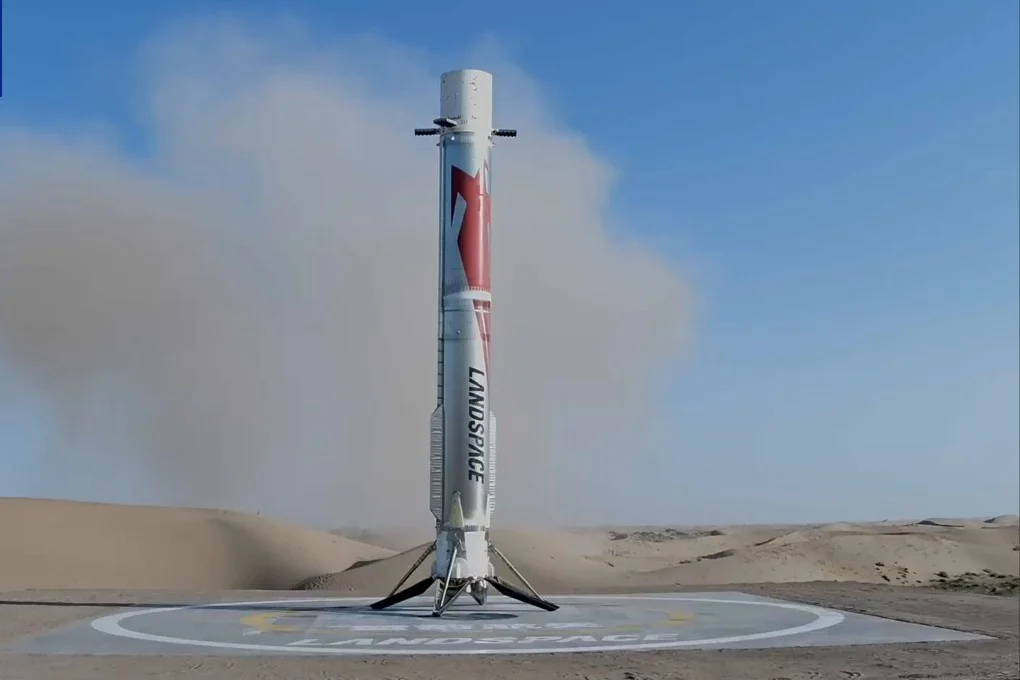
China’s LandSpace delivered the Honghu 03 satellite to orbit and brought the ZhuQue-3 Y2 first stage down on land on August 19, completing a mission that had eluded the rocket during its debut. LandSpace characterized the touchdown in Gansu Province as China’s first successful on-land recovery of an orbital-class booster using landing legs, a milestone also detailed in a postflight account of the mission.
The rocket lifted off at 7:35 a.m. local time from the Dongfeng Commercial Space Innovation Pilot Zone. Its stages separated approximately 137 seconds later. The upper stage placed Honghu 03, built by Hongqing Technology, into its designated orbit, while the first stage followed its planned return trajectory and made a soft touchdown at LandSpace Landing Site No. 1 in Minqin County.
That combination matters. Delivering the payload establishes that the flight performed its primary transportation job; recovering the booster demonstrates that the first stage retained enough control and propulsion capability to return intact. Neither result alone, however, proves that LandSpace can refurbish the stage quickly or fly it again economically.
The second flight reversed an earlier landing failure
ZhuQue-3 reached this point on only its second launch. During the first mission in December 2025, the upper stage reached low Earth orbit, but the booster encountered what was described as abnormal combustion during its landing attempt and exploded at the recovery site.
LandSpace subsequently reported several technical changes, including a simplified landing-burn arrangement, additional predicted-landing-point functionality in the autonomous safety-control system and improved thermal protection for reentry heating and structural loads. The successful second attempt indicates that the revised recovery architecture could execute one complete return. It does not establish the failure rate of that architecture across repeated missions.
The 66-meter-tall, 4.5-meter-diameter ZhuQue-3 uses liquid methane and liquid oxygen. Its reusable first stage has fold-out landing legs at the base and stabilizing fins near the top. LandSpace reports a low Earth orbit payload capacity of up to 14.2 metric tons.
Those features invite comparisons with SpaceX’s Falcon 9, but the visual resemblance should not be mistaken for equivalent operational performance. Falcon 9 has a stated maximum low Earth orbit payload rating of 22.8 metric tons and benefits from a mature recovery, refurbishment and launch system built through repeated flights. ZhuQue-3 has now demonstrated one successful landing after one failed attempt.
The propellant choice is another distinction. ZhuQue-3 burns methane rather than Falcon 9’s kerosene-based fuel. Methane can support reusable-engine goals, but propellant selection does not determine turnaround time by itself. Engine condition, thermal protection, structures, plumbing, inspection requirements and ground processing all influence whether a recovered stage produces meaningful cost or schedule savings.
China is testing two different recovery systems
LandSpace’s landing followed a separate Chinese recovery milestone in July. The state-owned China Aerospace Science and Technology Corporation recovered a Long March 10B booster at sea using a net-equipped ship. An earlier Long March 10A flight in February descended vertically but set down in the sea without being recovered.
The two programs therefore represent different approaches: ZhuQue-3 returned to a fixed land site on legs, while Long March 10B used ship-based capture hardware. Land recovery can avoid the logistics of operating a vessel, but it requires the vehicle and mission profile to support a return to an appropriate site. A ship can provide geographic flexibility downrange, although it adds marine equipment and recovery operations. One successful example of each does not yet show which approach will be more economical or reliable in Chinese service.
If either system matures into repeatable reuse, the practical consequence would be more important than the landing itself. Recovering flight hardware can reduce the need to manufacture a new first stage for every mission and potentially support a higher launch tempo. Realizing that benefit requires evidence from inspection, refurbishment, turnaround and reflights the next phase LandSpace must demonstrate.
That progression is relevant to U.S. commercial and national-security planners because launch cadence determines how quickly satellite networks can be expanded or replenished. U.S. Space Force Lt. Gen. Gregory Gagnon has said China operates about 1,900 satellites, including more than 500 remote-sensing spacecraft. Honghu 03 has not been assigned a military role in the available mission information, but a broader reduction in Chinese launch cost and processing time could support both commercial and national-security constellations.
ZhuQue-3 has validated orbital delivery and controlled recovery in the same mission. Its more consequential test will be whether this particular booster can return to flight and whether LandSpace can repeat that cycle often enough to turn a successful landing into routine launch capacity.
| More aerospace and engineering stories, right in your MSN feed. Follow AMI on MSN |
By David Whitaker — Associate editor for AMI’s aerospace and drone systems desk, translating flight systems, aircraft programs, spaceflight, and UAV developments into accessible technical stories.