Earth’s Shadow Will Cover 96% of Moon, Giving Billions a Chance
96.3%. That is how much of the Moon’s visible disk will sit inside Earth’s dark central shadow at the peak of a deep partial lunar eclipse spanning Aug. 27 and 28, 2026. More than 3 billion people 44% of the global population are geographically positioned to see at least part of the event, although weather, local Moon rise and Moon set will decide what any individual observer actually sees.

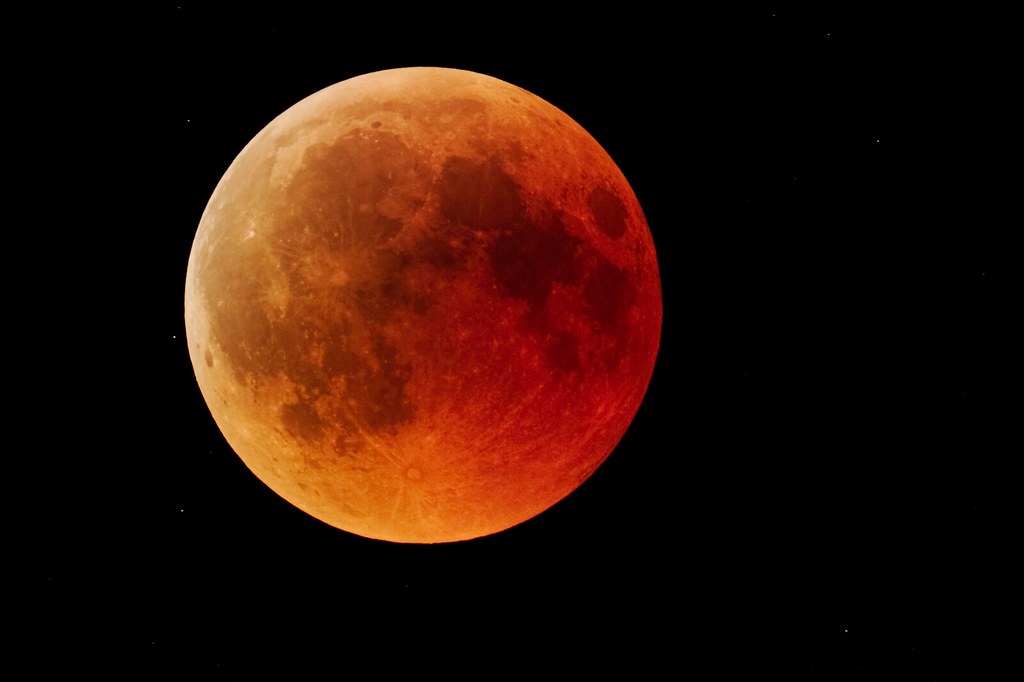
The eclipse will reach maximum coverage at 4:13 a.m. Universal Time on Aug. 28, or 12:13 a.m. EDT. NASA’s eclipse visualization and timing data show that a narrow portion of the lunar disk will remain outside the umbra, preventing this from becoming a total lunar eclipse. It will come close, but it will not produce a full “blood moon.”
Why 96% coverage is still partial
A lunar eclipse occurs when Earth moves between the Sun and the full Moon, causing the Moon to pass through Earth’s shadow. The outer region, called the penumbra, blocks only part of the Sun as viewed from the lunar surface. Its effect on the Moon is comparatively subtle.
The umbra is different. Inside that central shadow, Earth completely blocks direct sunlight. The Moon will begin entering the umbra at 2:34 a.m. Universal Time, equivalent to 10:34 p.m. EDT on Aug. 27. From there, Earth’s curved shadow will advance across the lunar disk until only about 4% remains outside the deepest coverage.
NASA also describes the maximum in another way: about 93% of the Moon’s diameter will be inside the umbra. That figure is not a conflict with the 96.3% disk coverage. One measures a linear distance across the Moon, while the other describes the share of its visible area covered by the central shadow.
The partial phase is expected to last more than three hours. Counting the Moon’s passage through the fainter penumbra, the entire eclipse will run for about 5.5 hours. The long progression means this is not a momentary event, but geography will cut that theoretical viewing window short in many regions.
Where the eclipse will be visible
Nearly 1 billion people across North, Central and South America are positioned to see the complete eclipse. At least part of it will also be visible from western Europe, western Africa, the Middle East, Hawaii, the eastern Pacific and portions of the United States and Canada.
The viewing boundary will be set by the horizon. The Moon will set while the eclipse is underway in Europe, Africa and the Middle East, so observers there will lose the later phases. It will already be in progress when the Moon rises over Hawaii, the eastern Pacific and northwestern parts of the United States and Canada. Alaska and northwestern Canada fall outside the region NASA identifies for viewing the moment of greatest eclipse.
Clear skies remain the largest uncontrolled variable. The estimate of more than 3 billion people describes the population within the visibility footprint, not a guaranteed audience. Buildings, terrain and local cloud cover can reduce that number further.
Why the covered Moon can turn coppery
Although direct sunlight is blocked inside the umbra, some light passes through Earth’s atmosphere and is bent toward the Moon. Atmospheric filtering favors reddish and orange light, giving the shadowed surface a coppery appearance. How vivid that color appears can vary, and the uncovered sliver will remain much brighter than the eclipsed portion.
Unlike a solar eclipse, a lunar eclipse is safe to observe directly. No protective eclipse glasses or solar filters are required; binoculars or a small telescope can provide a closer look at Earth’s curved shadow crossing the lunar surface.
The event will be 2026’s second lunar eclipse and fourth eclipse overall. The next total lunar eclipse is forecast for New Year’s Eve 2028, with Asia and Australia best positioned for it. North and South America are not expected to see another total lunar eclipse until 2029, making August’s 96.3% partial alignment the closest approach to totality available there before that return.
| More aerospace and engineering stories, right in your MSN feed. Follow AMI on MSN |
By David Whitaker — Associate editor for AMI’s aerospace and drone systems desk, translating flight systems, aircraft programs, spaceflight, and UAV developments into accessible technical stories.