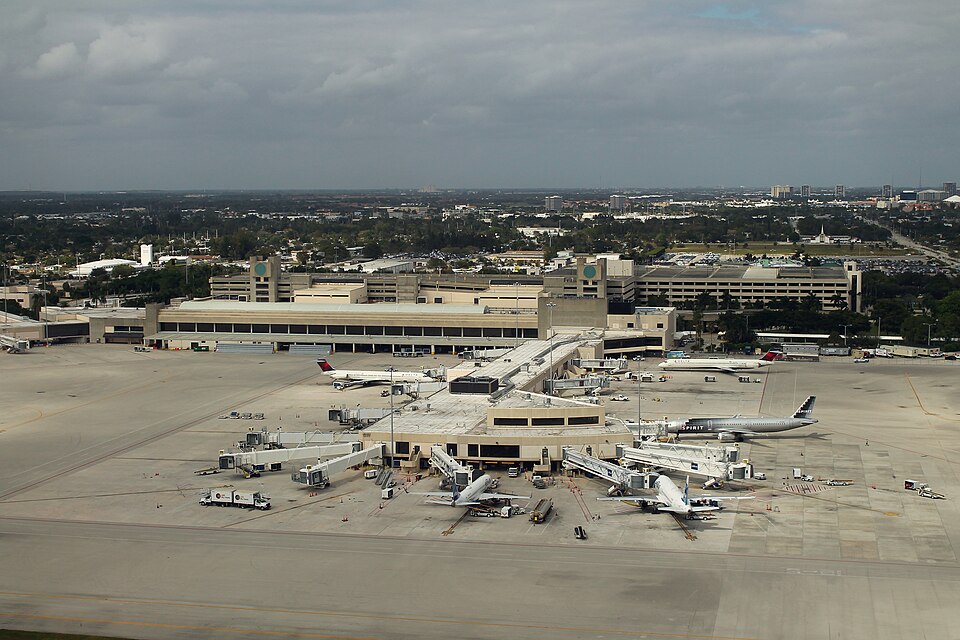
FAA Redraws Palm Beach Flight Paths After More Than 6,000 Noise Complaints
A security restriction designed to protect one location shifted an aviation burden onto surrounding communities. After more than 6,000 aircraft-noise complaints, the Federal Aviation Administration redesigned arrival and departure paths around the Mar-a-Lago exclusion zone in Palm Beach, Florida. Residents who previously experienced little aircraft noise were among approximately 20,000 people affected by the earlier routing change, according to local officials.
The operational tension remains: aircraft and drones are barred within one nautical mile of Mar-a-Lago and up to 2,000 feet, but traffic still must enter and leave the constrained Palm Beach airport environment. FAA Administrator Bryan Bedford said the agency moved quickly to establish the zone at the U.S. Secret Service’s request, then revised the perimeter approaches to reduce noise in nearby communities.
The redesign is an example of how a geographically small restriction can have effects beyond its boundary. An exclusion zone does not eliminate aircraft movements; it removes a portion of airspace from normal use. Controllers and route designers must accommodate the same basic airport function while keeping aircraft outside that protected volume, which can concentrate or redistribute overflights elsewhere.
That redistribution is the central public-policy issue. A security requirement may be justified on grounds that cannot be fully disclosed, while its operational costs become highly visible to residents under the resulting paths. Bedford said the Secret Service did not explain the intelligence underlying its request to him. That does not establish that the restriction was unnecessary, but it limits the public’s ability to compare the security benefit with the noise burden imposed on surrounding neighborhoods.
The complaint figures show the scale of public reaction, not a complete acoustic assessment. More than 6,000 complaints were filed after the restriction took effect, compared with fewer than a dozen per month beforehand. Complaint totals can identify disruption and changes in community response, but they do not by themselves establish sound levels, how frequently particular homes were overflown or whether complaints were evenly distributed among the approximately 20,000 affected residents.
Palm Beach County has infrastructure capable of producing a more technical assessment. Its Noise and Operations Monitoring System combines aircraft-surveillance information with permanent noise monitors. That integration can associate flight tracks with likely aircraft-noise events, examine the number, type and altitude of airplanes over a location, and check adherence to noise-abatement departure tracks.
Those measurements matter because a successful redesign must be evaluated across several dimensions. It could reduce overflights in the communities that generated the initial complaints while increasing exposure somewhere else. It could also change the time, frequency or type of noise without producing an equally visible change in the total number of complaints. Route maps, track data and measurements before and after the redesign would provide a stronger basis for judging whether the burden was reduced or merely redistributed.
Bedford said he believes complaints have declined significantly since the FAA changed the approaches. No updated complaint count or route map was provided to confirm that assessment, so the claimed improvement remains unverified. Palm Beach County separately provides a public noise-comment system, but complaint reporting and instrumented noise monitoring answer different questions and should not be treated as interchangeable.
Access and fairness also extend beyond residents. Revised paths affect arriving and departing aircraft, air traffic controllers, airport operations and airlines that must work within the protected airspace. The available information does not establish delays, capacity losses or safety effects from the redesign, and none should be inferred. What is confirmed is that the FAA altered routing to address the neighborhood consequences of the original configuration.
Palm Beach County and the city and town of Palm Beach sued the FAA in December, alleging that the restriction redirected aircraft over previously quiet coastal communities and was implemented without adequate consideration of surrounding effects. Those are allegations in ongoing litigation, not settled findings. The case is before a federal appeals court and may receive a decision by early 2027.
The route change therefore addresses the immediate noise problem without resolving the larger accountability question. The strongest test will not be the FAA administrator’s expectation that complaints have fallen, but comparable flight-track, monitoring and complaint data showing where aircraft now fly and which communities carry the remaining cost of preserving the security zone.
| More aerospace and engineering stories, right in your MSN feed. Follow AMI on MSN |
By Thomas Caldwell — AMI’s senior editor for mechanical and mobility engineering, covering vehicle electronics, systems integration, electrification, chassis systems, propulsion, and safety policy.