Navy Studies Ford Carrier Redesign With Cost and Future-Aircraft Risks
The U.S. Navy is evaluating changes to Ford-class aircraft carriers that could trade away two benefits built into the current design: flexible aircraft launching and roughly half an acre of additional unobstructed flight-deck space. The work concerns ships costing approximately $13 billion each, so changing the design late could add substantial expense and schedule pressure before producing an operational benefit.

The two proposals are distinct. A national security memorandum directs the Navy to plan a return from the Electromagnetic Aircraft Launching System, or EMALS, to steam catapults on later carriers. Separately, the service is assessing whether to move the ship’s flight-control tower, called the island, from its aft position toward amidships. A Navy spokesman said engineers had “begun moving out on options to meet the President’s intent,” but the service has not announced an assessment timeline or made a final implementation decision.
A catapult change reaches deep into the ship
EMALS is not simply a different mechanism mounted under the flight deck. The Ford class was designed around extensive electrification, while a steam system requires supporting machinery and distribution infrastructure appropriate to that technology. Replacing one with the other therefore raises a carrier-wide integration question involving space, weight, power, construction planning and the suppliers responsible for producing the equipment.
That distinction matters because the Navy has already committed to a production sequence. Four Ford-class carriers are under contract under a plan that could eventually include as many as 10 ships. USS John F. Kennedy is undergoing sea trials, while USS Enterprise and USS Doris Miller are under construction at Newport News in Virginia. Which hulls would receive redesigned systems has not been conclusively established in the available Navy assessment.
The public-cost issue is not merely the purchase price of replacement hardware. A late change can require new engineering, revised drawings, altered production work and additional testing. It can also strand completed or partly completed work. Current and former officials have cautioned that the proposed changes could require significant time and money, although the Navy has not released an official cost estimate for the combined redesign.
Future aircraft define the launch-system tradeoff
EMALS was selected partly because it can tailor launch energy across a broader range of aircraft weights. That range is intended to cover lightweight unmanned platforms as well as aircraft heavier than today’s F/A-18E/F Super Hornet. Such flexibility matters over a carrier’s long service life because its air wing can change repeatedly while the ship remains in operation.
An unnamed carrier-design engineer has questioned how steam catapults would perform with the prospective F/A-XX future fighter, which the engineer expects to be heavier than current carrier-capable aircraft. That is an attributed engineering concern, not an official finding that steam is incompatible with F/A-XX. The aircraft’s final requirements and the Navy’s catapult assessment would be needed before drawing that conclusion.
The relevant test is therefore broader than whether steam can launch a fighter. The Navy must determine whether the proposed system can cover the expected mix of aircraft, weights and launch requirements without narrowing the flexibility the Ford design was intended to provide. It must also compare that result against the cost and schedule consequences of inserting steam equipment into a carrier architecture developed for electromagnetic launch.
Moving the island would reclaim an old layout at a cost
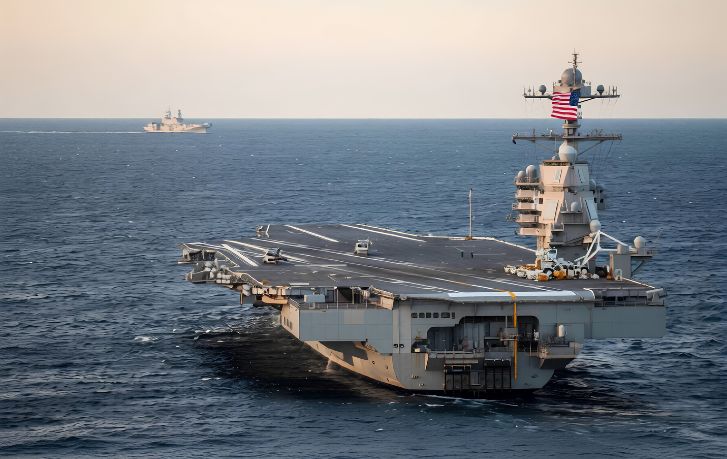
The island’s aft position is also tied to flight-deck operations rather than being an isolated styling choice. On the preceding Nimitz class, a starboard-quarter aircraft elevator is not normally used because reaching it can interrupt flight operations. The Ford design eliminated that fourth elevator, moved the island aft and created a larger unobstructed area forward of the tower.
The cited design explanation credits this arrangement with gaining approximately half an acre of deck space. That area supports aircraft parking and movement around the launch-and-recovery cycle. Moving the island toward the middle of the deck could change how that space is divided and used, even if the total deck dimensions remained unchanged.
Relocation would also mean more than lifting the tower and setting it down elsewhere. The island contains command, navigation and flight-control functions, while its position is part of the carrier’s overall structural and flight-deck arrangement. A responsible redesign would have to address those interfaces and then verify that the revised configuration works as intended.
The Navy now has to compare two proposed reversals against a mature production program: steam catapults versus EMALS’s wider launch envelope, and an amidships island versus the unobstructed deck area created by the aft layout. Until the service identifies the affected ships, publishes cost and schedule effects, and demonstrates compatibility with future aircraft, these remain consequential design studies not implemented improvements.
| More aerospace and engineering stories, right in your MSN feed. Follow AMI on MSN |
By David Whitaker — Associate editor for AMI’s aerospace and drone systems desk, translating flight systems, aircraft programs, spaceflight, and UAV developments into accessible technical stories.