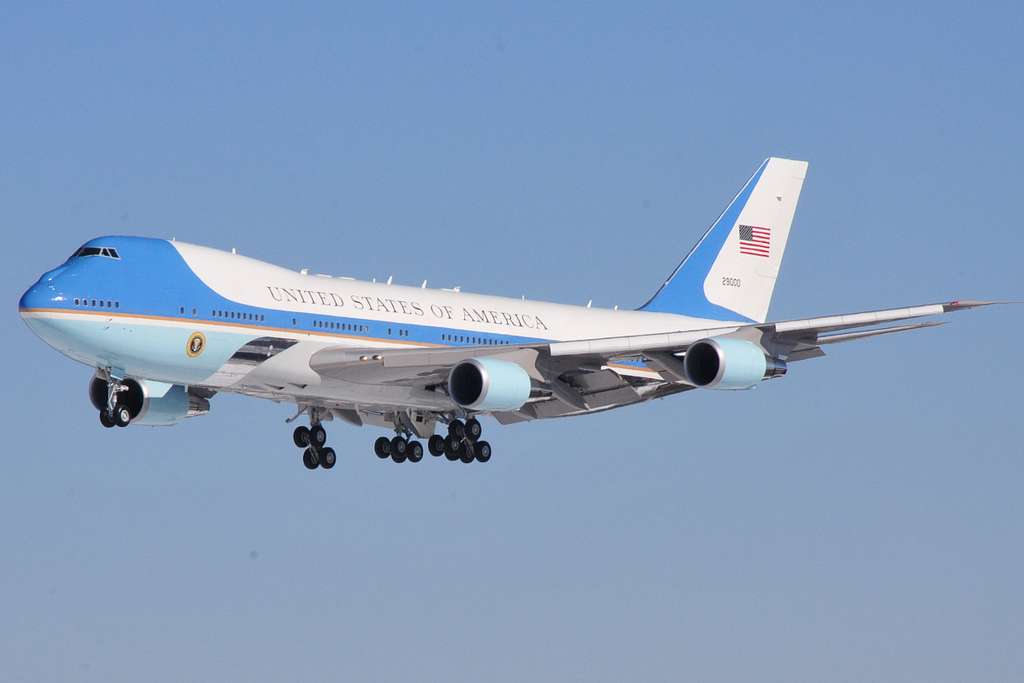
Boeing Adds $280 Million Air Force One Loss as Overruns Top $3 Billion
Boeing is spending more money to keep its revised Air Force One replacement schedule from slipping again. The company recorded another $280 million loss on the two-aircraft program, pushing its accumulated overruns above $3 billion while the first delivery remains delayed until mid-2028.

The latest charge reflects a difficult tradeoff: accepting a larger loss now to add production, testing and certification resources. Boeing CEO Kelly Ortberg said during the company’s July 28 earnings call that the added staffing and support are intended to reduce risk during certification and flight testing. The second aircraft is expected in mid-2029, according to the latest program update.
That does not mean taxpayers directly absorb Boeing’s newly reported $280 million charge. The two modified 747-8 aircraft are being developed under a $3.9 billion fixed-price contract signed in 2018, and Boeing is responsible for the overruns under those terms. Fixed-price development is designed to place much of the cost-growth risk on the contractor, but it cannot insulate the customer from a late delivery or the operational burden of keeping older aircraft available longer.
Why adding resources creates another loss
Boeing attributed the higher estimated completion cost to structural and wiring installation work, additional production resources and airworthiness-certification requirements. These are not interchangeable tasks. Physical modification must be completed to an acceptable configuration before much of the verification work can close, while certification requires evidence that the finished aircraft satisfies its applicable safety requirements.
Presidential aircraft add another layer of integration because they require specialized communications and defensive systems. Those systems must coexist with the underlying 747 architecture, aircraft wiring, structural modifications and other onboard equipment. More workers can help recover selected production tasks, but staffing alone does not compress every review, test or certification dependency. Late design changes or incomplete installation work can also force test plans to move.
This is why Boeing’s decision is best understood as schedule-risk reduction rather than a guarantee of a 2028 handover. Additional resources can improve the odds that build work, documentation and test preparation remain aligned. They cannot eliminate findings that emerge during ground or flight testing, nor can they predetermine the time needed to resolve those findings.
A recent Government Accountability Office assessment said the program was almost three years behind its current baseline schedule. Separate reporting on that assessment found that only seven of 80 airworthiness-certification steps had been completed. That does not establish that every remaining step carries equal difficulty, but it illustrates how much formal work must still be closed against a schedule that already has little credibility to spare.
The original deadline is already four years behind the new target
When the fixed-price development contract was signed, Boeing expected to deliver the first replacement aircraft by December 2024. The current mid-2028 target moves that handover roughly three and a half years beyond the original promise. The second jet is now planned for mid-2029.
The aircraft being replaced are two Boeing 747-200-based presidential transports that have supported the mission since the 1990s. Air Force One is technically the call sign used when the president is aboard an Air Force aircraft, but it is commonly associated with this pair of heavily modified jets. Their age makes the replacement schedule operationally important even though the available information does not quantify the maintenance or readiness consequences of another delay.
The financial exposure is also not necessarily finished. Boeing’s filing warned that additional losses could be recorded in future periods. That possibility follows the logic of a fixed-price program: when estimated labor, modification, supplier or certification costs rise, the contractor must recognize the added burden rather than simply pass an ordinary overrun to the customer.
The unanswered questions now matter more than the size of any single quarterly charge. Boeing has not publicly provided a detailed breakdown of the $280 million, identified how much certification work remains on the critical path or quantified the schedule reserve protecting the mid-2028 date. Until build progress and airworthiness approvals advance far enough to answer those points, Boeing’s extra spending buys a better attempt at holding the deadline not certainty that Air Force One will arrive on it.
| More aerospace and engineering stories, right in your MSN feed. Follow AMI on MSN |
By David Whitaker — Associate editor for AMI’s aerospace and drone systems desk, translating flight systems, aircraft programs, spaceflight, and UAV developments into accessible technical stories.