


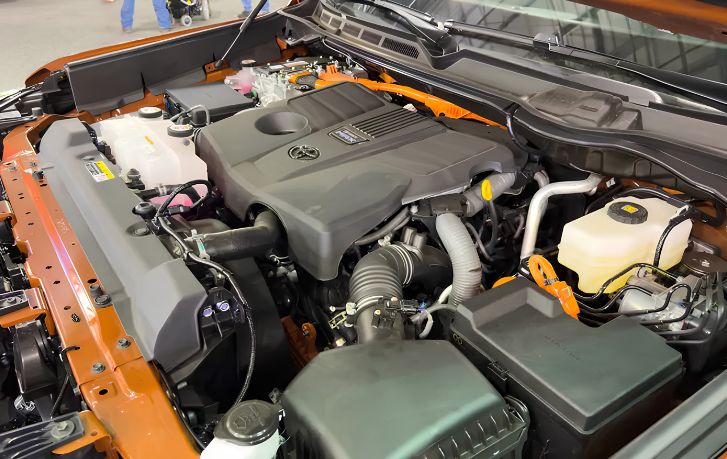
Toyota Uses Three Mallet Strikes to Screen Recalled V6 Engines for Replacement
A Toyota technician’s three strikes with a 250-gram plastic mallet could help determine whether a recalled twin-turbo V6 engine remains in the vehicle or is replaced. The mallet does not repair the engine. It supplies a controlled mechanical impulse, while an accelerometer and Toyota’s analysis software measure how the crankshaft and bearing structure respond.
The procedure, described in Toyota technical instructions obtained by Pickup Truck + SUV Talk, turns a familiar engineering technique into a dealership-level screening tool. Toyota is using the test on certain engines covered by its continuing response to manufacturing debris that may damage a main bearing and potentially cause engine knocking, rough operation, a no-start condition or loss of motive power.
The strike is only the input
Before taking measurements, technicians prepare the 3.4-liter twin-turbo V6 under specified conditions. The reported process includes changing or handling engine fluids, warming the engine to prescribed temperatures, removing the accessory drive belts and rotating the crankshaft into a defined position. A high-precision accelerometer is then bolted to the front crankshaft pulley bolt.
The technician strikes the pulley at its 3 o’clock position. Toyota’s software checks whether each impact is acceptable, identifying a strike as good, too weak, too strong or an unintended double hit. Three acceptable measurements are required before the inspection can proceed.
Those controls matter because vibration measurements are sensitive to both the test setup and the force being applied. Temperature can affect material and fluid behavior. Accessory belts can introduce other masses and damping paths. Crankshaft position can change how loads are carried through the assembly. Standardizing these variables gives Toyota a better basis for comparing one engine’s response with the response patterns established during development.
After the three accepted strikes, the recorded data and inspection diagnosis are sent to Toyota’s cloud system. The system returns an outcome indicating that engine replacement is not required or that the engine assembly should be replaced. Toyota has said dealers also collect available vehicle driving data as part of evaluating the number-one main bearing.
Why bearing condition changes vibration
The underlying method is generally known as impact testing or experimental modal analysis. A short impact excites a range of structural frequencies at once. An accelerometer records the resulting motion, allowing software to examine properties such as resonant frequencies and damping the rates and patterns at which vibration builds and decays.
A crankshaft, its bearings and the surrounding engine structure form a coupled mechanical system. Changes in bearing support, clearance, contact or wear can alter the system’s stiffness and damping. Toyota says its development work tested numerous engines and found resonant-frequency differences between a number-one main bearing with and without abnormal wear.
That distinction is relevant because Toyota attributes the recalled-engine problem to machining debris that may have remained inside some engines after manufacturing. Metal fragments can affect the main bearings, which support the crankshaft as it rotates. The reported inspection focuses on the number-one main bearing near the front of the engine, where the pulley is struck and the sensor is mounted.
The test therefore is not listening for loose debris moving around, nor does the impact dislodge or remove material. It is evaluating whether the engine’s measured dynamic response resembles the condition Toyota associates with an acceptable bearing or one that may have abnormal wear.
A screening decision without dismantling the engine
The practical advantage is that Toyota can assess the bearing indirectly without first tearing down every covered engine. Disassembly would consume considerably more dealership labor, occupy service space and require extensive engine work simply to inspect an internal component. A standardized sensor test can produce a replacement decision while leaving the engine assembled.
The broader recall issue has been reported as affecting more than 250,000 Toyota and Lexus vehicles, including Tundra, Lexus LX600 and Lexus GX models. However, that total should not be treated as the confirmed population for this particular inspection procedure. One identified campaign, called the V35A Crank Bearing Inspection, applies to certain 2022-2024 Toyota Tundras. Exact eligibility, production dates, market coverage and owner obligations depend on Toyota’s applicable recall and service documentation.
Toyota has not publicly detailed the software thresholds or supplied field-accuracy figures for the three-strike procedure in the material available here. A normal result should therefore be understood as Toyota’s prescribed inspection outcome, not proof that no unrelated engine problem can develop. Owners whose vehicles already exhibit knocking, rough running or a no-start condition have been advised to contact a Toyota or Lexus dealer rather than rely on the screening concept alone.
For affected owners, the consequential part is not the plastic mallet but the decision downstream: if Toyota’s software cannot confirm that the inspected bearing will remain free from abnormal wear associated with the debris issue, the dealer is directed to replace the engine.
| More aerospace and engineering stories, right in your MSN feed. Follow AMI on MSN |
By Thomas Caldwell — AMI’s senior editor for mechanical and mobility engineering, covering vehicle electronics, systems integration, electrification, chassis systems, propulsion, and safety policy.



