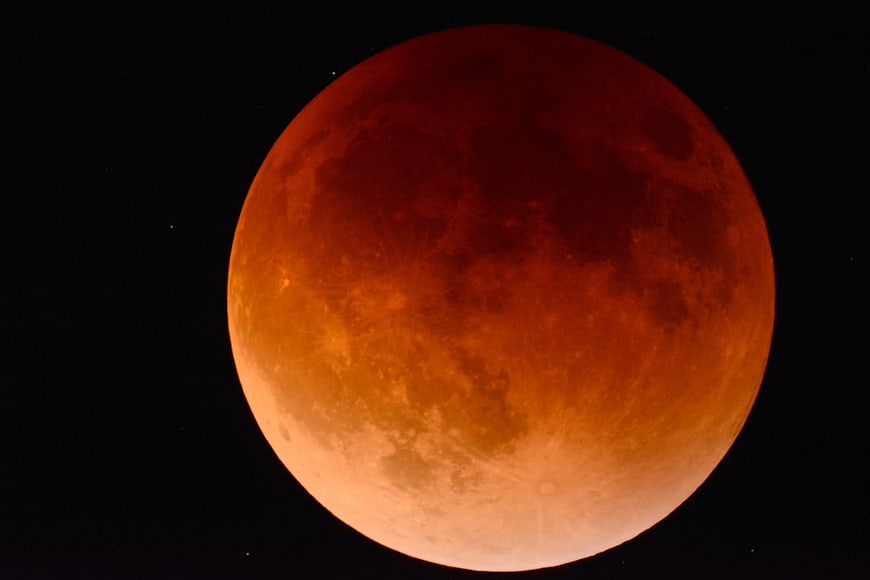
Near-total lunar eclipse will cover 96.2% of moon for most US viewers
96.2% of the moon will pass into Earth’s shadow at the peak of a near-total lunar eclipse Thursday night. Most of the continental United States should be positioned to watch the event from beginning to end, provided clouds do not block the view. NASA describes the Aug. 27-28 event as a deep partial lunar eclipse, with only a narrow portion of the lunar disk remaining outside Earth’s central shadow.

The eclipse begins at 9:23 p.m. Eastern Time Thursday as the moon enters the penumbra, the lighter outer part of Earth’s shadow. This initial stage can be difficult to notice because sunlight is only partially blocked there, producing a relatively subtle dimming.
The more obvious partial phase starts at 10:33 p.m. Eastern. Earth’s darker central shadow, called the umbra, will then appear to take a progressively larger bite out of the full moon. Coverage reaches its maximum at 12:12 a.m. Eastern on Friday, when 96.2% of the lunar surface will be shrouded. The moon leaves the outer edge of Earth’s shadow at 3:01 a.m., ending the event.
Where the entire eclipse will be visible
Most observers in North and South America will have an opportunity to see every stage. Alaska and the northernmost reaches of Canada fall outside that complete viewing region. Parts of Europe and Africa can also see the eclipse, although the moon will set there before the event finishes.
For U.S. viewers, geography provides the opportunity, but local weather determines whether the moon is actually visible. Cloud cover can erase the advantage of an otherwise favorable viewing position. Readers can inspect expected sky cover and other local conditions through the National Weather Service’s national forecast maps before heading outside.
No dark-sky site is strictly necessary because the full moon is bright. A location with an unobstructed view of the moon is more important, particularly if buildings or trees could interfere. Moving away from strong local lighting may nevertheless make the color and contrast changes easier to appreciate as the eclipse deepens.
Why the moon can turn reddish orange
A lunar eclipse occurs when Earth moves between the sun and the moon, placing the lunar surface inside Earth’s shadow. The three bodies must line up closely enough around the full-moon phase for that shadow to cross the moon.
The moon does not always disappear when it enters the umbra. Some sunlight passes through Earth’s atmosphere, where shorter wavelengths are scattered more strongly. The remaining filtered light can illuminate the eclipsed lunar surface with a reddish-orange or coppery appearance.
That color is associated with the “blood moon” label commonly applied to total lunar eclipses, but Thursday night’s event remains partial. A slim section of the moon will stay directly illuminated even at maximum coverage. As that bright portion contracts, observers’ eyes may adapt more effectively to the darker view and make the coppery region easier to perceive.
No eclipse glasses are required
Unlike a solar eclipse, this lunar eclipse is safe to watch directly with the naked eye. The observer is looking at the moon rather than toward the sun, so certified solar viewers and eclipse glasses are unnecessary.
Binoculars or a telescope can provide a more detailed look at Earth’s curved shadow moving over lunar terrain, but neither is required. Naked-eye observers can still follow the transition from the faint penumbral stage to the much darker partial phase and then watch the process reverse after the 12:12 a.m. peak.
The practical constraint is therefore not specialized equipment but timing, location and weather. If skies cooperate, most continental U.S. viewers will have several hours to watch Earth’s shadow advance until only 3.8% of the moon remains outside it.
| More aerospace and engineering stories, right in your MSN feed. Follow AMI on MSN |
By David Whitaker — Associate editor for AMI’s aerospace and drone systems desk, translating flight systems, aircraft programs, spaceflight, and UAV developments into accessible technical stories.