Earth’s Shadow Covered 96.3% of the Moon but Totality Stayed Out of Reach
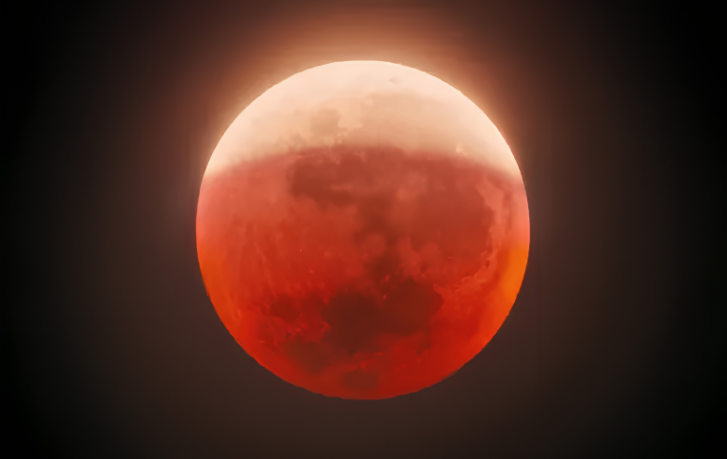
Earth’s darkest shadow covered 96.3% of the lunar disk at the peak of the August 27–28, 2026, partial lunar eclipse. That left only a narrow section in direct sunlight, giving observers an almost blood-moon view without producing a total eclipse. NASA’s eclipse visualization and timing data place the maximum at 4:13 a.m. Universal Time on August 28.
The number was exceptionally close to totality, but eclipse classifications leave no room for rounding. A total lunar eclipse requires the entire moon to enter Earth’s umbra the central region of the planet’s shadow where Earth completely blocks the sun. Because a small part of the moon remained outside that region, the event stayed partial even with nearly the whole visible disk darkened.
Why 96.3% did not mean totality
NASA presented the 96.3% figure as the portion of the moon’s disk within the umbra at maximum eclipse. Another NASA description said about 93% of the moon’s diameter was inside that shadow. Those percentages describe different geometric measures, but both point to the same physical boundary: a thin portion of the lunar surface remained directly illuminated.
The distinction matters because “almost total” can look dramatically different from an ordinary partial eclipse. Once most of the bright surface had entered the umbra, observers’ eyes could adapt to the darker scene. NASA expected that adjustment to make the coppery section within the shadow easier to perceive while the remaining sunlit edge stayed comparatively bright.
The red or rusty appearance came from sunlight filtered and refracted through Earth’s atmosphere before reaching the shadowed moon. That is the same broad mechanism associated with the familiar “blood moon” appearance during total lunar eclipses. In this case, however, the uncovered sliver prevented the entire disk from taking on the uniformly shadowed appearance possible during totality. Local sky conditions also affected how clearly observers could distinguish the subdued color.
Where the deep partial eclipse was visible
The eclipse favored much of North and South America, along with portions of western Europe and western Africa. NASA’s detailed visibility description excluded Alaska and northwestern Canada from the region able to see the moment of greatest eclipse. Other areas in Europe, Africa and western Asia could see at least part of the broader event, depending on whether the moon was above the horizon and whether skies were clear.
The partial phase began at 2:34 a.m. Universal Time on August 28, reached its 4:13 a.m. maximum and ended at 5:52 a.m. The subtler penumbral phase when Earth blocked only part of the sunlight reaching the moon extended from 1:24 a.m. until 7:02 a.m. Universal Time. Unlike a solar eclipse, the lunar event was safe to observe directly without eclipse glasses.
Not every listed region received the complete sequence. Lunar eclipses occur simultaneously worldwide, but only observers on Earth’s night side with the moon above their local horizon can see a given phase. Some locations therefore caught the eclipse near moonrise or moonset rather than watching it from beginning to end.
An eclipse geometry that repeats
The event belonged to Saros 138, one of the repeating families astronomers use to group eclipses with similar orbital geometry. Events in a Saros series are separated by approximately 18 years, 11 days and eight hours. The previous eclipse in this series occurred on August 16, 2008, while the next is scheduled for September 7, 2044.
The lunar eclipse also followed the total solar eclipse of August 12 by just over two weeks. Such pairings occur during an eclipse season, when the alignment of the sun, Earth and moon is favorable around consecutive new- and full-moon phases. The alignment was sufficient for a total solar eclipse earlier in the month, but at the later full moon it missed the final threshold for lunar totality.
Described as the deepest partial lunar eclipse until 2028, the August event was notable precisely because of that narrow miss. At 96.3% disk coverage, the remaining bright edge was small, but it marked the exact geometric line between an almost blood moon and a total one.
| More aerospace and engineering stories, right in your MSN feed. Follow AMI on MSN |
By David Whitaker — Associate editor for AMI’s aerospace and drone systems desk, translating flight systems, aircraft programs, spaceflight, and UAV developments into accessible technical stories.