


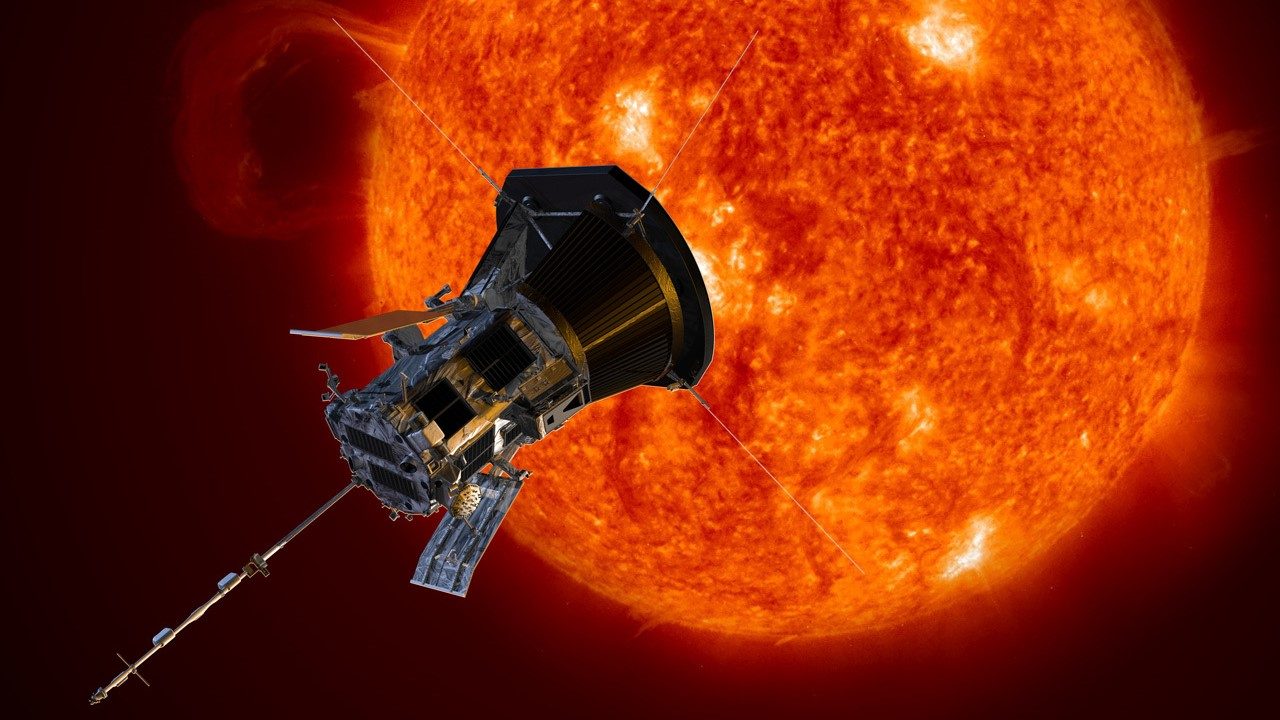
NASA’s Parker Solar Probe Again Hits 430,000 MPH, Future Under Review
At about 430,000 mph, NASA’s Parker Solar Probe covers roughly 120 miles every second. The spacecraft matched that record during its 28th close approach to the Sun on June 8, 2026, while operating just 3.8 million miles above the solar surface and gathering data from inside the corona.
The speed is not primarily a demonstration of high-thrust spacecraft propulsion. Parker reaches it because its orbit takes the probe deep into the Sun’s gravitational field. As the spacecraft falls toward the Sun during each close pass, gravity converts potential energy into velocity. The result is the highest speed achieved by a human-made object, repeated at the same record-setting distance.
Speed is a product of the scientific trajectory
Parker first reached the cited speed and distance on Dec. 24, 2024. Its June encounter again put the spacecraft through a flight regime that combines extreme velocity, intense heating and limited communication with Earth. Parker operated autonomously for nine days around the closest approach because its trajectory restricted communications, then sent controllers at the Johns Hopkins Applied Physics Laboratory a beacon indicating that its systems were operating normally.
That operating model matters as much as the headline speed. Parker cannot simply race past the Sun and remain continuously connected to its ground team. The spacecraft must maintain the required orientation, protect temperature-sensitive hardware and execute its observation plan without real-time intervention during a critical portion of the encounter.
Mission engineers estimate that Parker’s thermal-protection system reaches approximately 1,700 degrees Fahrenheit at closest approach. The spacecraft does not have a temperature sensor on the heat shield’s front face, so that figure comes from thermal models. Sensors behind the shield have shown consistent spacecraft temperatures across the record-distance passes, and mission leaders reported that Parker remained in excellent condition through the six approaches flown at that minimum distance.
What Parker measures inside the corona
The mission’s value comes from collecting local measurements where solar activity originates rather than observing every process from far away. Parker’s four scientific instrument suites measure particles, electric fields and magnetic fields while also imaging large-scale structures in the corona and solar wind.
One suite measures electric and magnetic fields, waves and turbulence. Another counts electrons, protons and helium ions in the solar wind and records properties including their velocity, density and temperature. Parker also measures energetic particles across a range of energies, while its sole imaging instrument observes coronal structures and solar material before those features pass over the spacecraft.
Combining images with direct measurements allows researchers to connect a visible solar structure with the fields and particles encountered in the near-Sun environment. That is important for investigating how the solar wind develops, how energetic particles accelerate and how activity in the corona produces space-weather effects that can affect astronauts, satellites, aviation and electrical grids.
The timing has also given the mission a broad sample of solar conditions. Parker launched in August 2018 when the Sun was near the minimum of its approximately 11-year activity cycle. It continued making close passes as the Sun entered the maximum period announced in 2024, allowing its instruments to observe the corona from relatively quiet conditions through a much more active phase.
A limited comparison shows what 430,000 mph means
New Horizons left Earth in 2006 at 36,400 mph, cited as the fastest launch achieved through spacecraft propulsion rather than later gravitational acceleration. Parker’s peak speed is nearly 12 times that figure, but the comparison has a firm boundary: Parker’s record is generated by a close solar orbit, not by an engine accelerating it to 430,000 mph at launch.
Parker is expected to remain in its present orbit and continue matching the same speed and distance records on future flybys. What follows later in 2026 and beyond is less settled. NASA is reviewing the mission’s next steps, with no final extension decision or detailed long-term plan yet announced. The spacecraft has demonstrated that it can repeatedly survive and collect data inside the corona; the unresolved question is how long NASA will continue using that capability as solar activity moves into its declining phase.
| More aerospace and engineering stories, right in your MSN feed. Follow AMI on MSN |
By David Whitaker — Associate editor for AMI’s aerospace and drone systems desk, translating flight systems, aircraft programs, spaceflight, and UAV developments into accessible technical stories.



