Two LaGuardia Controllers Could Be Fired After Reported Early Departures Before Fatal Collision
Two LaGuardia Airport air traffic controllers could be fired after reportedly leaving the tower about an hour early on the night of a fatal runway collision. An unnamed government official familiar with the investigation told The Associated Press that the Federal Aviation Administration is pursuing disciplinary action that could include termination. No final employment decision has been announced.
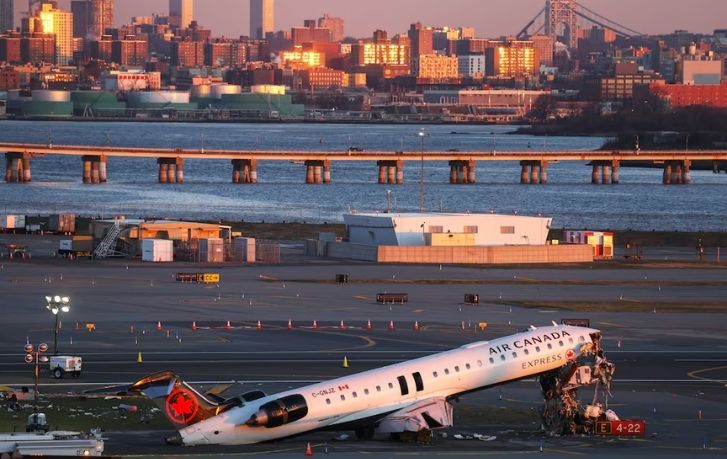
The March 22 collision occurred when an Air Canada Express jet struck a fire truck crossing a LaGuardia runway, killing both pilots. The reported departures present a legitimate staffing and workload question, but neither the early-departure account nor the preliminary investigation establishes that the absent controllers caused or contributed to the collision. Probable cause remains undetermined.
Staffing numbers do not show how work was distributed
Two controllers remained in the tower when the collision occurred. That was a standard staffing level for the time and shift, according to preliminary information discussed by the National Transportation Safety Board. The two controllers who reportedly left would have provided additional support, but the available information does not identify their assigned positions, exact scheduled departure times or whether either would have directly controlled the runway crossing.
Those missing details are critical. Tower safety depends not only on the number of people in the cab but also on which positions are open, how responsibilities are divided and whether one controller must absorb another position during a traffic or ground emergency. Staffing above a minimum level can provide operational margin by allowing duties to be separated, communications to be monitored and a controller facing a sudden workload increase to receive relief.
Preliminary findings show why that margin deserves examination here. One of the two controllers on duty was coordinating a separate ground emergency involving another aircraft. During that response, the local controller took over transmissions on both the local and ground radio frequencies. That arrangement concentrated aircraft and ground-traffic communications with one controller during a busy period, but it does not by itself demonstrate unsafe staffing or establish a connection to the collision.
Runway protection involved people, lights and surveillance
The investigation must examine more than head count. A runway crossing is governed by an integrated chain that includes the vehicle operator, radio clearance, controller awareness, visual cues and surface-surveillance equipment. A weakness or misunderstanding at any point can reduce the time available to recognize and resolve a conflict, while overlapping protections are intended to prevent one problem from becoming an accident.
Preliminary information indicates that runway warning lights were functioning and illuminated before the collision. Investigators have not determined why the truck continued toward the runway. The local controller cleared the vehicle to cross and later transmitted repeated stop instructions, but the truck crew initially did not understand who the first warning addressed. These facts establish a sequence, not a final explanation.
The surface-surveillance picture also had an important limitation. The responding vehicles lacked transponders, so the tower system could not reliably identify and track each vehicle or generate a predicted-conflict alert involving the truck and landing aircraft. That limitation matters because surveillance alerts can provide an additional layer of warning, but it does not establish what any controller saw, understood or could have done differently in the available time.
What investigators still need to establish
A defensible staffing assessment requires records showing the full tower roster, approved position plan, traffic volume, break arrangements and supervisory decisions that night. Investigators also need to determine which duties the two absent controllers were expected to perform and whether their presence would have changed the allocation of ground, local-control or coordination work.
Radio recordings, surveillance data and controller interviews will be needed to reconstruct workload and situational awareness without relying on hindsight. The analysis must distinguish between staffing that complied with the scheduled overnight configuration and additional personnel who could have provided useful backup during unusually demanding conditions. Those are related questions, but they are not interchangeable.
The FAA’s personnel process and the NTSB’s safety investigation also answer different questions. Employment action can address attendance, timekeeping or compliance with agency rules without proving accident causation. The NTSB, as the independent agency responsible for determining probable cause and issuing safety recommendations, must evaluate staffing alongside the runway clearance, vehicle movement, communications, warning lights and surveillance limitations.
Until that work is complete, the reported early departures warrant scrutiny as a loss of available support not as a settled explanation for why the Air Canada jet and fire truck occupied the same runway. The decisive evidence will be whether official records show that the missing staffing changed how safety-critical tower duties were performed before the collision.
| More aerospace and engineering stories, right in your MSN feed. Follow AMI on MSN |
By Thomas Caldwell — AMI’s senior editor for mechanical and mobility engineering, covering vehicle electronics, systems integration, electrification, chassis systems, propulsion, and safety policy.