Boeing Engineers Authorize Strike as MAX 10 Safety Reviews Remain Unfinished
The Boeing 737 MAX 10 has completed its planned certification flights, but the aircraft is not yet ready for Federal Aviation Administration approval. Specialized engineers and technical workers must still close major safety analyses and assemble the supporting regulatory record and those employees have authorized a possible strike as their contract approaches an October 6 expiration.
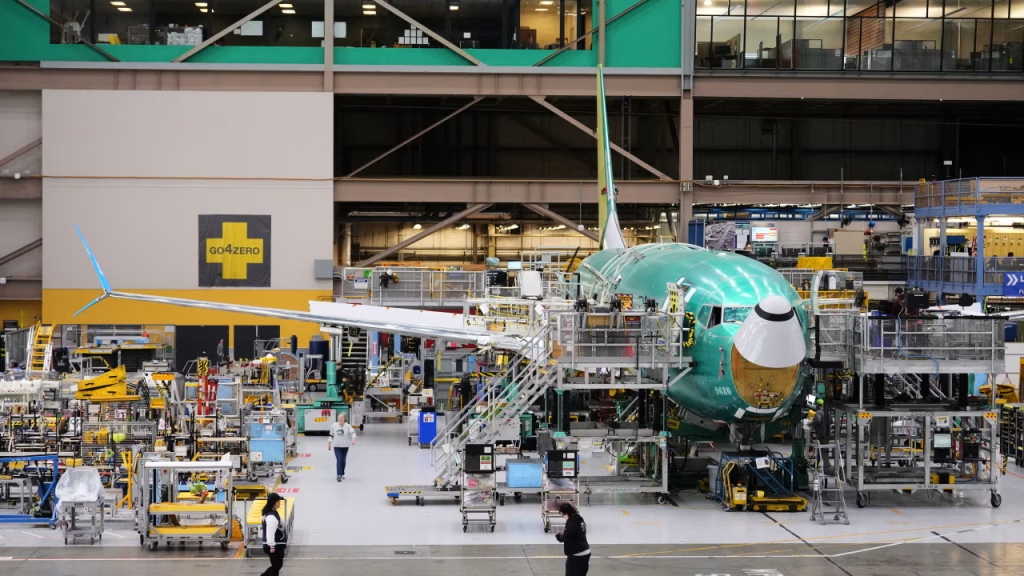
Boeing and the Society of Professional Engineering Employees in Aerospace met on August 31 and agreed to resume negotiations on September 8. A walkout is not certain and could not begin before October 7 under the timeline identified by the union. Nevertheless, a stoppage could interrupt certification work and put Boeing’s plan to begin MAX 10 deliveries in 2027 at risk. The FAA has not announced a certification date.
Finishing the flights did not finish certification
The MAX 10 completed its 976th and final planned certification flight on July 28. Three test aircraft accumulated more than 2,060 flight hours, supplemented by approximately 1,040 hours of ground testing. The last planned flight evaluated cabin audibility for the lavatory smoke detector and public-address speaker system.
That milestone closed the planned flight campaign, not the complete approval process. Certification also requires Boeing to show, through traceable engineering analyses, that the aircraft complies with applicable design and safety requirements. The FAA must accept the required submissions before issuing an amended type certificate that permits the model to enter airline service.
As of July 28, Boeing certification disclosures placed the fourth Development Assurance Review at approximately 60% complete. System Safety Assessments were about 32% complete. These percentages describe different workstreams and should not be treated as a simple overall completion gauge, but they show that substantial documentation remained after the flight campaign ended.
Development-assurance reviews examine whether the processes used to define, design, verify and control safety-critical systems provide the required rigor and traceability. System Safety Assessments evaluate potential failures and combinations of failures, their effects and whether the design keeps resulting hazards within acceptable limits. Flight data can support those findings, but completing a test flight does not automatically close the associated analysis, resolve every review comment or produce an accepted compliance document.
The labor risk is concentrated in specialized knowledge
SPEEA represents approximately 17,000 Boeing engineers and technical workers across the covered units. Professional Unit members rejected the tentative agreement by 64.25%, with 7,238 voting against and 4,027 in favor. Strike authorization received 87.82% support. In the Technical Unit, 71.87% rejected the offer, while 89.71% authorized a strike. The union has published the detailed voting results.
Authorization gives the union the ability to call a walkout after the existing agreement expires; it does not establish that one will happen. Negotiations provide time for another agreement, and Boeing has posted contractor positions as part of its contingency planning. The company said it intends to use qualified resources with an emphasis on safety and quality.
Certification continuity, however, involves more than adding engineering headcount. Final safety submissions depend on aircraft-specific knowledge, configuration history, analysis ownership, document traceability and the ability to answer regulator questions. Replacement or reassigned personnel may be technically qualified while still requiring time to understand the program’s assumptions, open findings and verification record. That makes specialized labor capacity a schedule constraint even if physical aircraft production continues.
The distinction matters because a strike would not necessarily stop every MAX 10 production task. It could instead slow the less visible work needed to convert test results and engineering analyses into an FAA-accepted safety case. Boeing could also continue some certification activity through managers, nonrepresented employees or contractors, but the available information does not establish how much work those resources could absorb or how quickly.
The FAA controls the final milestone
The FAA’s August approval of the smaller 737 MAX 7 illustrates the breadth of work behind an amended type certificate. The agency said its review covered flight controls, system safety assessments, human factors and flight-crew alerting, while requiring testing, design changes and additional analysis. That approval does not determine the MAX 10 schedule, but it demonstrates why the regulator’s decision rests on the complete design record rather than the date of the final planned flight.
The MAX 10 also has model-specific engineering to substantiate. At 43.8 meters, it is longer than the 42.1-meter MAX 9. Boeing incorporated semi-levered main landing gear that extends an additional 241 millimeters during rotation to address tail-strike risk. Those design facts do not indicate a defect; they illustrate why the longest MAX variant requires its own completed compliance findings.
The next consequential dates are September 8, when formal bargaining is scheduled to resume, and October 6, when the current contract expires. Until Boeing closes the remaining reviews and the FAA accepts the final certification record, 2,060-plus flight hours remain evidence supporting approval not approval itself.
| More aerospace and engineering stories, right in your MSN feed. Follow AMI on MSN |
By Thomas Caldwell — AMI’s senior editor for mechanical and mobility engineering, covering vehicle electronics, systems integration, electrification, chassis systems, propulsion, and safety policy.