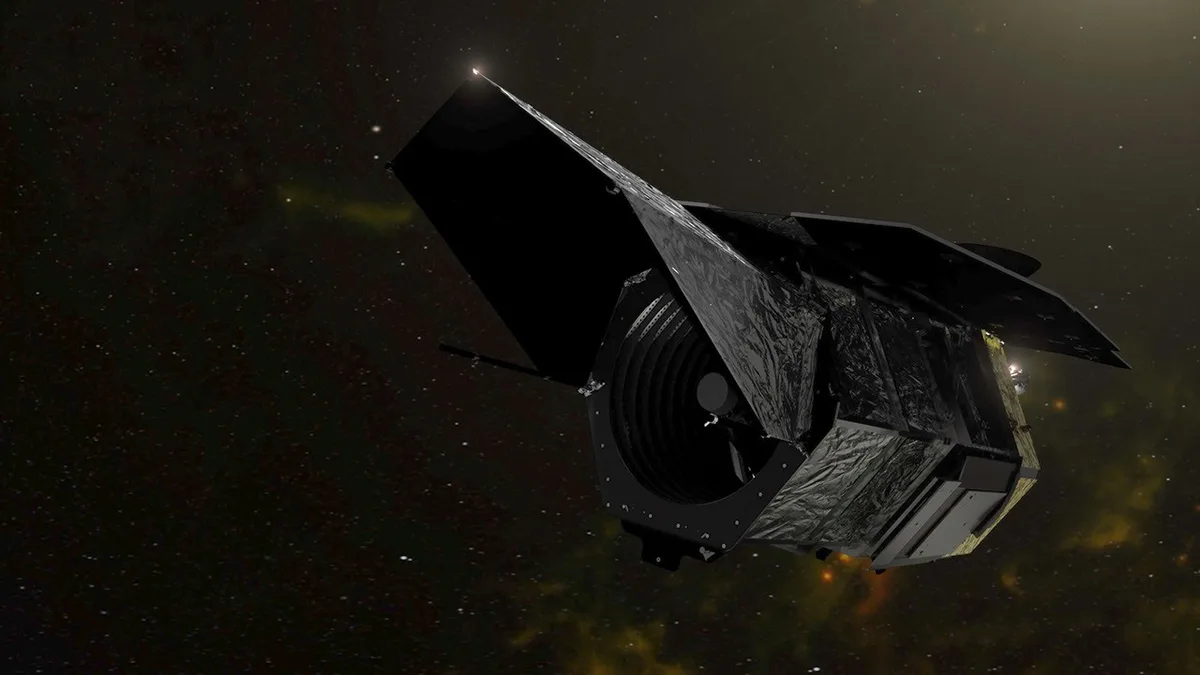
NASA Launches Roman Telescope to Image 100 Times More Sky Than Hubble
NASA has launched a telescope built around a striking trade: the Nancy Grace Roman Space Telescope uses a primary mirror the same diameter as Hubble’s, but its main camera can capture a patch of sky at least 100 times larger with comparable image sharpness. That combination is designed to turn Roman into a rapid surveyor, finding galaxies, exploding stars and planets that narrower observatories can then examine more closely.

Roman lifted off aboard a SpaceX Falcon Heavy from Kennedy Space Center in Florida at 7:26 a.m. EDT on Aug. 30, 2026. The observatory separated from the rocket’s second stage at 7:57 a.m. and began flying independently, according to NASA’s post-launch update. It is now traveling roughly one million miles toward the second Sun-Earth Lagrange point, or L2.
Roman trades a narrow view for survey scale
Hubble and Roman both have 7.9-foot primary mirrors, so the fundamental light-collecting aperture is familiar. The major difference is what sits behind Roman’s optics. Its Wide Field Instrument is a 300-million-pixel visible and near-infrared camera assembled from 18 individual 4K detectors.
That focal-plane array covers an active field of 0.281 square degrees. NASA’s technical description of the instrument says it provides comparable spatial resolution and better sensitivity than Hubble’s infrared camera while covering roughly 200 times its field. Using the broader mission-level comparison, Roman can produce Hubble-sharp images across at least 100 times as much sky in one exposure.
This is not simply a larger digital photograph. Roman’s wide field reduces the number of separate pointings needed to map an extensive region, changing what astronomers can reasonably survey within a fixed mission. During its first five years of observations, the telescope is expected to image more than 50 times the area that Hubble covered in 30 years.
Hubble remains better suited to some narrow, higher-resolution spectral studies. The James Webb Space Telescope also specializes in detailed observations with a narrower view. Roman’s system-level role is different: scan large areas efficiently, establish statistical context and identify objects that merit longer observations by Webb, Hubble or other facilities.
A camera designed for maps and repeated observations
The Wide Field Instrument can perform imaging through eight filters spanning visible to near-infrared wavelengths. It also carries prism and grism elements for slitless spectroscopy, allowing Roman to collect spectra from many objects across the field rather than placing a slit over one target at a time.
Those modes support several distinct jobs. Roman is intended to measure light from one billion galaxies and help construct three-dimensional maps of cosmic structure. Its broad surveys will examine how galaxies and dark matter are distributed, providing data for studies of the universe’s accelerating expansion and dark energy.
The telescope will also repeatedly revisit selected regions. Comparing wide-field images over time can reveal transient events—objects that brighten, fade or move. Roman’s planned work includes searches for exoplanets through gravitational microlensing, in which the gravity of a foreground object briefly magnifies light from a more distant star.
Roman was designed with the Vera C. Rubin Observatory and the European Space Agency’s Euclid telescope in mind. Combining their surveys can add wavelength coverage and context, while Roman can supply large target sets for Webb’s more detailed investigations. The benefit is less about replacing another telescope than dividing the workload between discovery at scale and close examination.
Launch success is only the start
Roman’s survey capability is not yet operational. The trip to L2 is expected to take about three months, during which engineers plan to monitor, test and calibrate the observatory, deploy its antenna and perform a mid-course correction. The Coronagraph Instrument is scheduled to be powered before the Wide Field Instrument.
Commissioning must verify pointing, focus, detector response and calibration across a focal plane containing more than 300 million pixels. Roman includes an internal relative-calibration system to measure and track detector response over the mission, an important requirement when small systematic errors could propagate through surveys containing enormous numbers of objects.
If the journey and commissioning proceed as planned, Roman’s first images may be released in January 2027; that date is a target, not a guaranteed result. Its primary mission is planned for five years, with a possible five-year extension. Although the observatory was designed to permit refueling, NASA does not currently have the ability to service a telescope at L2. For now, the decisive milestone is months away: proving that Roman can turn its Hubble-sized mirror and unusually broad focal plane into calibrated science images.
| More aerospace and engineering stories, right in your MSN feed. Follow AMI on MSN |
By David Whitaker — Associate editor for AMI’s aerospace and drone systems desk, translating flight systems, aircraft programs, spaceflight, and UAV developments into accessible technical stories.