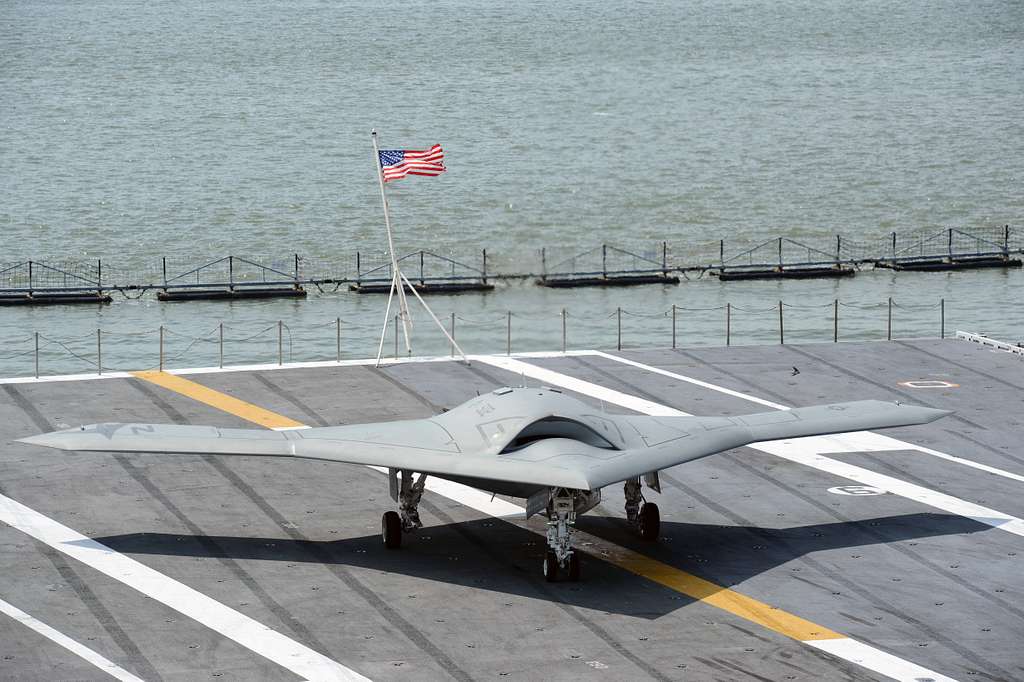
Navy Seeks Fighter-Sized Carrier Drones Carrying Up to 10,000 Pounds
The U.S. Navy has opened an industry search for two fighter-sized autonomous aircraft prototypes that could operate from Ford- and Nimitz-class nuclear aircraft carriers and carry up to 10,000 pounds externally. The unusually demanding combination makes this as much a ship-integration problem as an aircraft-design challenge.

Naval Air Systems Command released the request for information on Aug. 31. This is an exploratory step intended to identify available options for Collaborative Combat Aircraft Increment 1 not an aircraft selection, production contract or operational combat capability. The proposed schedule would give a future contractor three years to develop two prototypes and certify them for carrier operations at a shore-based facility.
A large aircraft must occupy limited carrier space
The central tension is physical. The Navy wants substantial carrying capacity but says each aircraft must occupy no more space than an existing fourth-generation fighter, apparently using the Boeing F/A-18E/F Super Hornet as the reference. As the published requirements specify, its dimensions and weight must also work with carrier decks, elevators and hangar bays.
That boundary matters because an aircraft carrier does not gain parking space when an air wing adds autonomous aircraft. Every new air vehicle must compete for hangar positions, maintenance access, elevator movement and flight-deck staging alongside crewed fighters and support aircraft. If multiple autonomous aircraft are intended to augment each crewed fighter, their cumulative footprint could become more consequential than the dimensions of any single prototype.
The potential 10,000-pound external load sharpens the design conflict. That figure is more than three times the estimated payload capacity of the Air Force’s Increment 1 collaborative aircraft, although it should not be treated as a normal operational load. The Navy will also consider internal carriage proposals. Either approach has implications for airframe volume, weight distribution and carrier suitability, but the available information does not establish which configuration the service will favor.
Deck labor is another fixed constraint
The Navy is also asking industry for deck-handling approaches that can support unmanned aircraft through launch, recovery and movement without adding flight-deck personnel or increasing support equipment. That requirement turns labor and equipment into firm parts of the aircraft’s integration envelope.
This is important because removing a pilot does not remove the need to position, inspect, service and secure an aircraft in a crowded shipboard environment. A system that needs a dedicated handling crew or specialized equipment for every air vehicle could consume the personnel and deck capacity that autonomy is meant to preserve. Scalability therefore depends on how routinely the aircraft can move through the existing carrier workflow, not merely on whether one prototype can complete a catapult launch and arrested landing.
Operating tempo is the practical measure. An autonomous aircraft that requires lengthy deck preparation, extra equipment movements or separate handling procedures could slow the launch-and-recovery cycle even if it meets every airborne requirement. Conversely, a design that fits established deck routines may offer more usable capacity than a nominally more capable aircraft that is difficult to stage and service.
New autonomy must coexist with the MQ-25
Control architecture presents a second integration boundary. The prototypes must comply with the joint Air Force-Navy government reference architecture, which is intended to separate autonomy software from a specific airframe. At the same time, the Navy wants the new capability integrated into the older MD-5 Unmanned Carrier Aviation Mission Control System used for the Boeing MQ-25 Stingray.
The service explicitly wants that integration completed without disrupting MQ-25 operations or forcing modification of the MQ-25 aircraft. This means the carrier drone effort cannot be treated as a clean-sheet control system. It must introduce newer, hardware-agnostic autonomy while preserving an existing unmanned-aircraft program and its shipboard infrastructure.
That coexistence requirement has long-term importance. A common control environment could reduce the need to install separate operator stations and support chains for each new unmanned type. But the prototype effort must demonstrate that architectural compatibility in actual hardware and software, not merely show that an autonomous jet can fly.
The Navy plans to provide industry teams with additional requirements on Sept. 22 in California, Maryland. Until concepts are evaluated and a subsequent award is made, the aircraft’s final design and operational future remain unresolved. The defining test is already clear, however: fitting a large autonomous aircraft into a carrier air wing without demanding more deck space, personnel or control infrastructure than the ship can absorb.
| More aerospace and engineering stories, right in your MSN feed. Follow AMI on MSN |
By Stephen Wallace — Editor for AMI’s aerospace integration and unmanned mobility coverage, focused on drone manufacturing, VTOL systems, autonomous networks, and air-ground mobility links.