Navy’s E-130J Replacement Aircraft Delayed About a Year by Heavy Equipment
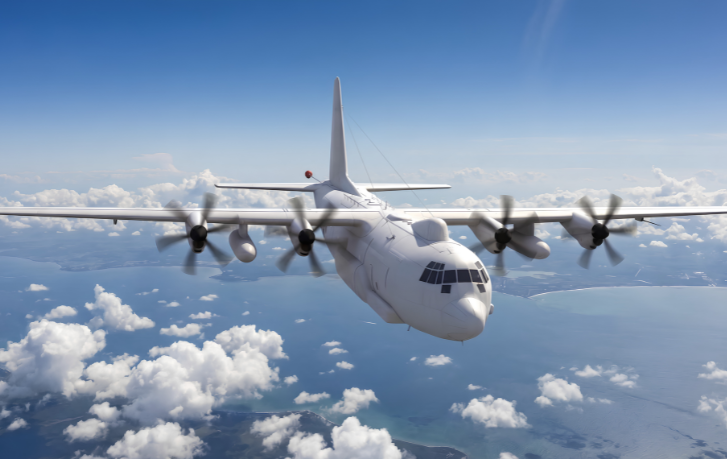
The Navy needs its E-130J Phoenix II to replace an aging strategic communications fleet, but the equipment required to perform that mission is complicating the replacement itself. The program has delayed its decision to begin low-rate production by approximately one year as engineers work to fit heavy mission systems into the selected C-130J-30 Hercules airframe, according to a 2026 Government Accountability Office assessment.
The delay does not mean the Navy’s strategic communications coverage has failed, nor does it establish that the service will abandon the Hercules-based design. It does mean Northrop Grumman and its program partners have more integration work ahead before the E-130J can move into initial production. No revised decision date or required weight reduction was specified in the cited assessment.
A transport airframe carrying a specialized system
The engineering problem is larger than installing radios in a cargo aircraft. The E-130J is intended to conduct the Navy’s Take Charge and Move Out mission, commonly shortened to TACAMO, by serving as an airborne communications station able to relay orders to submerged U.S. ballistic-missile submarines. That role demands specialized communications equipment, associated antennas, secure networks and supporting aircraft modifications.
Every added subsystem competes for aircraft resources. Equipment has physical mass and volume, but it can also require electrical generation, cooling, structural support and connections to the aircraft’s avionics. GAO previously identified size, weight, power and cooling among the program’s risk areas. Reducing one component’s mass may therefore help, but it does not automatically settle the complete integration problem.
Program officials told GAO that contractors were modifying existing mission systems to reduce their weight so they could be accommodated on the C-130J-30. That wording is significant: the work involves adapting established equipment to a different host aircraft, not simply designing an empty cabin around a clean-sheet payload.
Aircraft integration is also cumulative. A collection of components that individually meets its limits can still create problems when installed as a complete mission suite. Engineers must account for the combined configuration, including how equipment placement affects structural loads, cooling demand, wiring, maintenance access and the aircraft’s usable operating margin. The available information does not identify which individual component is driving the weight work, so assigning the delay to one subsystem would go beyond what GAO documented.
The Hercules brings benefits and boundaries
The C-130J-30 offers a major support advantage over the Boeing 707-derived E-6B Mercury: it remains in production and belongs to a widely operated aircraft family with an established U.S. maintenance, training and logistics base. It can also use a wider range of airfields than the larger E-6B. Those characteristics help explain the attraction of a modern Hercules platform for a long-duration replacement program.
They do not make integration free. The C-130J-30 is smaller and slower than the jet-powered E-6B, and GAO had already questioned whether the selected configuration could satisfy operational-availability requirements. That concern is not merely about whether one aircraft can fly with the equipment installed. Availability measures whether enough aircraft can remain ready over time after accounting for inspections, repairs, scheduled maintenance and mission-system support.
Weight reduction can preserve performance margin and ease structural demands, but redesign also carries procurement consequences. Modified equipment must be evaluated in its intended aircraft environment, supported by documentation and incorporated into a repeatable production configuration. If components depart from standard designs, manufacturing and sustainment planning may also become more involved. The one-year movement at the production-decision stage indicates the Navy is confronting these issues before committing to a production run.
The schedule transfers pressure to the E-6B
The immediate tradeoff falls on the existing fleet. The Navy operates 16 E-6Bs built on a commercial-airliner design that has been out of production for decades. Those aircraft are aging and becoming more difficult to sustain, yet the Navy plans to keep them in service until E-130Js arrive so that the transition does not interrupt mission coverage.
That makes an E-130J delay more than an internal acquisition milestone. Each additional period of development can extend demand for E-6B maintenance, parts and aircraft availability. It can also keep training and operational requirements tied to a small legacy fleet for longer than planned. None of that proves an imminent readiness gap, but it narrows the program’s schedule margin and increases the importance of sustaining the Mercury fleet through the transition.
The Navy has not publicly changed its selected airframe in the information available here, and weight-reduction work does not establish that such a change is coming. The harder near-term test is whether the program can produce an integrated configuration that meets mission and availability requirements without carrying unresolved modifications into manufacturing. Until that configuration clears the production decision, the aging E-6B fleet remains the bridge the Navy cannot retire.
| More aerospace and engineering stories, right in your MSN feed. Follow AMI on MSN |
By David Whitaker — Associate editor for AMI’s aerospace and drone systems desk, translating flight systems, aircraft programs, spaceflight, and UAV developments into accessible technical stories.