


Simulations Link RBH-1’s High-Speed Galaxy Escape to a Black Hole Merger
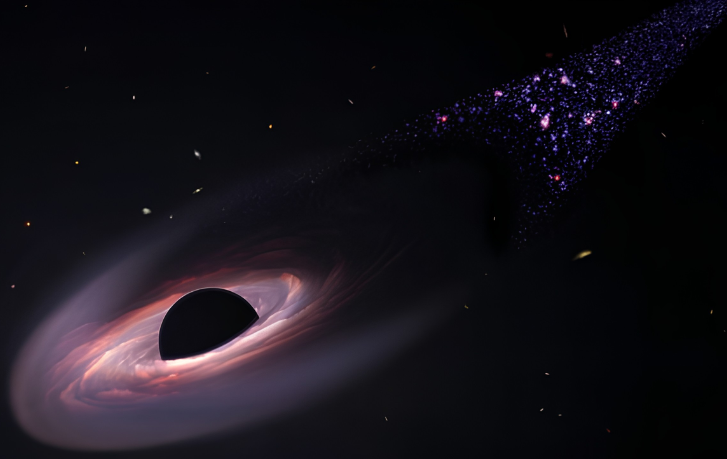
A candidate supermassive black hole appears to be racing between galaxies at nearly 1,000 kilometers per second, trailing a chain of young stars more than 202,000 light-years long. Astronomers have now used telescope observations and hundreds of thousands of simulations to identify the kind of black-hole merger that could have expelled RBH-1 from its apparent host galaxy.
The reconstruction led by researchers at the University of California, Santa Barbara points to two rapidly spinning supermassive black holes with misaligned rotational axes and relatively similar masses. Their merger could have emitted gravitational waves unevenly enough to kick the combined remnant into intergalactic space.
That interpretation begins with an unusual structure detected in 2022 near a galaxy about 7.5 billion light-years from Earth. A thin stellar trail extended directly away from the galaxy, ending at a bright unresolved object without visible surrounding stars. The geometry, apparent speed and young-star population led astronomers to propose that a massive object was moving through surrounding gas and stimulating star formation in its wake.
Working backward from the recoil
The latest work treats RBH-1’s reported motion as an engineering-style inverse problem. Instead of starting with two known black holes and predicting the merger’s outcome, the researchers began with an apparent outcome the object’s speed and trajectory and searched for initial conditions capable of producing it.
Observations from the Hubble and James Webb space telescopes helped trace the apparent path back toward the galaxy. The team then evaluated hundreds of thousands of simulated mergers while changing the black holes’ masses, rotation rates, spin directions and orbital configurations.
The matching cases occupied a demanding part of that parameter space. The larger black hole could be no more than six times as massive as its companion, while both objects had to rotate rapidly with their spin axes out of alignment. The study estimates that the larger black hole was spinning at roughly 70% to 75% of the maximum permitted by general relativity.
Those constraints matter because gravitational waves carry energy and momentum away from a merger. If the radiation leaves symmetrically, the merged black hole receives little net push. Certain unequal and misaligned configurations instead produce an imbalance, causing the remnant to recoil in the opposite direction. In the scenarios consistent with RBH-1, that recoil was strong enough to explain its nearly 1,000-kilometer-per-second motion.
I was initially surprised by how extreme this sounds, but then I realized it probably had to be the case in order to have produced the dramatic feature visible in telescopes, study co-author Tejaswi Venumadhav, a UC Santa Barbara associate professor of physics, said of the inferred spins and merger configuration.
A merger tied to galaxy evolution
The proposed history starts with two galaxies colliding roughly 70 million years before RBH-1 formed. Their central supermassive black holes would have moved toward one another and eventually merged. Under the reconstructed conditions, asymmetrical gravitational-wave emission then launched the remnant away from the galactic center.
That sequence would connect processes normally studied at very different scales. Black-hole spin and gravitational-wave emission govern the merger itself, while the resulting recoil could remove a supermassive black hole from a galaxy and produce a star-forming wake spanning more than 202,000 light-years. The findings, published in Physical Review Letters, therefore give astronomers a possible observational bridge between strong-field gravity and the evolution of an entire galactic system.
The simulations narrow the merger conditions, but they do not eliminate the central uncertainty: RBH-1 is still described as a candidate runaway supermassive black hole. Its identity and history are an interpretation of the observations rather than a directly observed merger. Even so, the reconstruction turns an extraordinary stellar line into a testable physical scenario one requiring a near-peer pairing of rapidly rotating, misaligned black holes to eject the remnant from its galaxy.
| More aerospace and engineering stories, right in your MSN feed. Follow AMI on MSN |
By David Whitaker — Associate editor for AMI’s aerospace and drone systems desk, translating flight systems, aircraft programs, spaceflight, and UAV developments into accessible technical stories.



