Webb Finds Red Object With 100 Billion Times Known Stars’ Output
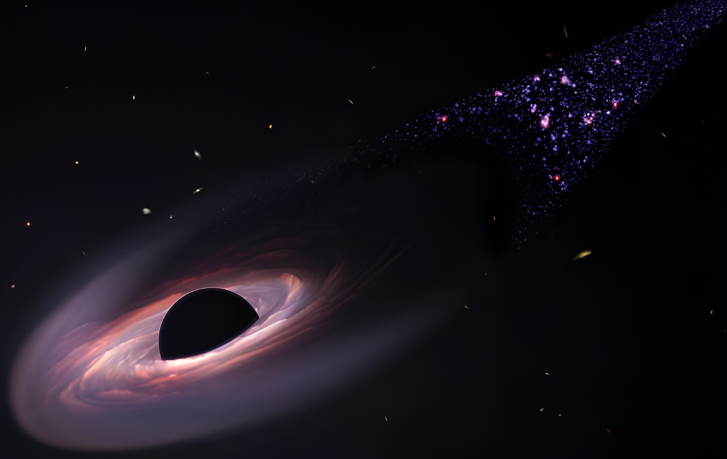
A red point in James Webb Space Telescope data looks partly like a star, but researchers calculate that it emits roughly 100 billion times more energy than any known star can produce. Their study published in Nature argues that the object is more plausibly a black hole concealed within an exceptionally dense envelope of hot gas.
The object, designated MoM-BH*-1, is not yet a confirmed new class of celestial body. The team calls its proposed configuration a “star-black hole,” but that label does not describe a literal hybrid of a conventional star and a black hole. It is shorthand for a system whose light carries star-like signatures even though its reported energy output requires a more powerful central engine.
A red dot that failed the stellar test
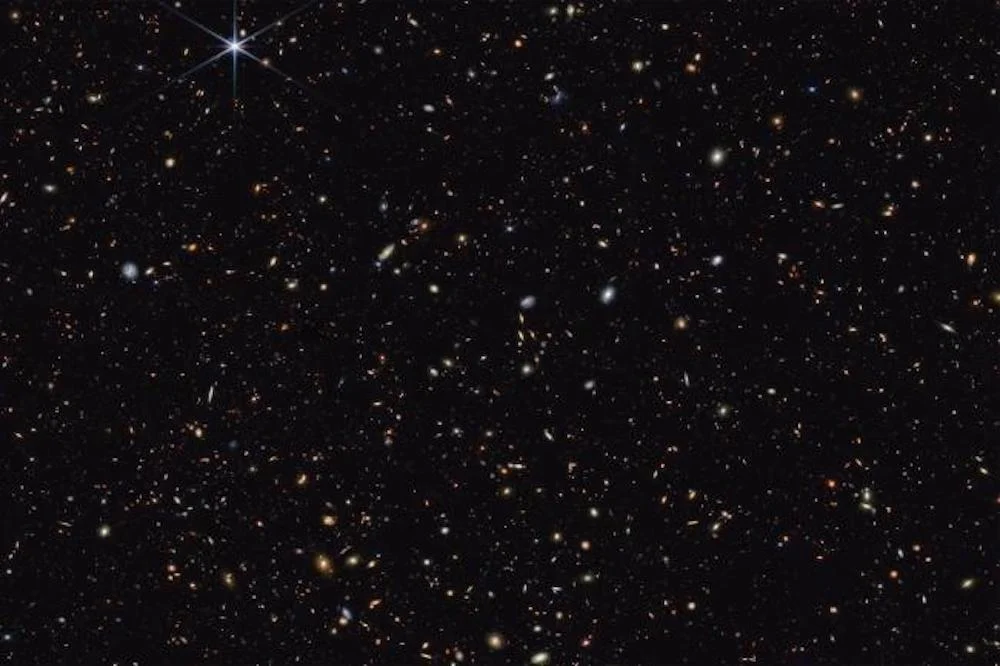
Astronomers first noticed MoM-BH*-1 while searching archived Webb images for extremely distant galaxies. It appears in the direction of the constellation Cetus, and its light dates to approximately 660 million years after the Big Bang.
The initial clue was its appearance as an unusually bright, red, compact point. Spectroscopy then exposed the more difficult puzzle: its light drops sharply below a particular wavelength. That feature, known as a Balmer break, is often associated with hydrogen absorbing radiation in stellar atmospheres or populations of stars.
MoM-BH*-1’s break is far stronger than conventional stellar models can readily produce. Its spectrum also contains broad hydrogen emission and deep hydrogen absorption. Together, those signatures suggest that the radiation is passing through unusually dense gas rather than emerging from an ordinary fusion-powered star.
Energy output provides the harder boundary. Nuclear fusion powers known stars, but the team’s calculation puts MoM-BH*-1 far beyond that operating range. Accreting black holes, by contrast, can release energy on the required scale as surrounding material heats while falling toward them.
Why gas fits better than a giant star
The researchers tested competing explanations with computer simulations. Their favored model begins with an actively accreting black hole and passes its radiation through an extremely dense, turbulent gas envelope. Hydrogen in that envelope absorbs, scatters and reprocesses the light, producing a spectrum that can resemble radiation passing through an enormous stellar atmosphere.
This mechanism also changes the interpretation of the object’s red color. Astronomers often associate red celestial objects with dust, which preferentially blocks or scatters shorter-wavelength light. The model for MoM-BH*-1 requires little dust. Instead, hydrogen opacity accounts for its weak shorter-wavelength output and unusually deep spectral break.
That distinction matters because dust and dense gas imply different physical environments. A dust-based model primarily changes how an underlying source appears. A sufficiently dense gas envelope can reshape both the continuum and hydrogen-line profiles, complicating estimates of the black hole’s mass and the motion of material around it.
The Nature paper explicitly limits the conclusion. Its selected simulation is a feasible broad physical picture, not a unique reconstruction of the object. The modeled parameter space is complex and contains degeneracies, meaning different combinations of gas conditions and central-source properties may reproduce parts of the data. Estimates of the black hole’s mass are consequently highly dependent on the assumptions used.
A possible view of rapid early growth
If the gas-envelope interpretation holds, MoM-BH*-1 could expose a short-lived stage in early black-hole development. Dense surrounding material could both feed a growing black hole and alter the radiation that astronomers use to measure it. That would offer a possible route toward understanding how some massive black holes became so large during the universe’s first billion years.
The object may also help decode the compact early-universe sources commonly called “little red dots,” which Webb has revealed in substantial numbers. Researchers have debated whether those objects are dominated by stars, accreting black holes or mixtures of both. MoM-BH*-1 is particularly useful because its central source appears to dominate nearly all the observed light, reducing interference from its host galaxy.
Still, one unusually clear object cannot establish that all little red dots share the same architecture. Nor does a successful simulation prove that MoM-BH*-1 contains the exact gas structure modeled by the team. Additional spectroscopy and monitoring are needed to test whether its brightness changes, refine its line profiles and determine whether comparable objects follow the same pattern.
For now, Webb has established the observational contradiction: MoM-BH*-1 carries a spectral feature traditionally associated with stars while operating at an energy scale that fusion cannot explain. The next measurements must determine whether a gas-blanketed black hole resolves that contradiction or whether the early universe has supplied an even less familiar mechanism.
| More aerospace and engineering stories, right in your MSN feed. Follow AMI on MSN |
By David Whitaker — Associate editor for AMI’s aerospace and drone systems desk, translating flight systems, aircraft programs, spaceflight, and UAV developments into accessible technical stories.