Air Force Awards $31.8 Million for Ski-Equipped C-130 Antarctic Transport Engineering
Nearly $32 million is now committed to engineering a modern ski-equipped C-130, but the award does not buy an operational aircraft. It starts the technical work needed to convert a production C-130J Super Hercules for Antarctic transport while the existing 10-aircraft fleet reportedly keeps only four aircraft mission-capable at a time.

The Air Force awarded Sierra Nevada Corporation $31,789,335 for the design, development and analysis of a post-production modification kit. According to the federal contract notice published September 2, 2026, the work will take place in Colorado Springs, Colorado, and is scheduled for completion by March 27, 2028. The sole-source contract obligates fiscal 2025 research, development, test and evaluation funding.
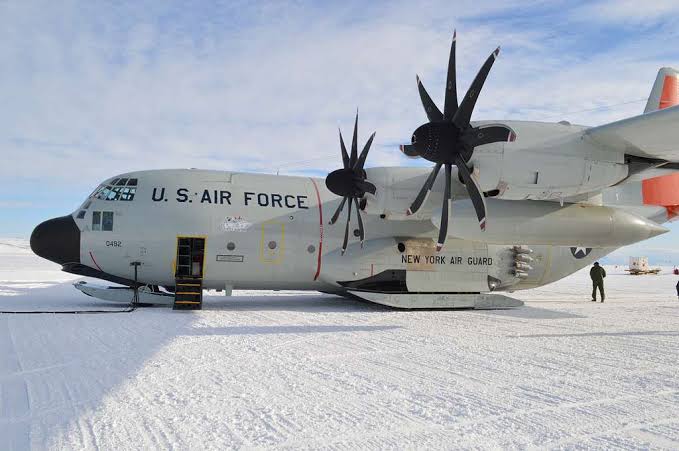
That distinction between engineering and procurement is central. Congress funded a broader transition effort, but this contract covers non-recurring engineering: the one-time design and analysis required to define a repeatable conversion. It does not establish that an LC-130J has been built, tested, accepted or delivered to the New York Air National Guard.
Why a conversion kit matters
The intended product is a post-production kit capable of turning a standard production C-130J into an LC-130J that can operate on skis from snow and ice. A kit-based approach potentially preserves the production C-130J as the baseline aircraft while adding the specialized hardware and associated changes needed for polar service after production.
That is more than a landing-gear substitution. The funded scope must define how the modification fits the aircraft as a complete system, including the design loads, interfaces and configuration changes associated with the ski installation. The public notice does not specify the final architecture or test program, so it is too early to claim how closely a future LC-130J would reproduce the current aircraft’s installation.
The baseline C-130J nonetheless offers a clear modernization foundation. The Air Force describes it as having digital avionics, a two-pilot flight station, Rolls-Royce AE 2100D3 turboprops and six-bladed composite propellers. Compared with older C-130 variants, the service says the J model flies farther and faster and requires fewer crew members. Those general C-130J advantages do not by themselves demonstrate the performance of a ski-equipped version, which will have its own weight, drag and structural considerations.
Post-production conversion also creates a procurement tradeoff. Using a standard production aircraft could reduce the need for an entirely separate manufacturing line, but specialized aircraft still require controlled configurations, dedicated maintenance knowledge, replacement parts and validated operating procedures. With only one unit flying the ski-equipped Hercules, the resulting fleet would remain small even if the conversion succeeds. That limits the scale over which development and support costs can be spread.
A small fleet carries a large Antarctic workload
The New York Air National Guard’s 109th Airlift Wing is the only unit operating the ski-equipped Hercules. Its LC-130Hs move researchers, passengers, cargo and fuel in support of National Science Foundation work in Antarctica, including service to locations that depend on snow-and-ice airfields.
The scale of that mission is visible in the wing’s 38th Operation Deep Freeze season, completed March 11, 2026. Three LC-130Hs operated from McMurdo Station, while a fourth was staged in Christchurch, New Zealand. The wing flew 63 missions to Amundsen-Scott South Pole Station and 17 to the West Antarctic Ice Sheet Divide. It transported 1,086 passengers, 2.6 million pounds of cargo and one million pounds of fuel.
Those figures explain why availability matters even in a fleet that numbers only 10 aircraft. Lawmakers supporting the transition said just four LC-130Hs were mission-capable at any given time and that most were built in the 1970s. Those are attributed congressional claims, not an Air Force readiness finding disclosed in the contract notice. Even so, the recent season shows that four deployed or staged aircraft can underpin a substantial logistics operation.
The public-cost question is therefore not simply whether nearly $32 million is high for a conversion design. It is what that engineering buys before the government commits to aircraft modification and fleet support. A credible design package can reduce uncertainty around structural integration, configuration control and later testing. It cannot remove the continuing cost of sustaining the LC-130H fleet while a replacement remains under development.
Lawmakers said the fiscal 2026 defense funding bill included $194 million to develop and procure an LC-130J, following $29 million for non-recurring engineering in the fiscal 2025 package. Those appropriations indicate intent and available funding, but they should not be counted as a delivered replacement. Contracted engineering, aircraft procurement, modification, ground and flight testing, airworthiness work, acceptance and operational fielding are separate milestones.
The next firm date is March 27, 2028, when Sierra Nevada’s contracted engineering work is expected to finish. Until that design effort advances into hardware, testing and an accepted aircraft, Antarctic research operations will continue to depend on the aging LC-130H fleet the new kit is meant to replace.
| More aerospace and engineering stories, right in your MSN feed. Follow AMI on MSN |
By David Whitaker — Associate editor for AMI’s aerospace and drone systems desk, translating flight systems, aircraft programs, spaceflight, and UAV developments into accessible technical stories.