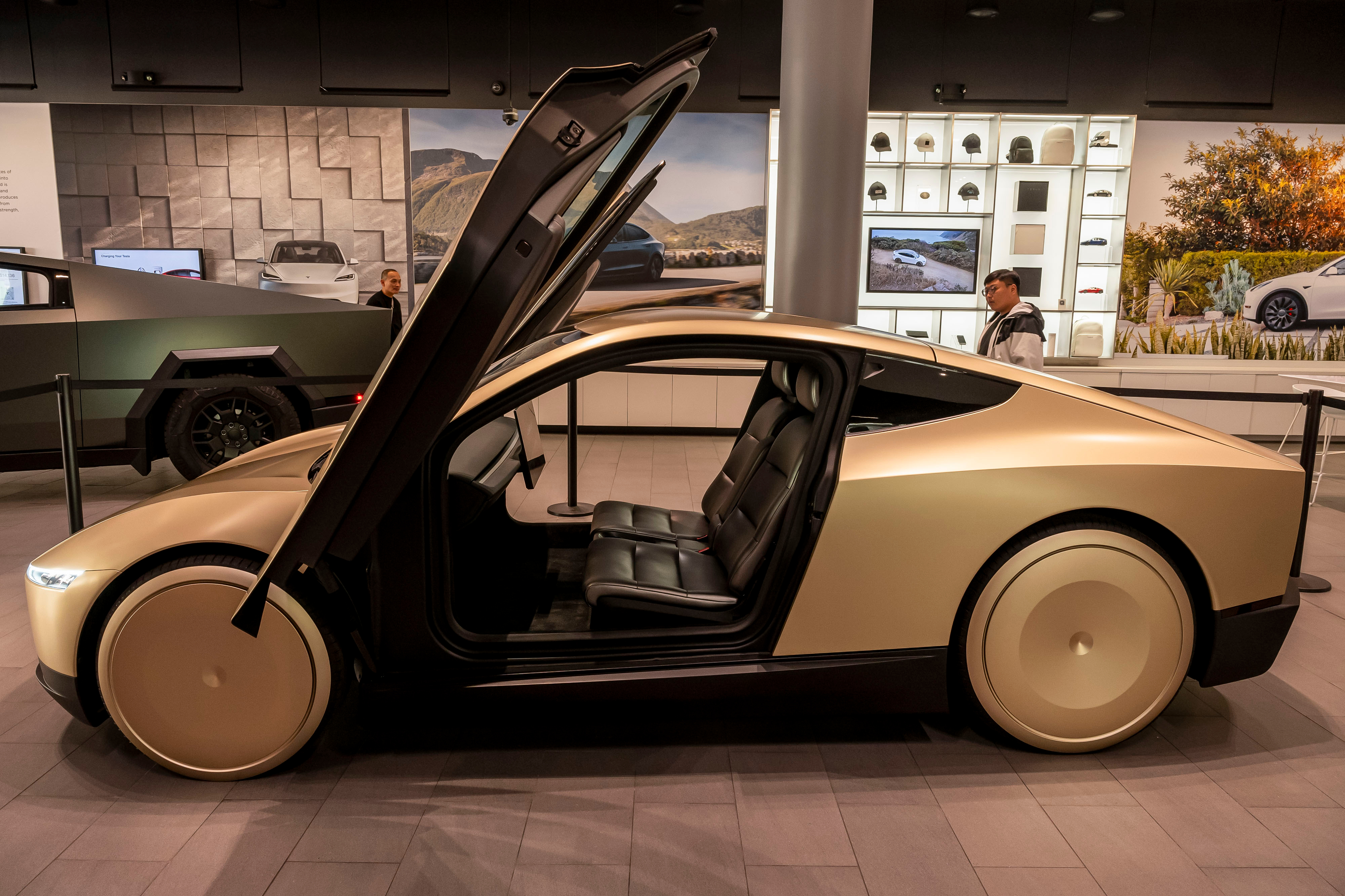
Federal Regulators Audit Tesla Cybercabs Without Steering Wheels or Brake Pedals
Federal vehicle-safety regulators are auditing Tesla’s newly deployed Cybercabs because the two-seat taxis operate without steering wheels, rearview mirrors or brake pedals. The National Highway Traffic Safety Administration opened the review on September 4 after Tesla began commercial passenger service with dozens of the purpose-built vehicles in Austin, Texas.

The inquiry does not establish that Tesla violated a safety rule. It is an Audit Query intended to examine the process and technical data supporting Tesla’s claim that the Cybercab complies with every applicable Federal Motor Vehicle Safety Standard. No final compliance finding, suspension order or completion date has been announced.
The central question is which standards apply
Federal vehicle regulation in the United States generally relies on manufacturer self-certification. NHTSA sets performance requirements, and an automaker certifies that each vehicle meets the standards applicable to it. The agency does not provide advance approval for every new model, but it can inspect the technical basis for a certification and conduct enforcement investigations.
That framework is straightforward when a new car follows the architecture assumed by longstanding rules: a human driver, a steering control, pedals and mirrors. Cybercab removes those interfaces because its design assigns the complete driving task to an automated system. Passengers therefore cannot grab a wheel or press a brake pedal if they believe intervention is necessary.
NHTSA said its audit will determine whether Tesla’s compliance framework treated certain requirements as inapplicable to an automated vehicle. That distinction matters. Tesla is not merely claiming that alternative hardware performs the same function as a conventional control; the regulator is examining whether the company had an adequate basis for concluding that particular control-related provisions did not apply at all.
The audit consequently puts two separate issues under examination: the Cybercab’s technical performance and the legal reasoning used to map an unconventional vehicle onto rules written around conventional controls. Self-certification permits manufacturers to make that initial assessment, but it does not make the assessment immune from federal review.
Rules are changing, but current rules still govern
NHTSA says it is working on eight rulemakings involving automated-vehicle-relevant subjects, including brake pedals, rearview mirrors, windshield wipers and lighting. That work acknowledges a genuine systems-integration problem: a requirement designed around a person sitting at the controls may not translate neatly to a vehicle with no driving position.
However, pending modernization does not itself authorize a manufacturer to disregard an existing provision. NHTSA explicitly says current standards remain in force until the updates are completed. The Cybercab audit will therefore test Tesla’s certification against the rules in effect when the vehicles entered commercial service, not against a future regulatory framework.
This creates a consequential timing tension. Purpose-built automated vehicles can eliminate components that are unnecessary to their intended operating concept, potentially changing cabin packaging and the relationship between passengers and the machine. Regulators, meanwhile, must determine whether removing those components preserves the safety outcomes required by law and whether existing standards legally accommodate that approach.
Austin riders encounter the design before the audit is complete
The immediate public stake is not an abstract debate about terminology. Dozens of Cybercabs are already operating on Austin streets, where passengers and other road users encounter vehicles whose occupants have no conventional means of taking control. That does not prove the vehicles are unsafe, but it makes the integrity of the automated system and the validity of Tesla’s certification especially consequential.
The review also matters beyond Austin. Tesla intends to add Cybercabs to a robotaxi network that previously used conventional Tesla vehicles. That network has operated in Austin for more than a year and has begun offering rides in five other cities in Texas and Florida. Tesla has characterized the Cybercab launch as the beginning of a planned national rollout, but that wider deployment remains a plan rather than a completed expansion.
Existing robotaxis based on conventional cars and the control-free Cybercab may provide a similar passenger service, yet they present different human-factor boundaries. A conventional vehicle retains hardware associated with manual driving even when automation is active. Cybercab makes the absence of passenger intervention a permanent design condition, increasing the importance of how regulators classify each requirement and assess the supporting engineering data.
Tesla did not immediately respond to a request for comment. Separate federal inquiries involving its driving software and crash-reporting practices remain distinct from this certification audit and do not establish the Cybercab’s compliance status. The next decisive development will be NHTSA’s determination of whether Tesla’s technical record and interpretation of applicable standards justify putting a control-free passenger vehicle on public roads.
| More aerospace and engineering stories, right in your MSN feed. Follow AMI on MSN |
By Thomas Caldwell — AMI’s senior editor for mechanical and mobility engineering, covering vehicle electronics, systems integration, electrification, chassis systems, propulsion, and safety policy.