


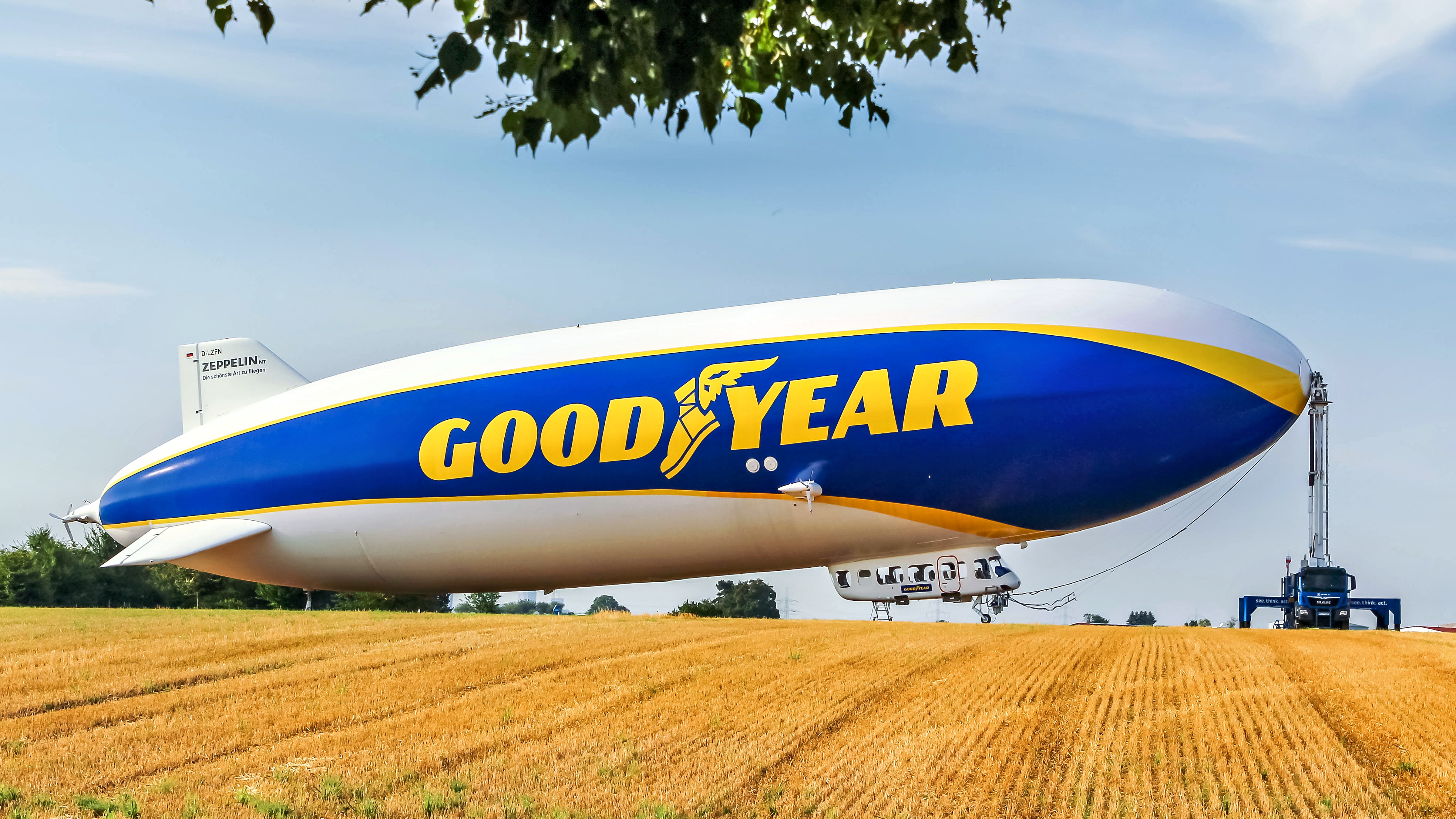
Goodyear’s Three Airships Require Round-the-Clock Watch and Specialized Maintenance
A familiar piston engine becomes a very different maintenance proposition when it sits about 30 feet above the ground on an aircraft nearly 250 feet long. Goodyear’s three Zeppelin NT airships combine conventional Lycoming powerplants with large reduction gearboxes, vectored thrust, helium lift and an internal framework that technicians must enter using climbing equipment. That combination drives a maintenance system built around elevated access, gas management, continuous monitoring and years of specialized training.

Goodyear operates Wingfoot 1, Wingfoot 2 and Wingfoot 3 from bases in Akron, Ohio; San Francisco; and Pompano Beach, Florida. The fleet flies five or six days per week for events, festivals and charity flights, with typical missions lasting six to eight hours. Adam Basaran, Goodyear’s chief pilot for training, safety and standards, described the operation and its maintenance demands in an Aviation Week interview.
Familiar engines, airship-specific installation
The Zeppelin NTs use Lycoming IO-360 engines, a widely used piston-aircraft engine family. “It’s the same engine you’d find on a lot of Cessna 172s, so that aspect of the ship is familiar,” Basaran said. The installation is not: Each engine drives a nine-foot propeller through a 90-degree gearbox that cuts propeller speed by almost 50%. The airships also use vectored thrust for takeoff and landing.
That propulsion arrangement changes how mechanics reach the hardware. During field maintenance, crews can hoist metal scaffolding to an engine gondola and climb a rope ladder to the work platform. The airship can move while maintenance is underway outdoors, adding an access and coordination constraint absent from a fixed shop floor. In the Akron hangar, movable lifts and platforms provide a more controlled way to reach the engines.
Maintenance begins soon after an airship is moored. A mechanic starts a postflight process that can take one to two hours, while longer deployments such as multiweek road trips can lead to 100-hour inspections. The frequency matters because this is an active three-aircraft operation rather than a collection flown only occasionally.
Helium makes parking an active operation
Helium supplies most of the lift, while air-filled ballonets help control pressure as gas conditions and temperatures change. Unlike a conventional airplane that simply becomes lighter as it burns fuel, the airship’s lift and pressure state must be managed as helium, air and temperature interact. At minimum fuel burn, an airship could remain aloft for almost 24 hours on just over 300 gallons, according to Basaran, although that is well beyond the normal mission duration.
The lifting system also means the aircraft cannot simply be parked and left unattended. “When it’s not being flown, there’s somebody on watch with the airship 24 hr. a day,” Basaran said. That watch covers helium purity, internal pressure, weather and emerging maintenance conditions. Problems are communicated to Goodyear’s repair station for documentation and follow-up work.
The cockpit is comparatively modern, using fly-by-wire controls and a Garmin 500H-series avionics suite that supports operation from either seat. But digital flight controls do not remove the physical demands imposed by the envelope, propulsion installation and mooring environment. The Zeppelin NT may cruise at only 45 to 55 knots, yet its support system must accommodate an aircraft longer than most commercial widebodies.
Annual maintenance transforms the aircraft
Each airship returns to Akron annually for heavier work. Technicians remove the helium, compress it and store it in a tanker truck. Without helium lift, the aircraft weighs just under 20,000 pounds and hangs from a center rail in the hangar. That transition changes the job from managing a buoyant aircraft to supporting a large suspended structure.
Technicians then use climbing gear and an ascender system to enter and inspect the carbon-fiber-and-aluminum internal framework. Limited entry and exit points make this a confined-space operation, requiring dedicated training, on-site rescue equipment and procedures coordinated with local fire departments. Those safeguards are part of the maintenance architecture, not ancillary workplace measures.
The workforce is the tightest constraint. Goodyear says an airframe-and-powerplant-certified technician needs several additional years to develop the required airship capabilities, progressing through different maintenance and inspection levels. The company faces a similar scarcity on the flight side: It operates its own pilot school, requires lighter-than-air airship ratings and has a designated pilot examiner who coordinates check rides with the FAA.
For a fleet of only three aircraft, that is a substantial training and support structure. The engines may be familiar, but the helium system, elevated field access and confined internal framework ensure that keeping Wingfoot 1, Wingfoot 2 and Wingfoot 3 available depends on expertise that cannot be transferred overnight from conventional aircraft maintenance.
| More aerospace and engineering stories, right in your MSN feed. Follow AMI on MSN |
By David Whitaker — Associate editor for AMI’s aerospace and drone systems desk, translating flight systems, aircraft programs, spaceflight, and UAV developments into accessible technical stories.



