


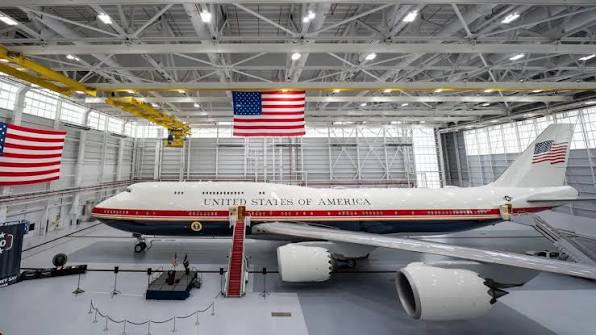
Qatar-Gifted 747 Returns Overseas After $400 Million Retrofit, More Costs Undisclosed
The Qatar-gifted Boeing 747 used for presidential transport is scheduled to carry President Donald Trump to Ireland next week after $400 million in U.S.-funded conversion work. The trip would return the aircraft to international service while the cost and schedule of additional modifications remain undisclosed.
The planned flight follows a security precaution during a July visit to Turkey. Intelligence concerning a potential Iranian attack led Trump to depart aboard an Air Force C-32A rather than the converted 747. The larger aircraft continued with other officials, staff and reporters aboard. That operational decision does not establish that the gifted jet is unsafe, but it makes the unanswered questions about its final configuration and intended operating role more consequential.
A $400 million conversion without a disclosed final bill
The central accountability problem is not simply how much has already been spent. It is that the government has not defined publicly what that $400 million purchased, what further work remains or how much the completed effort is expected to cost.
Trump said in July that the aircraft would be sent away to be “maxed out.” Former White House press secretary Karoline Leavitt previously said modifications would begin in the fall and take about a month. Specialists cited in public reporting questioned whether the necessary work could be completed within that period, and the White House has not subsequently announced a schedule.
“We don’t comment on specific upgrades or modifications to Air Force One,” a senior administration official said. The official added that the government maintains “a consistent posture that ensures a safe, secure, and reliable capability” and changes that capability as required.
There are valid reasons not to publish sensitive details about a presidential aircraft. Those limits do not prevent the government from releasing program-level information such as an overall budget, contracting structure, broad categories of work, projected downtime or a target for returning the aircraft to its intended service level. Keeping technical protection measures confidential is different from leaving the public cost and schedule undefined.
Conversion scope determines whether the timeline is credible
A commercial or executive 747 cannot be judged as a presidential transport from its airframe alone. The conversion also involves government communications, mission equipment, cabin changes, electrical integration, testing and support arrangements. Each added system can affect power demand, cooling, weight, maintenance access and electromagnetic compatibility with equipment already aboard.
That integration burden is why a short modification window should not be interpreted as proof that the aircraft will become technically equivalent to the purpose-built presidential 747s now under development. A one-month period could cover a limited package of changes, but the government has not identified the package or the associated test scope. Without those boundaries, neither the schedule nor the remaining cost can be evaluated meaningfully.
The White House says the gifted aircraft is state of the art and fitted with high-level security protocols. That is an official readiness claim, not a public accounting of its configuration. The July aircraft switch likewise demonstrates that planners can change platforms in response to a particular risk assessment; it does not, by itself, reveal which systems were present, absent or decisive.
The bridge aircraft sits inside a much larger delay
The gifted 747 is serving as a bridge because the two Boeing 747s ordered by the Air Force in 2017 for the long-term presidential mission remain delayed. It is unclear whether those government-purchased aircraft will be ready before January 2029.
The Government Accountability Office estimates that enhancement costs for the two replacement aircraft now exceed $5.6 billion. That figure provides context for the expense and complexity of presidential-aircraft conversion, but it is not an apples-to-apples price comparison. The two-aircraft program has its own requirements, development work, testing burden and fleet-support responsibilities. Nothing publicly established shows that the $400 million bridge conversion buys equivalent capability.
The bridge strategy may reduce pressure on the aging presidential fleet while Boeing works through the replacement program, but it also creates another aircraft configuration to operate, maintain and support. Its value therefore depends on more than being available for a high-profile trip. It depends on how broadly the aircraft can be assigned, how much additional work it requires and whether that work can be completed without consuming time and money better directed toward the permanent fleet.
The Ireland flight will show that the converted 747 remains available for international presidential service. It will not answer the larger procurement question: what final capability taxpayers are buying beyond the $400 million already spent, and when that conversion will actually be finished.
| More aerospace and engineering stories, right in your MSN feed. Follow AMI on MSN |
By David Whitaker — Associate editor for AMI’s aerospace and drone systems desk, translating flight systems, aircraft programs, spaceflight, and UAV developments into accessible technical stories.



