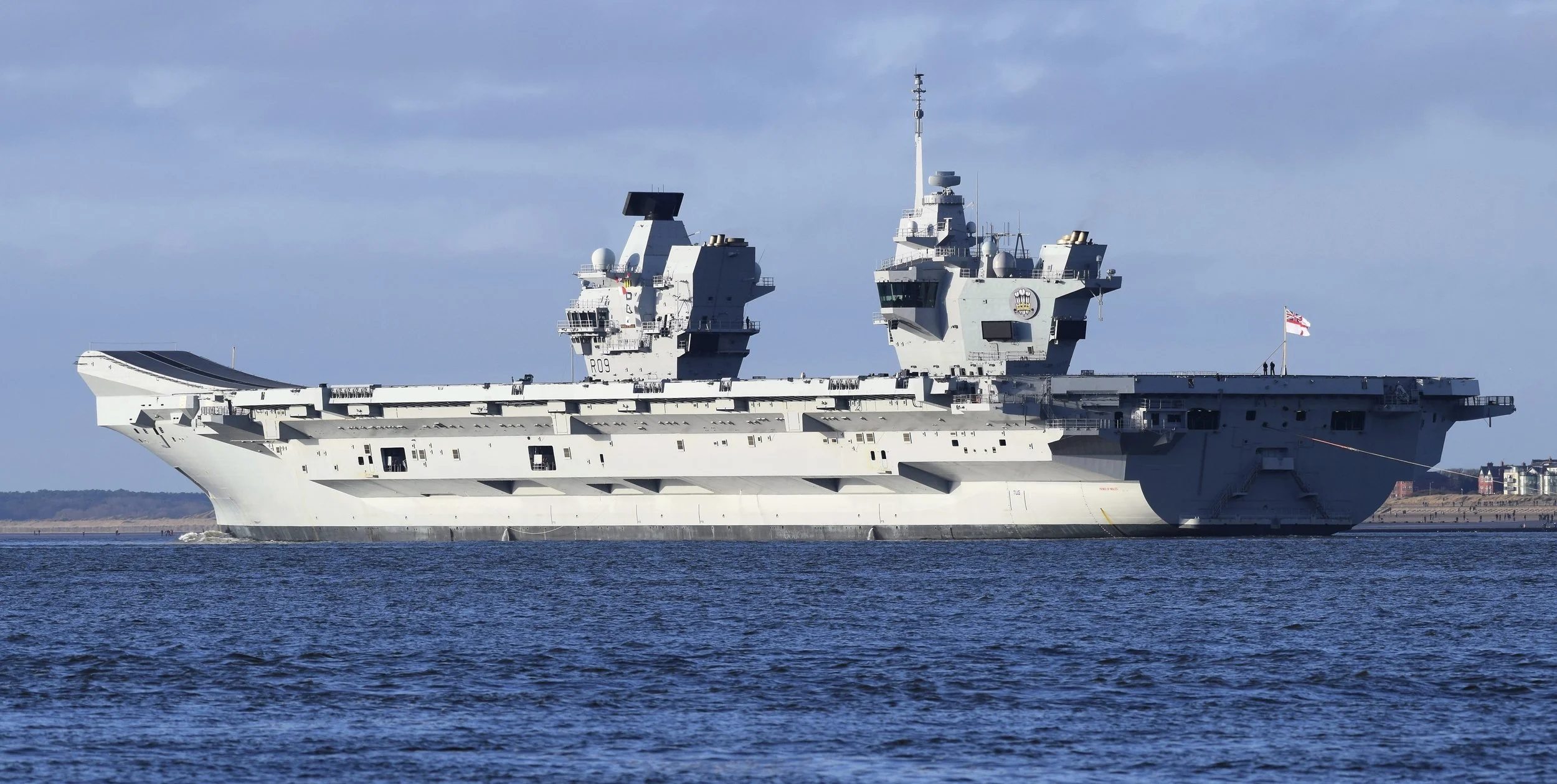
HMS Prince of Wales Spent Roughly One-Third of Its Life Under Repair
HMS Prince of Wales has reportedly spent roughly one-third of its life in port undergoing repairs and only about one-fifth at sea. That limited availability carries an unusually visible public cost: Britain’s two Queen Elizabeth-class aircraft carriers reached an official program cost of £7.6 billion by 2019, up from an original allocation of £3.9 billion.

The numbers connect cost growth to an operational constraint rather than merely an expensive procurement history. Britain bought two carriers partly to preserve access to one while the other underwent maintenance, training or upgrades. When corrective repairs consume long periods on top of scheduled upkeep, that two-ship structure has less flexibility to deliver continuous availability.
A shaft failure became a nine-month repair
The most consequential mechanical event occurred in August 2022, two days after Prince of Wales departed Portsmouth. An external coupling failed, significantly damaging the carrier’s starboard shaft and 22-ton propeller while causing superficial damage to the rudder. An official investigation concluded that the shaft had been misaligned during construction and that several important components were installed incorrectly.
The resulting repair took approximately nine months and cost an estimated £25 million. Those figures demonstrate the reach of propulsion-line defects on a ship of this scale. A shaft is not an isolated replaceable module: it forms part of a long mechanical path connecting the propulsion machinery, couplings, bearings, seals and propeller. Alignment and installation quality therefore affect how loads travel through the entire assembly.
Couplings must transmit substantial rotational force while accommodating the movement and tolerances allowed by their design. Misalignment or incorrectly installed components can create loading outside the intended condition, but the available findings do not establish that every later coupling issue had the same cause. That distinction is important when assessing whether the class has one systemic defect or several separate maintenance problems.
The two carriers have not shown an identical failure pattern
HMS Queen Elizabeth, which entered service in 2017 two years after its original target, experienced leakage through a faulty seal around a stern propeller shaft soon after entering service. The reported inflow was approximately 200 liters of seawater per hour. In February 2024, a pre-sailing inspection identified another problem involving the starboard propeller-shaft coupling, forcing the carrier to withdraw from NATO’s Exercise Steadfast Defender.
The Ministry of Defence attributed the 2024 problem to wear and tear on a hydraulic clamp coupling and said it was separate from the 2022 Prince of Wales failure. That official distinction prevents a firm conclusion that the two events reveal a common class-wide fault. What can be concluded is narrower: shaft seals, couplings, alignment and installation quality have each generated availability consequences across the two-ship program.
Corrective work also competes with scheduled maintenance for dockyard capacity, engineering labor and parts. Large carriers require periodic hull, rudder, propeller and underwater-opening inspections, even when nothing has failed. Queen Elizabeth has spent extended periods in dry dock for inspections and shaft work, while reports from 2023 and 2024 also described backlogs involving plumbing and faulty showers in living spaces.
Time alongside should not automatically be counted as breakdown time. Planned maintenance protects certification and future availability, and some work can be distributed across shorter alongside periods. Corrective propulsion repairs are different because they can abruptly remove a ship from an exercise or operating schedule and force dockyard plans to be rearranged.
Cost decisions narrowed the program’s margin
Not all of the increase from £3.9 billion to £7.6 billion resulted from mechanical defects. A 2008 decision to slow construction during the financial crisis added around £1.56 billion, while a later decision to return the second carrier from a proposed catapult configuration to a short-takeoff-and-vertical-landing design contributed further cost and delay. The program total therefore combines procurement decisions, schedule changes and engineering work rather than representing a repair bill.
Yet the availability figures show why construction quality and maintainability remain public-cost issues after delivery. Spending more on a platform does not guarantee more usable time if installation defects trigger lengthy corrective work or if maintenance capacity cannot absorb emerging demands. The affected groups include taxpayers funding repairs and Royal Navy planners trying to sequence two ships through operations, training and upkeep.
There is now a measurable recovery milestone. HMS Queen Elizabeth began a three-month training and operations period around Britain and northern Europe in September 2026 after its first major refit. The Royal Navy says the carrier is preparing to replace Prince of Wales as Britain’s flagship and high-readiness strike carrier in late 2027.
That handover will test whether completed shaft work and a more distributed maintenance approach can restore the intended benefit of owning two carriers. For a £7.6 billion program, the decisive measure is no longer the size of the ships or the completion of construction. It is how reliably the Navy can keep one available while maintaining the other.
| More aerospace and engineering stories, right in your MSN feed. Follow AMI on MSN |
By David Whitaker — Associate editor for AMI’s aerospace and drone systems desk, translating flight systems, aircraft programs, spaceflight, and UAV developments into accessible technical stories.