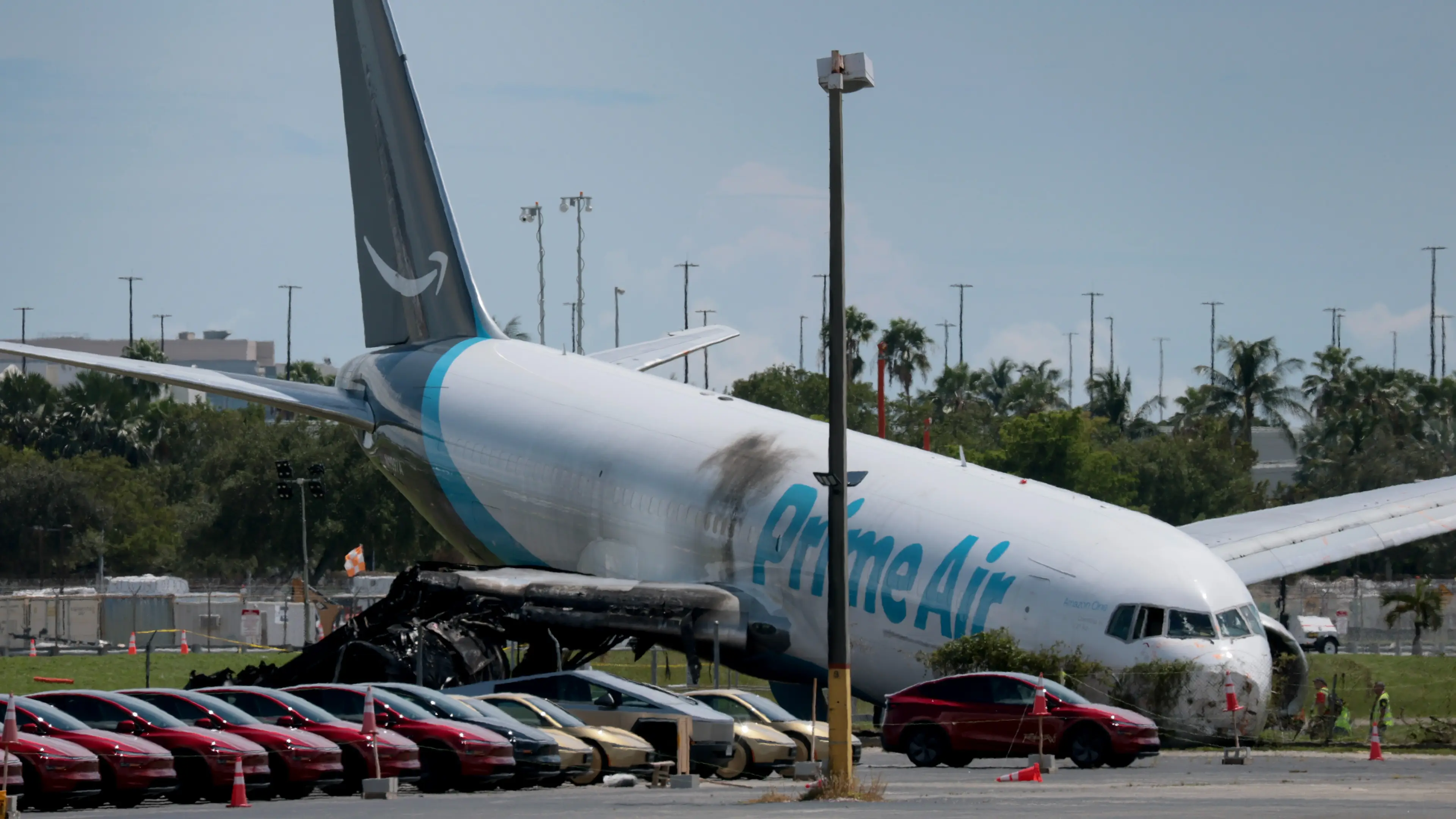
Black Boxes Recovered After Amazon Boeing 767 Overrun Kills Five
Federal investigators have recovered both recorders from the Amazon Prime Air Boeing 767 that traveled 1,300 feet beyond a paved runway at Miami International Airport, struck two occupied vehicles and left five people dead. The recovery gives the National Transportation Safety Board two central evidence streams, but it does not establish why the aircraft failed to stop within the paved area.
The Boeing 767-33 Alpha, operated by 21 Air, was arriving from San Juan, Puerto Rico, shortly before 2 p.m. EDT on Sunday, September 6. According to NTSB Chairwoman Jennifer Homendy, the aircraft struck navigational aids and other airport equipment before hitting a white van carrying seven people inside the airport perimeter. It then struck a Toyota SUV outside the perimeter fence. Five people in the vehicles were killed and five others were injured. Both crew members survived.
The flight data recorder and cockpit voice recorder were recovered Monday and sent to NTSB headquarters for evaluation. Thirty-two investigators had reached the scene, where victim recovery, fuel removal and management of widespread debris affected when investigators could access portions of the aircraft and surrounding evidence.
What the recorders can establish
The flight data recorder provides a time-based record of selected aircraft parameters. The cockpit voice recorder preserves the flight-deck audio needed to examine crew communications, alerts and coordination. Neither recorder should be interpreted alone. Their principal investigative value comes from synchronizing the recorded information with physical evidence, air traffic control records and interviews.
Investigators can construct a common timeline and compare it with tire marks, damaged airport equipment, the aircraft’s final position and the documented 1,300-foot path beyond the pavement. They also plan to interview the two pilots, examine their experience and training, review their actions during the landing, inspect the aircraft and evaluate air traffic control information.
That comparison is essential because an overrun is an outcome, not a cause. The distance traveled beyond a runway does not by itself identify the aircraft’s touchdown point, condition, speed history, crew decisions or system performance. Those subjects require validated data and corroborating evidence. No finding about braking, weather, mechanical condition, pilot performance or responsibility is justified at this stage.
The FAA’s guidance on landing performance and runway-excursion mitigation illustrates the broader systems approach used to manage landing risk. It addresses arrival-time landing-distance assessments, runway-condition information, operating procedures, training and briefings. The document is advisory rather than legally binding, and it is not an explanation of what happened in Miami.
Airport defenses are a separate question
Miami International has a 1,000-foot runway safety area and was reported to meet the FAA’s required dimensions. It does not have an engineered materials arresting system, a bed of crushable material installed at some airports to decelerate an aircraft after it leaves a runway. Such systems are generally used where a full conventional safety area cannot be provided.
That distinction matters, but it cannot support a conclusion about this accident. The aircraft traveled about 1,300 feet past the paved surface, and investigators have not determined its speed or other conditions needed to assess how a different runway-end configuration might have affected the outcome. Infrastructure mitigation and the cause of an overrun are also separate investigative questions: one concerns why an aircraft left the available pavement, while the other concerns what happened after it did.
The accident also affected the wider airport system. Two of Miami International’s four runways remained closed Monday while investigators worked, contributing to 129 domestic delays and 65 cancellations. Accident-site access, debris removal and evidence preservation can constrain airport capacity even when other runways remain available.
Why a cause will take longer
The NTSB expected its on-scene work to last at least a week, but laboratory evaluation and record collection extend well beyond that period. Recorder information must be downloaded, checked for quality and aligned with air traffic control records, physical marks, aircraft inspections and witness interviews. Investigators must also separate observations made after the accident from conditions that existed during the landing.
A final NTSB report is typically issued 12 to 24 months after a crash. Until that process produces findings, the recovered black boxes narrow the evidence gap without resolving the central question: why this Boeing 767 did not stop before crossing the airport’s paved boundary and reaching occupied vehicles beyond it.
| More aerospace and engineering stories, right in your MSN feed. Follow AMI on MSN |
By Thomas Caldwell — AMI’s senior editor for mechanical and mobility engineering, covering vehicle electronics, systems integration, electrification, chassis systems, propulsion, and safety policy.