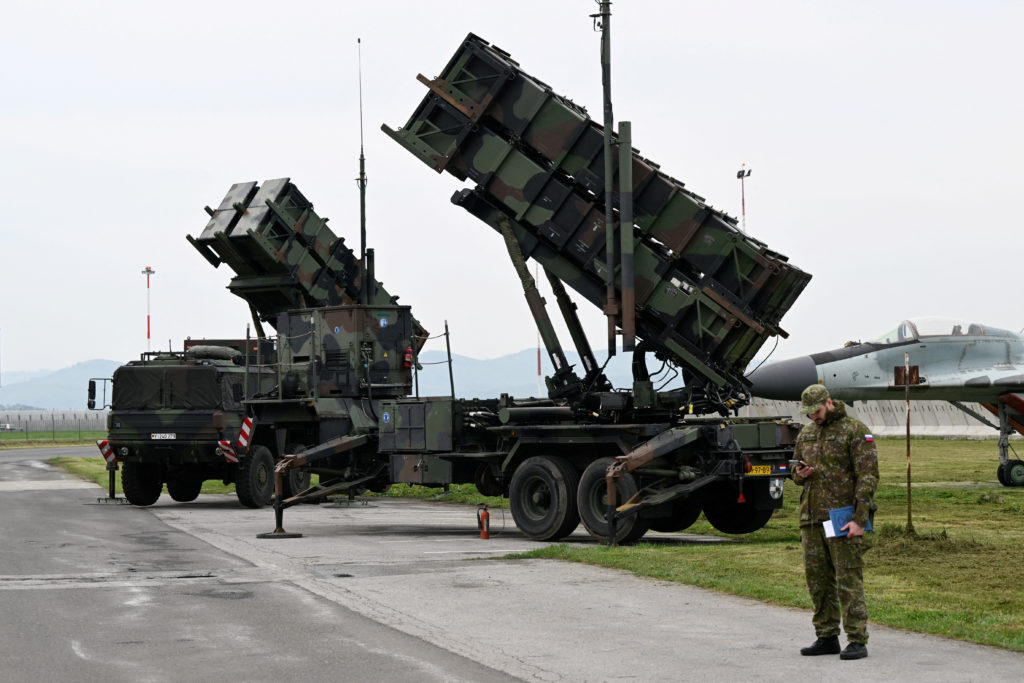
UK Funds Patriot Air Defense; 95,000-Plus Drone Deliveries Still Pending
Britain has put two sharply different measures of defense support on the same winter schedule. The UK is contributing £100 million for Patriot missiles and other air-defense equipment due before winter, while reporting that just 25,000 of the more than 120,000 drones promised for this year have been delivered. That leaves more than 95,000 drones still to move through production, acceptance and logistics.

The UK Ministry of Defence package also includes large-caliber artillery ammunition and continued deliveries of drones for counter-drone, reconnaissance and attack missions. The ministry says Britain recently delivered its millionth large-caliber artillery round and plans to provide tens of thousands of long-range rounds in the coming months, funded with Germany, Denmark, Lithuania, the Netherlands, Norway and Sweden.
Patriot funding is broader than one missile type
The £100 million figure should not be read as a disclosed order value for Patriot interceptors alone. It covers Patriot missiles and other air-defense equipment, and the announcement does not divide the money among those categories. It also does not identify interceptor models, quantities, unit prices or the exact delivery sequence.
That distinction matters because a funding commitment is not the same thing as a count of ready-to-ship missiles. Britain is making the contribution through NATO’s Prioritised Ukraine Requirements List. As the House of Commons Library explains, that mechanism uses funding from NATO allies to acquire U.S. military equipment for Ukraine rather than relying only on direct donations from national inventories.
The arrangement can give European governments access to equipment produced through the U.S. defense base, but it also separates the public funding announcement from the underlying allocation and delivery details. Without a missile count or equipment breakdown, it is not possible to calculate how much additional interceptor capacity the British contribution purchases or how much of the package consists of other air-defense hardware.
The drone pledge is a manufacturing and delivery test
The drone figures provide a clearer unit count but an incomplete capacity picture. Delivering 25,000 aircraft against a commitment exceeding 120,000 means less than roughly one-fifth of the stated annual total had arrived at the time of the announcement. More than four-fifths remained outstanding, although the precise share cannot be calculated because the commitment is described only as “more than” 120,000.
That gap does not by itself prove a production failure. A yearly commitment can be weighted toward later batches, and “delivered” may trail contracting, manufacturing or acceptance work already underway. But the ministry did not provide a monthly schedule, supplier list, drone-type breakdown or production status. Those omissions prevent a firm judgment about whether the remaining aircraft are already built, under contract or still dependent on future manufacturing.
The broad drone label also limits meaningful comparisons. Small unmanned aircraft can differ substantially in airframe, propulsion, controls, payload integration, communications and acceptance requirements. A total fleet count therefore says little about production complexity unless the mix of systems is known. Tens of thousands of simpler aircraft and a smaller number of more complex platforms can impose very different demands on suppliers and logistics organizations.
For UK taxpayers and partner governments, the central accountability issue is not only the size of the pledge but the conversion of money and commitments into accepted equipment. The air-defense package supplies a concrete funding figure without a unit count; the drone program supplies a large unit commitment without a detailed delivery plan. Each is measurable in one dimension and opaque in another.
The artillery component offers the most mature delivery benchmark in the package: the ministry reports that Britain has already reached one million large-caliber rounds delivered. Patriot-related equipment and the drone commitment have not been reported with comparable detail. The next meaningful milestones will be an itemized air-defense allocation and a substantially updated drone-delivery total before the annual and winter deadlines close.
| More aerospace and engineering stories, right in your MSN feed. Follow AMI on MSN |
By David Whitaker — Associate editor for AMI’s aerospace and drone systems desk, translating flight systems, aircraft programs, spaceflight, and UAV developments into accessible technical stories.