


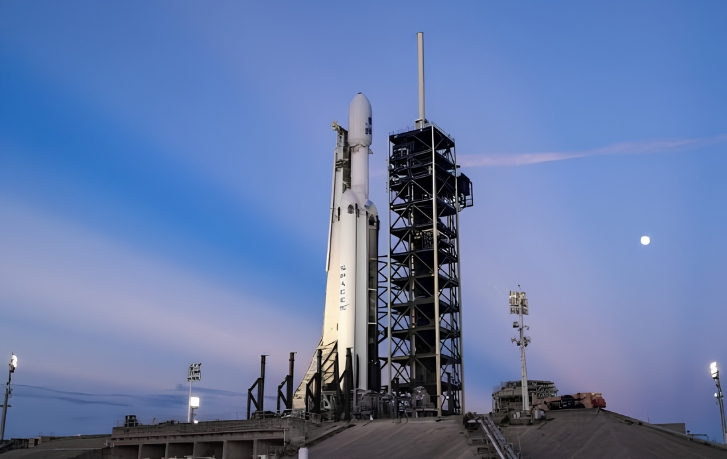
SpaceX Hits 100 Falcon Missions With 27 Starlinks, Trails 2025 Record
One hundred Falcon-family launches in less than eight months: SpaceX reached that mark for 2026 on Aug. 22, when a Falcon 9 carried 27 Starlink satellites from Vandenberg Space Force Base in California. The satellites deployed on schedule, and the company recovered the rocket’s first-stage booster after its ninth flight.
The milestone is substantial, but it does not represent a new annual record. SpaceX completed 165 Falcon launches during 2025, all with Falcon 9 rockets. Reaching 100 before the end of August nevertheless shows how a combination of reusable first stages and recurring Starlink missions supports a launch rate that would be difficult to sustain with a new booster for every flight.
What SpaceX’s 100-launch total includes
The Aug. 22 mission was the 99th Falcon 9 launch of 2026. The remaining flight in the Falcon-family count was an April Falcon Heavy mission that launched the Viasat-3 F3 telecommunications satellite. That distinction matters because Falcon Heavy uses three connected first-stage cores, while the far more frequently flown Falcon 9 supplies nearly all of the family’s annual cadence.
The latest Falcon 9 lifted off at 3:25 a.m. EDT, corresponding to 12:25 a.m. local time in California. Its upper stage continued toward low Earth orbit and released all 27 Starlink spacecraft just under 62 minutes after liftoff.
Meanwhile, first-stage booster B1100 completed the reusable portion of the mission. It landed on the droneship Of Course I Still Love You in the Pacific Ocean approximately 8.5 minutes after launch. This was B1100’s ninth flight, following an earlier NROL-105 mission and seven previous Starlink launches.
Nine flights make B1100 experienced, but it was not approaching the highest reuse count within the Falcon fleet. Another Falcon 9 booster, B1078, had completed its 30th mission one day earlier. The contrast illustrates how SpaceX’s launch system depends on a fleet of boosters at different points in their service histories rather than a single record-setting vehicle.
Starlink supplies most of the workload
Starlink missions accounted for 76 of the first 99 Falcon 9 flights in 2026. Put another way, more than three-quarters of those launches were dedicated to SpaceX’s own broadband constellation rather than outside commercial or government payloads.
That concentration gives Falcon 9 a large, recurring internal customer. Starlink satellites are launched in batches, creating repeat missions with a broadly consistent purpose: placing more spacecraft into low Earth orbit to expand and replenish the network. The Aug. 22 flight added 27 satellites to a constellation reported to contain more than 11,000 operational spacecraft.
The relationship works in both directions. Falcon 9 provides the launch capacity required to build and maintain a constellation at that scale, while Starlink supplies enough missions to keep launch sites, recovery vessels, booster processing and production operations working at high tempo. The launch count is therefore not simply a measure of rocket demand across the broader market; it is closely tied to SpaceX’s vertically integrated satellite program.
Reuse supports cadence, but does not erase the workload
Recovering a booster removes the need to manufacture a completely new first stage for each mission, but reuse does not make a launch automatic. Every flight still requires payload processing, an expendable upper stage, propellant operations, range coordination, recovery assets and inspection and preparation of the returned booster.
B1100’s landing is important in that context. A successful recovery preserves the first stage for potential future service, but the next flight depends on the company completing the required post-flight work and assigning the booster to another mission. The public mission result confirms the landing, not a schedule for B1100’s tenth launch.
SpaceX’s next numerical challenge is clear. Its 100th Falcon-family mission of 2026 arrived with more than four months remaining in the year, yet the company still stood 65 launches short of matching its 2025 record. Whether it closes that gap will depend largely on the same operating model behind the first 100 flights: repeated Falcon 9 booster use and a Starlink deployment schedule that already supplied 76 missions.
| More aerospace and engineering stories, right in your MSN feed. Follow AMI on MSN |
By David Whitaker — Associate editor for AMI’s aerospace and drone systems desk, translating flight systems, aircraft programs, spaceflight, and UAV developments into accessible technical stories.



