


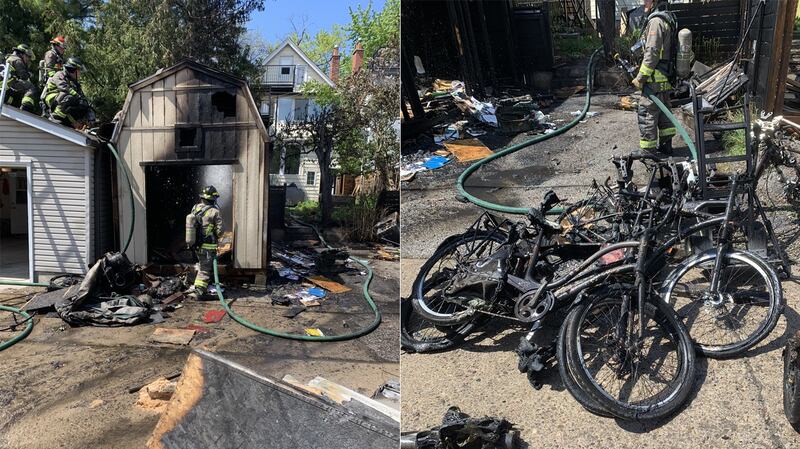
Toronto Reports 97 Lithium-Ion Battery Fires, Surpassing Its Annual Record
Ninety-seven lithium-ion battery fires have been recorded in Toronto so far in 2026, already exceeding the previous full-year record of 91 set in 2025. Toronto Fire Services reported the new high with four months still remaining in the year and said the incidents were associated with 14 injuries.
The count has increased by more than 200 percent since the fire service began tracking these incidents four years ago. Officials identify batteries used in e-bikes and e-scooters particularly packs that have been overcharged, modified or damaged as major contributors to the increase. That finding does not mean every micromobility device or lithium-ion battery is unsafe. It identifies specific product and operating conditions that can remove or overwhelm the protections designed into a battery system.
Why a damaged pack can escalate quickly
A lithium-ion cell normally keeps its positive and negative electrodes separated while its controls limit current, voltage and temperature. Physical damage, an internal defect, excessive heat, an incompatible charger or an inadequate battery-management system can upset those safeguards. The resulting internal short circuit or overheating can initiate thermal runaway, an uncontrollable self-heating state in which the cell generates heat faster than it can release it.
That mechanism helps explain the speed and intensity described by Toronto Fire Chief Jim Jessop. He said lithium-ion battery fires can develop faster than typical fires and that batteries can explode and become projectiles. Failure in one cell can also heat adjacent cells in a multi-cell pack, creating the potential for rapid propagation through a battery used to provide an e-bike or scooter with useful range and power.
The risk extends beyond the initial flames. Jessop said toxic battery chemicals can leave carcinogenic contamination on firefighters’ equipment, requiring specialized decontamination. For emergency services, the growing incident count therefore creates more than a conventional fire-suppression burden: it also affects responder exposure, equipment handling and the time required to return protective gear to service.
Certification evaluates the battery as part of a system
Safety certification is significant because a micromobility product is not simply a collection of interchangeable electrical parts. Standards can evaluate the battery, charger, protection circuitry and electrical drive system as a combination. Replacing a charger or pack with an incompatible component can change the voltage, current or protection assumptions under which the original system was designed.
Health Canada’s lithium-ion battery guidance recommends using the original battery and charger, checking packs for swelling, dents or other damage, and never modifying or building a battery. It also advises charging devices at room temperature where they can be observed, away from soft surfaces and exit doors. Toronto Fire similarly recommends safety-tested and certified devices, compliance with manufacturers’ charging and storage instructions, and keeping batteries away from flammable materials.
These precautions address several different layers of risk. Avoiding damaged packs reduces the chance of an internal short circuit. Compatible chargers and observant charging reduce electrical and thermal stress. Keeping a charging device away from an exit does not prevent cell failure, but it can preserve an escape route if a fire begins. No single measure substitutes for sound cell manufacturing, protective electronics and correct system integration.
Regulatory responses remain pending
The policy response has not yet caught up with the incident record. Jessop opposes an outright battery ban but wants stronger provincial and federal rules covering storage and safety. The Canadian Association of Fire Chiefs is working with Health Canada on proposed regulations and has advocated tighter import controls, particularly for products without safety ratings.
Health Canada has stated that Canada currently has no lithium-ion-battery-specific requirements under the Canada Consumer Product Safety Act. Its proposed regulatory initiative considers mandatory performance criteria and third-party certification for batteries and covered consumer products. However, the proposal remains under development, and its stated scope excludes electric micromobility devices that meet the legal definition of a vehicle. That boundary matters because e-bikes and scooters are central to the conditions Toronto officials are highlighting.
Other changes are also prospective rather than adopted. National building and fire code updates scheduled for 2030 are expected to address battery safety, while Ontario’s fire marshal is considering provincial fire-code changes. Until those measures are finalized, Toronto’s 97 incidents leave a clear systems challenge: rapidly expanding battery use is already interacting with product quality, charging behavior, indoor storage and building evacuation, while the rules intended to manage those interfaces remain unfinished.
| More aerospace and engineering stories, right in your MSN feed. Follow AMI on MSN |
By Thomas Caldwell — AMI’s senior editor for mechanical and mobility engineering, covering vehicle electronics, systems integration, electrification, chassis systems, propulsion, and safety policy.



