


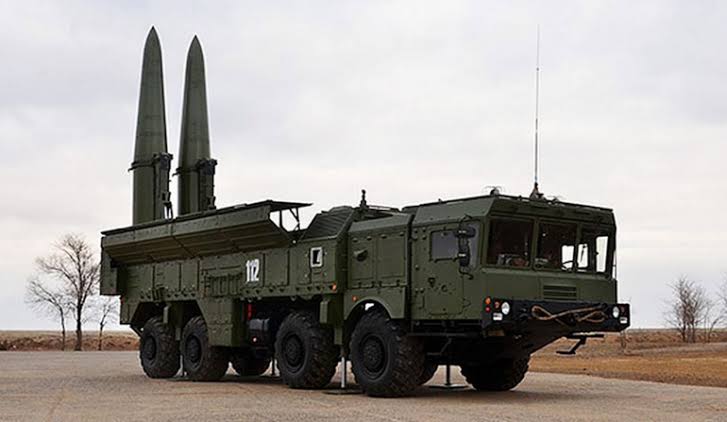
Ukraine Maps 140 Iskander Missile Components, Says Three Quarters Are Foreign-Made
Of 140 components highlighted in Russia’s Iskander-M missile production network, only about one quarter were made by Russian companies, according to a dataset published by Ukraine’s Defence Intelligence Directorate. The August 27 disclosure presents a quantified picture of continuing dependence on foreign electronics but the names stamped on recovered parts do not establish who sold them to Russia or whether their manufacturers knew the final destination.
The Ukrainian agency, commonly known as HUR, mapped components, companies, personnel and industrial equipment associated with the 9M723 Iskander-M ballistic missile. It said the latest release covers 140 Russian and foreign components, 35 enterprises and 108 officials and employees connected to production. HUR identifies NPK KBM, part of Rostec-controlled High Precision Systems, as the missile’s principal developer and producer.
The component count points beyond Russia
HUR attributed 63 components to manufacturers in the United States. Manufacturers in Switzerland and Belarus accounted for eight each, Germany and Taiwan four each, and China three. Those country totals are manufacturer attributions within the dataset, not proof that shipments traveled directly from those countries to Russia.
The identified parts include microprocessors, field-programmable gate arrays, memory devices, and analogue-to-digital and digital-to-analogue converters. These are broad classes of electronic hardware used across commercial and industrial markets. That matters for enforcement: widely distributed components can pass through multiple resellers, equipment integrators or re-export jurisdictions before reaching an end user.
One subsystem illustrates the scale of the reported dependence. HUR said that just five of 43 components identified in a flight-information processing unit connected to the missile’s laser gyroscope were Russian-made. That is a more focused result than the overall 140-part count, although it remains an attributed finding based on Ukraine’s identification work.
The production side extends beyond circuit boards. HUR’s broader Iskander database lists 121 items of foreign-made technological equipment allegedly used by participating companies. Manufacturing equipment can be as consequential as individual electronic parts because it supports repeatable fabrication, inspection and assembly across a production line. Unlike a replaceable chip, however, installed machinery may remain useful for years after its original purchase.
A manufacturer label is not a transaction record
The dataset’s central limitation is also critical to interpreting it responsibly. A manufacturer’s name or marking can identify a component’s origin, but it does not reveal the complete chain of custody. It cannot by itself show that the original manufacturer dealt directly with a Russian missile producer, approved a resale or knew where the product would ultimately be installed.
That distinction shifts the practical question from brand identification to distribution tracing. Investigators and export-control authorities need transaction records, dates, part numbers, intermediaries and shipping routes to determine whether an item was sold before restrictions, diverted by a customer or re-exported through another jurisdiction. The appearance of foreign hardware is therefore a lead for enforcement, not automatic evidence of manufacturer complicity.
Controls have continued to tighten around that problem. Canada’s Russia sanctions framework restricts exports of listed electronics, computers, telecommunications hardware, sensors, navigation equipment and other technologies, while noting that exceptions and permit mechanisms can apply. The G7 also updated industry guidance in September 2024 on preventing Russian export-control and sanctions evasion.
Switzerland took a more geographically targeted step in August 2026, activating an anti-circumvention tool that prohibits exports of certain sensitive goods to Kyrgyzstan. The measure demonstrates why origin-country bans alone may not close a supply chain: enforcement increasingly must account for third-country trade and re-export patterns.
HUR’s broader database contains more than 170 components identified in missiles used by Russia, along with 82 Russian companies and two Belarusian enterprises. It also includes an interactive three-dimensional model of the 9M723, although the industrial picture is the more consequential part of the release.
HUR separately claims that an updated missile designated 9M723-2 was used in an attack on Kyiv and estimates a range of up to 550 kilometers, compared with 390 kilometers for the 9M723-1 configuration in its comparison. That designation, configuration and performance have not been independently confirmed by Russian authorities, so they should not be treated as established specifications.
The confirmed value of the new disclosure lies in its scale: approximately three quarters of the 140 highlighted components were attributed to foreign manufacturers, while 121 foreign-made machines appear in the wider production dataset. Establishing how any of that equipment reached the Iskander network will require transaction-level evidence that component markings alone cannot provide.
| More aerospace and engineering stories, right in your MSN feed. Follow AMI on MSN |
By David Whitaker — Associate editor for AMI’s aerospace and drone systems desk, translating flight systems, aircraft programs, spaceflight, and UAV developments into accessible technical stories.



