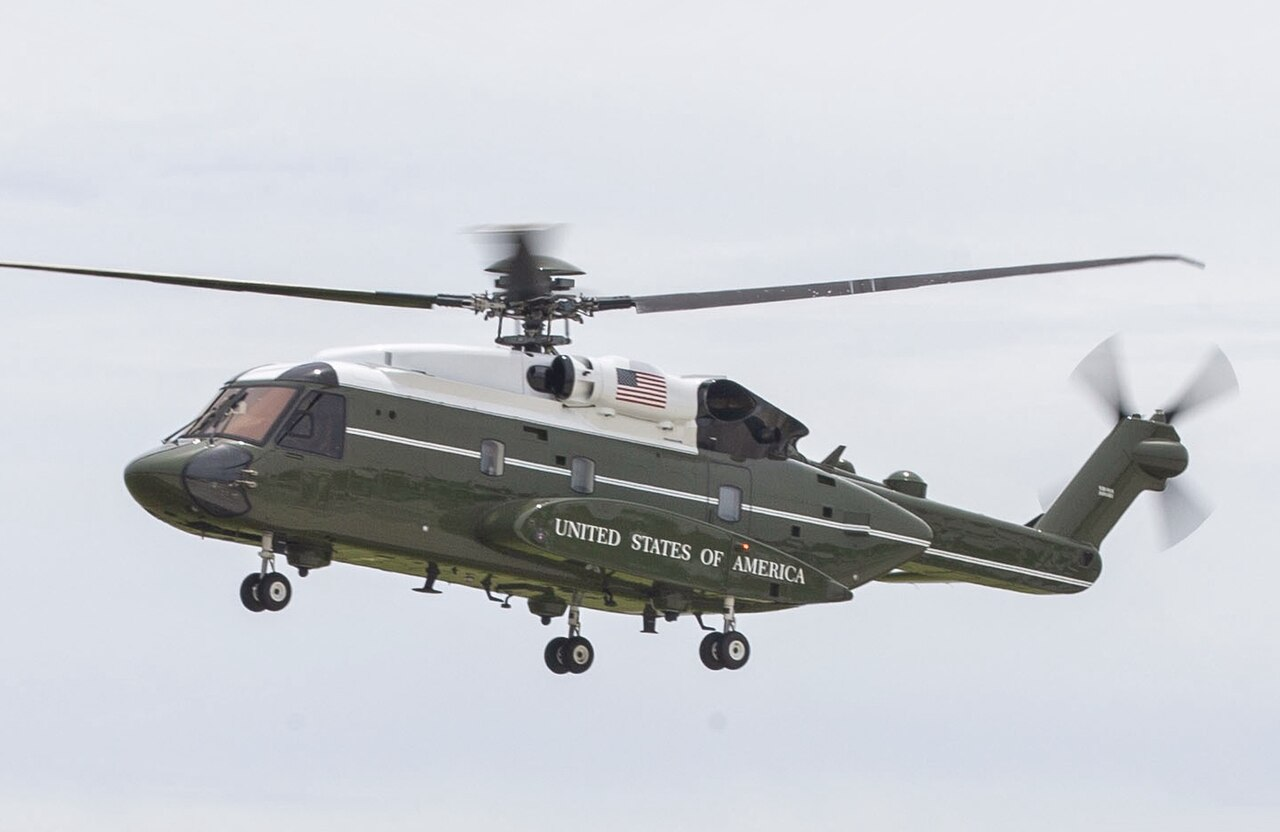
White House Granite Pad Addresses VH-92A Presidential Helicopter Landing Shortfall Tracked Since 2018
The VH-92A Patriot presidential helicopter has not met a performance requirement to land without damaging the surface beneath it. The Government Accountability Office first reported that shortfall in April 2018 and has continued tracking it. The permanent granite landing pad now completed on the White House South Lawn is therefore more than a landscaping measure: it is a ground-based response to an unresolved aircraft and site compatibility problem.

The issue became concrete during a September 2018 training event, when the Navy found that the helicopter’s exhaust damaged a landing zone. Program officials told the GAO that the result did not represent a typical operation because the surface was exposed to exhaust for longer than it ordinarily would be. That qualification limits what can be concluded from the event, but it did not erase the unmet requirement or the need for a workable solution at one of the aircraft’s most important operating locations.
The VH-92A, built by Sikorsky and derived from the commercial S-92A, directs substantial exhaust heat downward. Grass can absorb only so much of that thermal load before scorching or other damage occurs. The White House response has been to replace the traditional grass landing area and removable markers with a fixed surface intended to tolerate routine helicopter operations.
This shifts part of the engineering burden from the aircraft to its infrastructure. The GAO previously identified three broad categories of potential remedies: revised operating procedures, helicopter changes and treatments to the lawn surface. Sikorsky also flight-tested a prototype auxiliary-power-unit exhaust deflector in March 2020. The completed pad represents another path designing the landing environment around the heat the aircraft produces rather than relying solely on changes aboard the helicopter.
That distinction matters because a site-specific solution can restore operations at one location without demonstrating that the aircraft itself has met the original requirement everywhere. A hard landing surface may tolerate heat better than grass, but it does not by itself establish how the VH-92A will interact with other prepared or unprepared landing areas. The pad addresses a White House operating constraint; it should not be read as proof that the underlying aircraft performance shortfall has been eliminated.
The South Lawn also imposes civil-engineering constraints beyond heat resistance. A helicopter landing area must provide suitable levelness, while the surrounding lawn has a slope and must continue to drain. Those requirements can compete: flattening and hardening a section of ground changes how water moves across it, while preserving drainage can complicate the effort to provide a consistent landing surface.
Parts of the initial installation were removed and redesigned, and the completed structure was raised and regraded to make it flatter. However, no authoritative details have been provided about the exact design changes, granite specifications, heat-resistance targets, drainage testing, acceptance criteria or maintenance plan. Those omissions prevent an independent assessment of how the finished pad was validated against the conditions that prompted it.
The permanent pad was described as “just completed” on September 6, 2026. It was funded through a Lockheed Martin contribution to the National Park Service, although a definitive project cost has not been established in the available information. The completion follows the Marine Corps’ December 2021 declaration of initial operational capability for the VH-92A and a January 2023 assessment by the Pentagon’s operational-test office that the type was operationally effective and suitable.
The remaining question is operational rather than architectural: whether the completed pad has been accepted for regular VH-92A South Lawn use and how its performance will be monitored over repeated landings. Until operating records or acceptance results establish that, the granite surface is best understood as a completed infrastructure intervention for a helicopter landing requirement that the GAO has tracked for more than eight years not confirmation that the original shortfall has been closed.
| More aerospace and engineering stories, right in your MSN feed. Follow AMI on MSN |
By Thomas Caldwell — AMI’s senior editor for mechanical and mobility engineering, covering vehicle electronics, systems integration, electrification, chassis systems, propulsion, and safety policy.