Switzerland Seeks $1.2 Billion Up Front to Protect Air-Defense Delivery Slots
Nearly $1.2 billion would be paid substantially in advance not to approve another set of weapons purchases, but to keep Switzerland’s planned air-defense equipment in crowded factory queues. The Swiss Federal Council announced on August 19 that it intends to ask Parliament for 970 million Swiss francs in supplementary credit to reserve manufacturing capacity and protect delivery schedules.

The proposal reflects an increasingly consequential procurement constraint: Having money allocated for a defense system does not necessarily guarantee timely access to the production line. Manufacturers facing heavy global demand are requiring larger down payments, and the government says failing to provide them could delay urgent acquisitions by several years. The payments would also support on-time deliveries so operational training can begin as planned, according to details of the funding request.
Where the 970 million francs would go
The largest allocation, 650 million francs, would support medium-range air defense. That tranche corresponds to the IRIS-T SLM program from Germany’s Diehl Defence, valued overall at one billion francs. Swiss procurement agency Armasuisse signed a cooperative acquisition contract for the system in July 2025.
Another 250 million francs would be allocated to short-range defense, corresponding to Rheinmetall’s truck-mounted Oerlikon Skynex 35 mm gun system. The full Skynex program is valued at 800 million francs. On August 20, the Swiss defense department said that project remained on schedule and that contract negotiations with the supplier were underway.
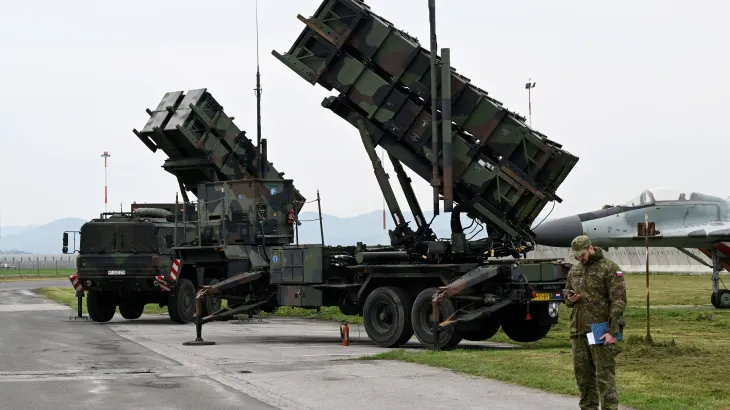
The remaining request includes 60 million francs for a semi-stationary medium-range radar and 10 million francs for defenses against small drones. The package does not cover Switzerland’s long-range air-defense tier, an important boundary given separate uncertainty surrounding the country’s Patriot plans.
Advance payments shift procurement risk toward the customer
Ordinarily, governments manage major acquisitions through staged approvals, contracts and payments tied to milestones. In a capacity-constrained market, however, the factory slot itself becomes a scarce procurement asset. Switzerland is effectively being asked to commit public funds earlier so suppliers can hold production capacity before equipment reaches the manufacturing queue.
That arrangement may reduce schedule risk, but it changes when taxpayers bear financial exposure. The government would commit substantial funding well before complete systems are delivered, while suppliers gain stronger assurances that capacity reserved for Switzerland will be financed. The practical benefit is earlier access to production and a better chance of keeping delivery and training timelines intact; the tradeoff is that more public money is tied up sooner.
The request also shows why a system’s headline program value does not tell the full procurement story. The 250 million-franc Skynex payment is part of an 800 million-franc program, while the 650 million-franc medium-range allocation supports an IRIS-T SLM program valued at one billion francs. These are not small deposits. Together, the two advance-payment tranches account for 900 million francs of the 970 million-franc request.
For smaller customers, this production model can create an access problem. When factories are booked years ahead and suppliers require substantial down payments, governments must have both authorization and near-term fiscal room to preserve their place. A delayed parliamentary decision can therefore become a delayed production decision, even when the underlying equipment requirement is already established.
Parliament still controls whether the money moves
The credit has not been approved. Parliament is scheduled to consider the underlying Army Message 2026 during its September 14-October 2 Autumn session, followed by the supplementary credit during the November 30-December 18 Winter session. Both measures require Federal Assembly approval before the defense department can release the advance payments.
The government says the added spending would not require cuts or reallocations elsewhere because federal revenue forecasts have improved, largely through higher-than-expected corporate tax receipts. That addresses the immediate source of the funding, but it does not remove Parliament’s responsibility to weigh earlier financial exposure against the risk of later deliveries.
A separate 100 million-franc proposal would fund physical-security upgrades at more than 60 military sites, with completion expected by early 2029. The production-slot request is distinct: Its deadline is governed less by construction schedules than by suppliers’ order books. Switzerland’s decisive milestones now fall in two parliamentary sessions, after which manufacturers not procurement plans alone will determine how much schedule the advance payments can preserve.
| More aerospace and engineering stories, right in your MSN feed. Follow AMI on MSN |
By David Whitaker — Associate editor for AMI’s aerospace and drone systems desk, translating flight systems, aircraft programs, spaceflight, and UAV developments into accessible technical stories.