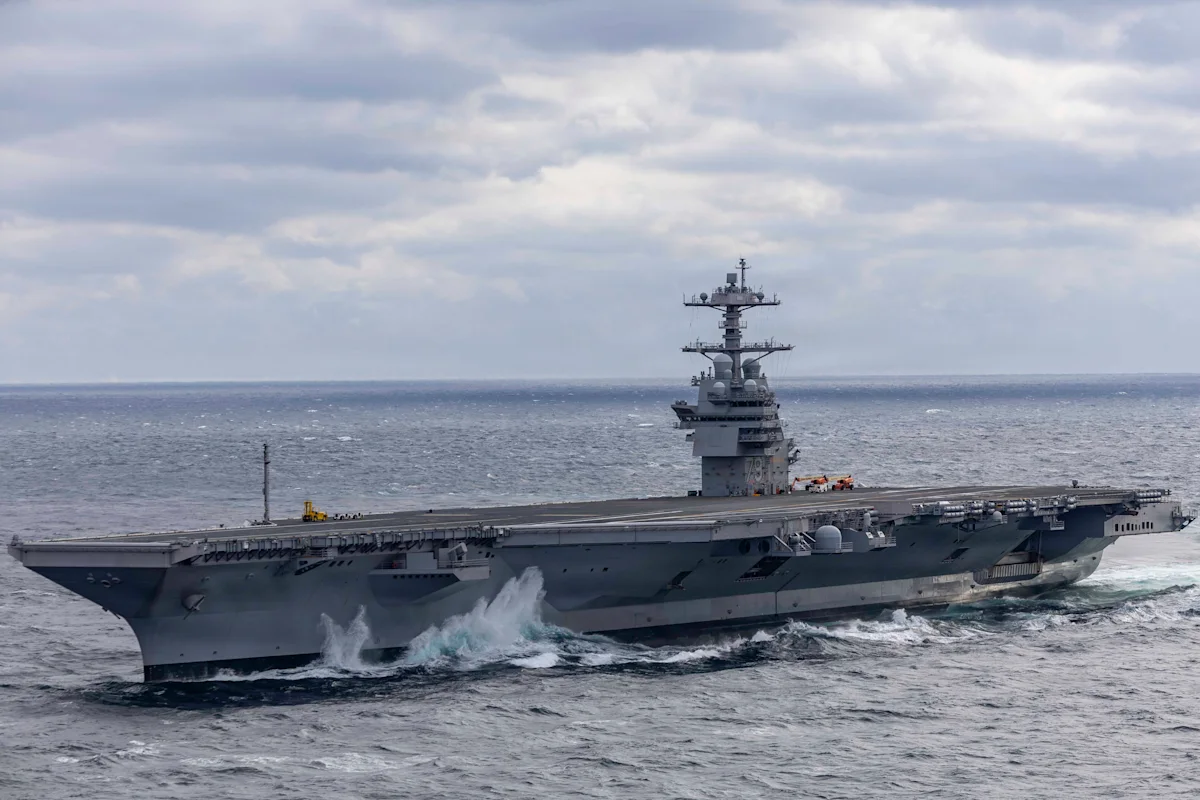
John F. Kennedy Passes Sea Trials After Delays Help Extend Nimitz Service
The delayed March 2027 delivery of the future USS John F. Kennedy contributed to the Navy’s decision to keep USS Nimitz in service longer. Kennedy has now passed acceptance sea trials, but that milestone does not erase the schedule pressure that prompted the service-life extension.
Keeping Nimitz available longer is intended to help the Navy preserve the legally required force of 11 aircraft carriers during the transition to the Ford class. Even with that measure, the service is projected to experience a one-year period with 10 active carriers, making Kennedy’s remaining delivery and fleet-entry work consequential beyond a single shipbuilding program.
Huntington Ingalls Industries announced on August 15 that Kennedy had completed acceptance sea trials, a major pre-delivery test of the second Ford-class carrier. The trials brought together sailors assigned to the ship, other Navy personnel and Newport News shipbuilders to evaluate its operations. The completed test campaign moves the carrier toward preliminary acceptance and further Navy evaluation.
The important distinction is that passing sea trials is not the same as delivery, commissioning or operational readiness. Kennedy remains a pre-commissioning unit, and the schedule anticipates delivery in March 2027. Work after the test milestone includes inspections, inventory, loading and the transfer or accounting of specialized Navy material.
Why one carrier’s delay affects another
Aircraft-carrier planning depends on overlapping construction, maintenance and retirement schedules. A delayed replacement cannot immediately assume the fleet role of an older carrier simply because its major hull and propulsion work is complete. It must clear formal test and acceptance gates, receive Navy equipment and complete subsequent work before it can contribute as an operational ship.
That sequencing explains why Kennedy’s delays reached back into the plan for Nimitz. Extending the older carrier’s service life provides schedule margin while the Navy brings the Ford class into the fleet. It is a fleet-management response to a transition problem: an outgoing ship remains necessary because its replacement has not yet reached the point where it can reliably carry the same force-structure burden.
The extension does not mean Nimitz and Kennedy are interchangeable at every stage. Kennedy passing acceptance trials establishes that the ship cleared an important construction and testing gate. It does not establish that the carrier is ready to deploy, nor does it remove the need for fitting-out, deficiency correction and additional evaluation.
After delivery, a carrier ordinarily enters a post-shakedown availability. That period, estimated at roughly six to 12 months, is used to correct deficiencies identified during shakedown and incorporate approved improvements. Completion of that work and departure from the construction yard mark the end of the construction period, but those steps follow delivery rather than precede it.
A long transition remains exposed to schedule movement
Kennedy’s keel was laid in July 2015, giving the program an unusually visible connection between shipyard progress and fleet availability. The first carrier in the class, USS Gerald R. Ford, took 12 years to build and begin active service. That history underscores why the Navy cannot treat a successful sea trial as the end of the transition risk.
The projected temporary decline from 11 active carriers to 10 also shows the limit of extending Nimitz: retaining an older ship can reduce schedule pressure, but it cannot by itself compress Kennedy’s remaining acceptance, delivery and post-delivery work. Carrier availability ultimately depends on ships being operational, not merely under construction or formally delivered.
Kennedy’s next milestones will therefore carry fleet-level weight. Any further movement in the March 2027 delivery schedule would affect more than the completion date of a carrier begun in 2015; it would further narrow the Navy’s margin for managing Nimitz and maintaining the required 11-carrier force through the Ford-class transition.
| More aerospace and engineering stories, right in your MSN feed. Follow AMI on MSN |
By David Whitaker — Associate editor for AMI’s aerospace and drone systems desk, translating flight systems, aircraft programs, spaceflight, and UAV developments into accessible technical stories.