


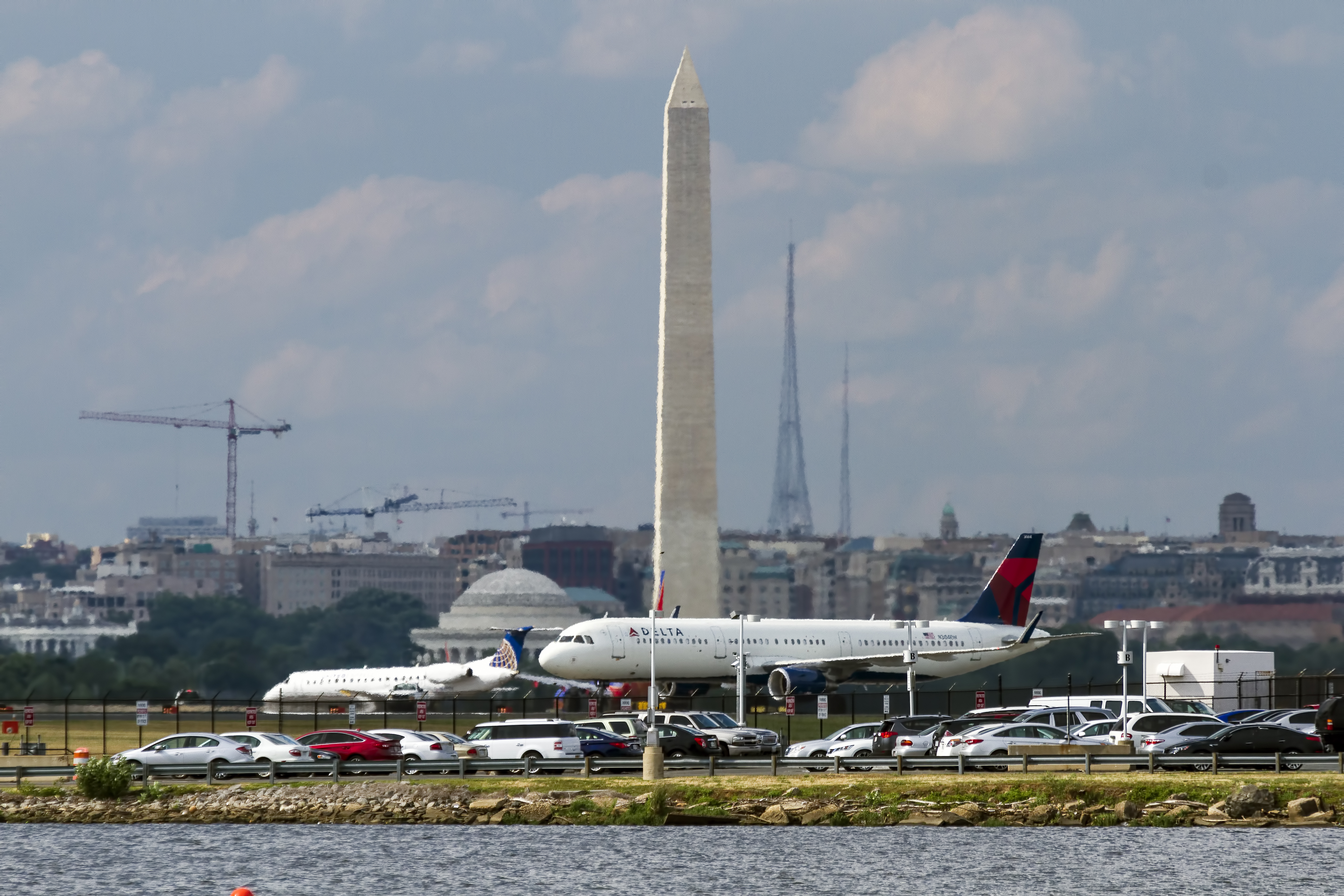
Proposed Reagan National Bill Would Eliminate 30 Daily Flights After Crash
For years, Congress added flights at Ronald Reagan Washington National Airport to expand access, including longer-distance service useful to lawmakers traveling home. Now Virginia Senators Tim Kaine and Mark Warner are proposing the opposite: a safety-focused reduction in airport traffic following the January 2025 midair crash near the airport.

The senators’ DCA Air Safety Act, unveiled September 10, 2026, would cap arrivals at 28 aircraft in any consecutive 60-minute period, establish binding half-hour limits intended to reduce concentrated traffic periods, and eliminate 30 daily flight slots over five years. It is proposed legislation, not an operating restriction now in force, and would require congressional approval before implementation.
The plan provides considerably more detail than a general call to reduce flights. Six slots would be removed annually beginning in 2028, with the process completed by the end of 2032. At least 26 of the eliminated slots would come from exemptions allowing service beyond Reagan National’s normal 1,250-mile perimeter. The senators say 64 daily flights have been added since 2000.
A limit on scheduling, not a single safety fix
From a systems perspective, the bill addresses both aggregate demand and how that demand is distributed. An hourly arrival ceiling controls the number of aircraft scheduled to reach the airport, while the proposed 30-minute caps target clustering short periods when takeoffs and landings are compressed into particularly busy windows.
Those are related but distinct operating constraints. An airport could remain within an hourly ceiling while placing a disproportionate share of its movements into one part of that hour. Smoothing the schedule may therefore matter as much as cutting its total size, although the actual safety effect would depend on implementation, airline schedules and the interaction between different users of the surrounding airspace.
The legislation should not be interpreted as establishing that overall commercial flight volume alone caused the 2025 crash. The senators attribute their proposal to findings about traffic levels and controller workload, but aviation accidents generally involve multiple interacting conditions. A capacity reduction is consequently best understood as one proposed layer in a broader safety system, rather than proof of a single cause or a guarantee against another collision.
Convenience and access carry the cost
Removing 30 slots would reduce some of the access that Congress previously chose to add. Concentrating at least 26 cuts among beyond-perimeter exemptions places much of that burden on longer-distance service rather than necessarily distributing it evenly across every market.
That choice creates identifiable winners and losers. Lower traffic demand could give airspace and airport operations more margin, while affected passengers could face fewer nonstop options or use another Washington-area airport. Airlines could lose operating rights, schedules would need adjustment, and airport workers could see changes tied to reduced service. Nearby communities and other Washington-area airspace users may experience a different operating environment, but the proposal does not by itself quantify those effects.
Fairness will depend heavily on which slots are removed. The bill would require the Federal Aviation Administration to publish a proposed list, accept public comments for 60 days and issue a final list within 120 days after that period closes. That process matters because a numerical capacity cut becomes a practical access policy only when regulators decide which routes and operators absorb it.
The phased schedule also buys time for operational adjustment, but delays the full reduction until the end of 2032. That is a consequential tradeoff: immediate cuts could produce faster capacity relief but greater disruption, while gradual cuts preserve near-term access and postpone the proposal’s complete effect.
The central reversal is now concrete. Congressional policy that previously expanded Reagan National service would be turned toward fewer flights, tighter arrival limits and less scheduling concentration. Whether that becomes a durable safety boundary will depend first on passage of the bill, then on the FAA’s public process and the specific slots selected for elimination.
| More aerospace and engineering stories, right in your MSN feed. Follow AMI on MSN |
By Thomas Caldwell — AMI’s senior editor for mechanical and mobility engineering, covering vehicle electronics, systems integration, electrification, chassis systems, propulsion, and safety policy.


