NASA Pairs Total Solar Eclipse With 96.2% Lunar Eclipse
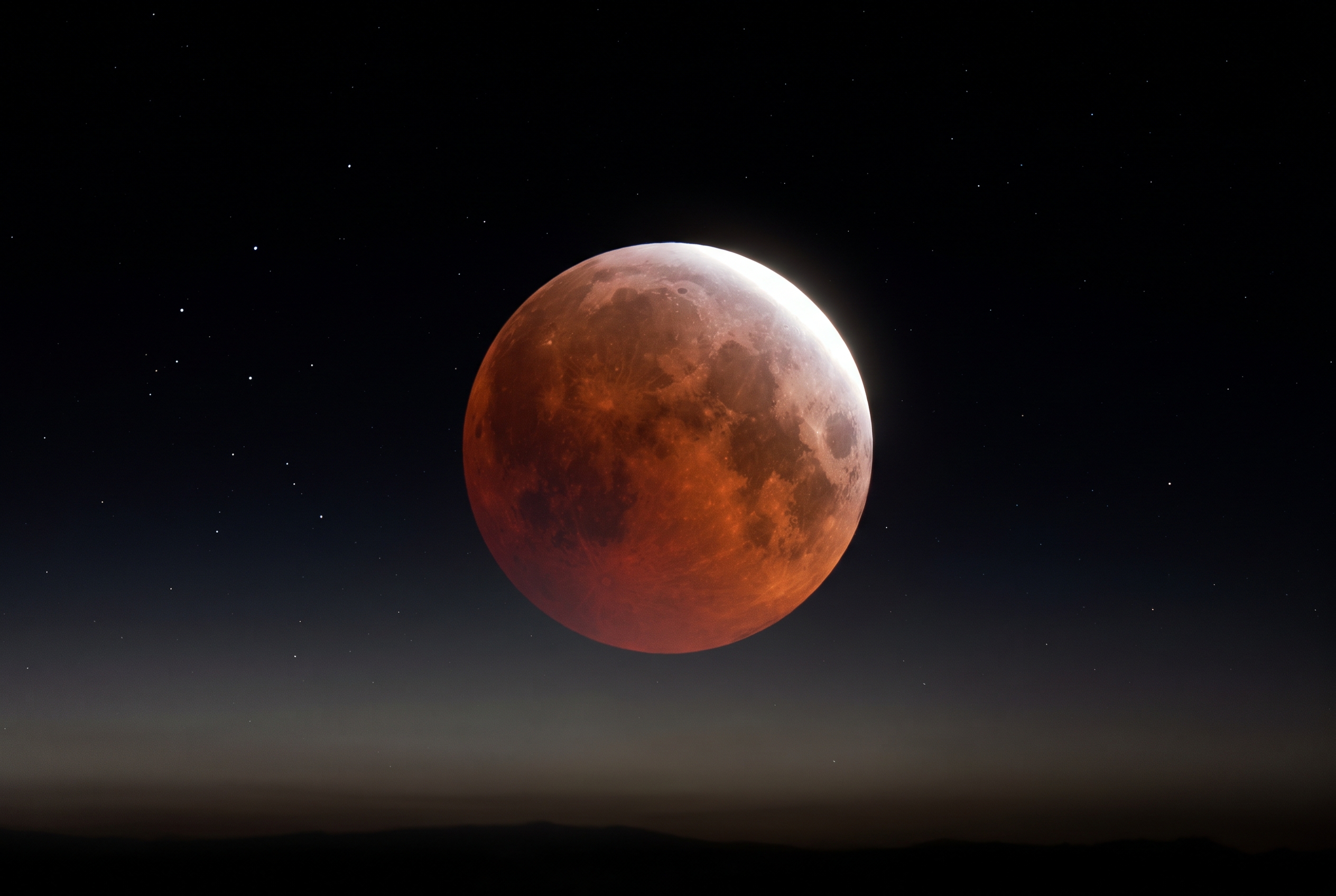
Just over two weeks separated two markedly different alignments of the Sun, Moon and Earth. NASA’s Aug. 29 Astronomy Picture of the Day pairs the Aug. 12, 2026 total solar eclipse with the deep partial lunar eclipse of Aug. 27-28. The lunar image, recorded from Sèvres, France, shows much of the Moon darkened and reddened inside Earth’s central shadow.
Eclipse seasons last about 34 days, during which the three bodies can come close enough to alignment to produce eclipses around consecutive new- and full-moon phases. A solar eclipse can occur at new moon, followed just over 14 days later by a lunar eclipse at full moon. The August lunar event looked close to complete, but it remained a partial eclipse rather than becoming total.
The defining number was 96.2%: the widely published fraction of the lunar disk covered by Earth’s umbral shadow at maximum. A NASA Goddard visualization gives the closely matching figure of 96.3%. Either way, a narrow portion of the Moon remained outside the umbra, and that small geometric difference kept the event below the threshold for a total lunar eclipse.
One eclipse season, two different alignments
The pairing illustrates how the same three objects can produce opposite-looking events within one lunar cycle. On Aug. 12, the Moon moved between Earth and the Sun, producing a total solar eclipse. The image featured by NASA recorded that eclipse from Peñafiel, Spain, near the start of totality, with Baily’s beads and the solar corona visible in the composite.
By the full moon of Aug. 27-28, Earth occupied the middle position and cast its shadow onto the lunar surface. The paired lunar image was made from Sèvres. NASA describes it as a high-dynamic-range composite recorded when the eclipse was closer to half of its maximum phase, rather than at the moment of deepest coverage. About half of the visible lunar disk therefore appears darkened and reddish in the frame.
That distinction matters when interpreting the picture. The image documents the eclipse, but it does not show the Moon at the event’s 96.2% peak. Near maximum, only a slim sunlit section remained outside the central shadow. The photograph instead emphasizes the boundary between the normally illuminated surface and the portion already immersed in the umbra.
The umbra is the central region of Earth’s shadow, where Earth completely blocks direct sunlight from reaching the Moon. Outside it is the penumbra, where the Sun is only partly obscured. The penumbral effect is comparatively subtle, while the umbra produces the conspicuous dark area that advances across the lunar disk during the partial phase.
Earth’s atmosphere also alters the light reaching the shadowed Moon. Some sunlight is filtered and scattered through the atmosphere, contributing the coppery or reddish-orange appearance associated with deep lunar eclipses. That color can become easier to perceive as the directly illuminated portion of the Moon shrinks and an observer’s eyes adapt to the darker scene.
Why the pair was close, but not closer
Solar and lunar eclipses commonly appear in pairs because the new moon and full moon are separated by roughly half a lunar cycle. What varies is the precision of the alignment at each phase. NASA notes that it is rare for both alignments within one eclipse season to be close enough to produce total solar and total lunar eclipses. Partial events are more common.
August 2026 reached totality on the solar side but narrowly missed it on the lunar side. The difference was not the broad timing the two events occurred exactly where an eclipse-season pairing would be expected but the Moon’s precise path through Earth’s shadow. Even with more than 96% of its disk inside the umbra, the remaining illuminated edge was enough to preserve the partial classification.
The lunar eclipse was visible from the Americas, excluding Alaska and northwestern Canada, as well as western Europe and western Africa. Its deepest point occurred at about 4:13 a.m. Universal Time on Aug. 28. Those viewing details are now secondary to the post-event comparison: two photographs, made in Spain and France just over a fortnight apart, captured how a small change in orbital alignment separated a total eclipse from one that stopped barely short.
| More aerospace and engineering stories, right in your MSN feed. Follow AMI on MSN |
By David Whitaker — Associate editor for AMI’s aerospace and drone systems desk, translating flight systems, aircraft programs, spaceflight, and UAV developments into accessible technical stories.