Moon’s 96% Eclipse Links 2008, 2026 and 2044 in 18-Year Cycle
The deep partial lunar eclipse of Aug. 27-28, 2026, belongs to Saros 138, according to NASA’s eclipse record and visualization. Members of this series are separated by 18 years, 11 days and 8 hours a precise interval that places the nearly total-looking event within a much longer sequence rather than treating it as an isolated alignment.
The previous Saros 138 eclipse occurred on Aug. 16, 2008. The next will take place on Sept. 7, 2044. Those dates establish the central connection: the 2026 eclipse was the middle member of an astronomical chain linking events 36 years apart, even though each is experienced at a different date, time and location around Earth.
What the Saros label establishes
A Saros series is useful because it identifies eclipses that recur on the same 18-year, 11-day and 8-hour rhythm. The eight-hour component matters for interpreting the schedule: it is one-third of a day, so a returning eclipse does not simply replay at the same local clock time around the world. That helps explain why belonging to the same series does not guarantee that the same cities or continents receive the same viewing opportunity every 18 years.
The classification also prevents a common scheduling mistake. The next lunar eclipse on the calendar is not necessarily the next member of Saros 138. Other eclipse families continue on their own sequences between 2026 and 2044. Indeed, the 2026 event was one of four eclipses that year two solar and two lunar while the next Saros 138 member remains nearly two decades away.
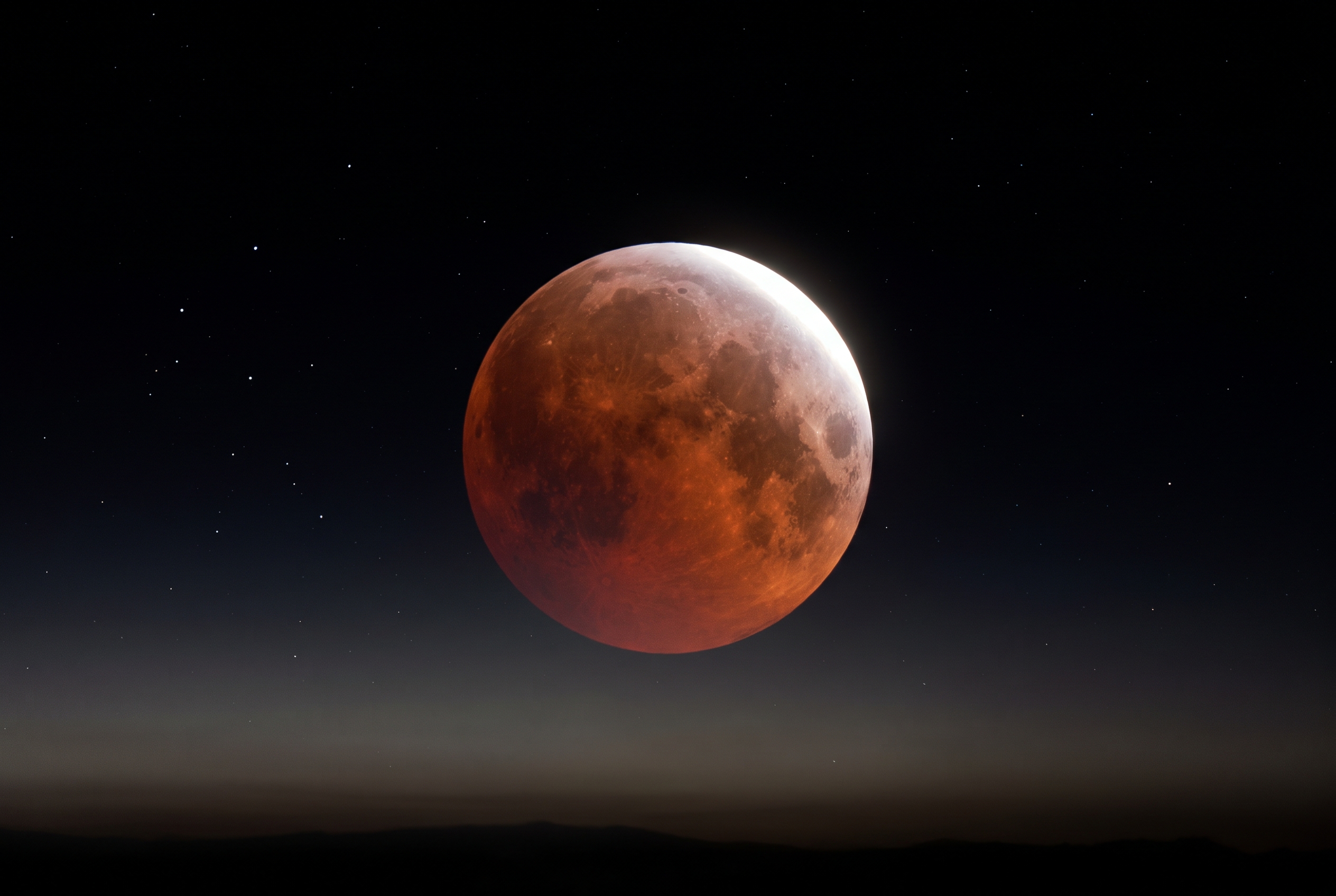
That distinction is especially important because the Aug. 27-28 event came unusually close to totality. At greatest eclipse, at 4:13 a.m. Universal Time, NASA calculated that 96.3% of the Moon’s disk was inside Earth’s umbra, the central shadow in which Earth completely blocks the Sun. A narrow portion of the lunar disk remained directly illuminated, so the eclipse was formally partial despite looking close to a total lunar eclipse.
A global event with local limits
The eclipse had a potential audience exceeding 3 billion people, or 44% of the global population, across the Americas, Europe, Africa, the Middle East, Hawaii and parts of the Pacific. Nearly 1 billion people in North, Central and South America were geographically positioned to see the complete sequence.
That figure described access, not a confirmed audience. Clouds could block the Moon, while the horizon imposed another hard limit. In parts of Europe, Africa and the Middle East, the Moon set while the eclipse was underway. Over Hawaii and northwestern portions of the United States and Canada, it rose after the event had already begun. The partial phase lasted more than three hours, with the full passage through Earth’s outer and inner shadows spanning roughly five and a half hours, but no observer could see phases that occurred below the local horizon.
The reddish or coppery appearance came from sunlight filtered through Earth’s atmosphere before reaching the shadowed lunar surface. Yet the defining technical result was not the color. It was the geometry that left 3.7% of the Moon outside the umbra at maximum, preserving the event’s status as a partial eclipse.
Saros 138 places that near miss on a timeline extending well beyond a single night. The 2008 eclipse provides its immediate predecessor, the 2026 event marks the latest member, and Sept. 7, 2044, is the next date when the series returns after another 18 years, 11 days and 8 hours.
| More aerospace and engineering stories, right in your MSN feed. Follow AMI on MSN |
By David Whitaker — Associate editor for AMI’s aerospace and drone systems desk, translating flight systems, aircraft programs, spaceflight, and UAV developments into accessible technical stories.