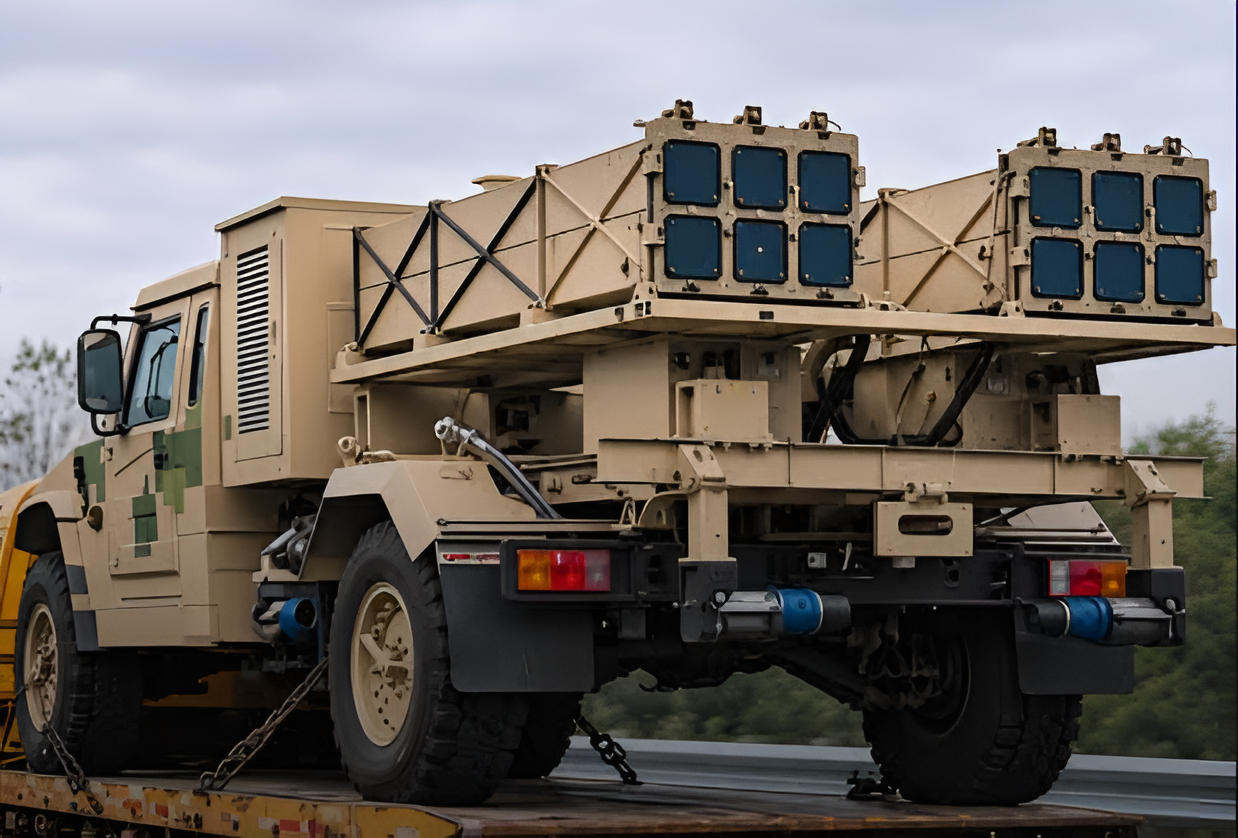
China’s Yitian-L Air Defense Truck Appears With 12 Missiles, Up From Four
A compact Yitian-L air-defense truck that previously carried four missiles now appears to carry 12 in two six-tube roof packs. If the configuration is confirmed, that would triple the vehicle’s ready-missile capacity while retaining the same general Dongfeng Mengshi 4×4 platform, a Chinese vehicle commonly compared with the Humvee.
The unresolved question is who the vehicle is for. The available images show it being transported but do not establish where or when they were recorded. It is also unclear whether this is a Chinese military system, an export model or a development vehicle awaiting a customer. NORINCO, which builds the Yitian family, has not commented on the reported redesign.
What can be established from the configuration
The most visible change is the launcher architecture. Earlier descriptions of the lightweight Yitian-L show four individual missile canisters alongside a foldable three-dimensional X-band radar. The apparent new version replaces that four-round arrangement with two enclosed packs, each presenting six launch tubes.
That gives the 4×4 a nominal total of 12 ready rounds three times the previous load and four more than the heavier Yitian and Yitian II variants. Those larger systems are mounted on armored personnel carriers and carry eight TY-90 missiles apiece.
Tube count alone does not establish the new vehicle’s performance. The images do not reveal whether the 12 weapons are standard TY-90 missiles or a smaller derivative, and they do not show whether the vehicle retains the established radar and fire-control package. There is consequently no confirmed change to detection range, engagement range, target capacity or interception performance.
More rounds change the operating balance
The established Yitian-L is described as carrying four infrared-guided TY-90 missiles. NORINCO claims its folding radar can detect targets at distances of up to 11 miles, or 18 kilometers. The missile has a stated engagement range from 500 meters to 3.7 miles, or 6 kilometers, and a stated altitude limit of 2.48 miles, or 4 kilometers.
Originally developed as a short-range air to air missile for Chinese helicopters, the TY-90 was subsequently adapted for ground launch. It uses passive infrared guidance to track heat signatures and is described as a fire and forget weapon, so the launcher does not have to illuminate a target continuously. A two-person crew controls the existing system from inside the vehicle through a joystick-operated digital console.
Moving from four ready missiles to 12 could reduce how quickly a launcher exhausts its onboard supply when facing numerous airborne objects, particularly small drones. That is an engineering consequence of greater magazine depth rather than a confirmed claim about this vehicle’s intended mission. Actual capacity would still depend on the identity of the missiles, the sensing package, fire-control processing and how many targets the system can manage.
The redesign also presents integration questions. Three times as many canisters add mass and volume above the vehicle, while the roof installation must accommodate launcher actuation, structural loads, electrical supply and sensor sightlines. Nothing currently available establishes whether the apparent configuration changes mobility, stability or reload requirements.
A wider push for deeper mobile magazines
The apparent Yitian-L fits a broader emphasis on carrying more interceptors in mobile short-range defense systems. China’s larger FK-3000 has been displayed with multiple interceptor arrangements, including configurations designed around numerous small weapons. That 6×6 system is a different vehicle with its own radar, optical sensors and automatic cannon, so its much larger advertised capacity is not a direct performance comparison with the Yitian-L.
For the smaller 4×4, packaging 12 rounds would purchase magazine depth without moving to the armored personnel-carrier chassis used by the eight-missile Yitian variants. The trade remains unquantified: no confirmed specifications show what was added, removed or reduced to make the larger launcher fit.
The next useful confirmation will therefore be more than another count of the tubes. Identification of the missile, radar and fire-control equipment would establish what the redesigned vehicle can actually do. Identification of its operator or buyer would answer the more immediate question: whether the 12-round Yitian-L is entering Chinese service or being prepared for export.
| More aerospace and engineering stories, right in your MSN feed. Follow AMI on MSN |
By Jonathan Barrett — Editor for AMI’s future mobility and autonomous systems section, with two decades covering robotics, e-mobility, drone-vehicle convergence, and transport mechanical systems.