Webb’s Deepest Spectrum Yet Strengthens Case for Gas-Cocooned Black Holes
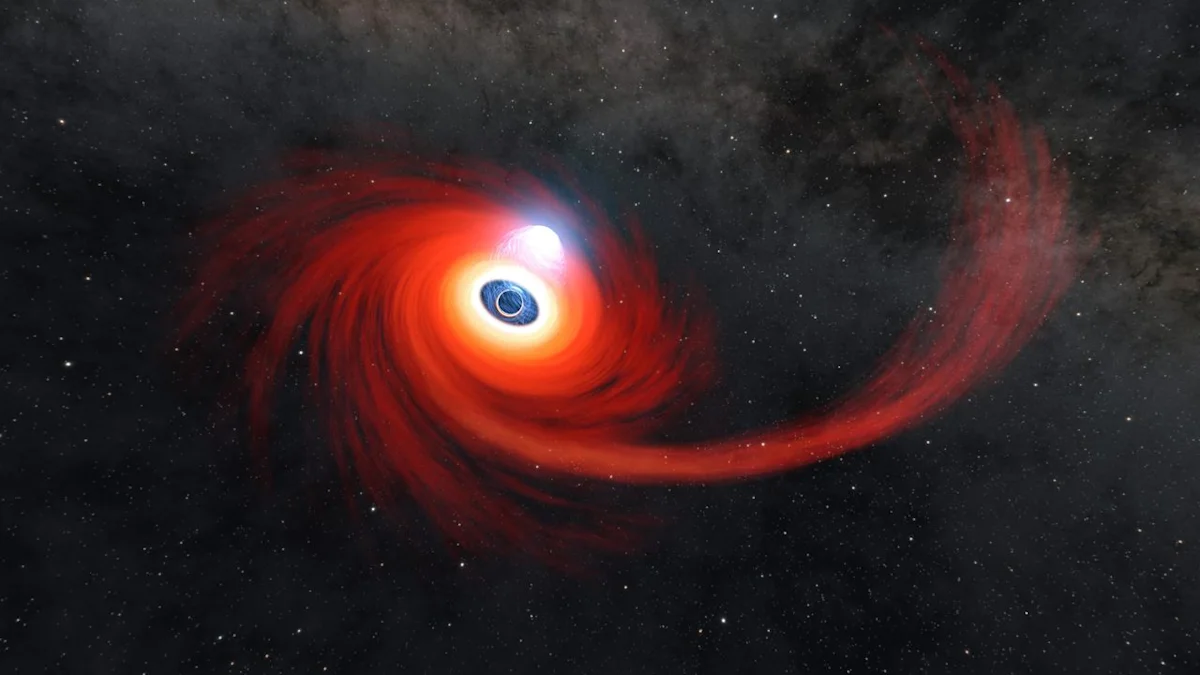
GLIMPSE-17775 is a separate little red dot from the recently reported MoM-BH*-1, and it offers a much richer test of what these unusual objects contain. As detailed in a NASA Webb science update, gravitational lensing amplified a James Webb Space Telescope observation enough to expose more than 40 spectral lines the most detailed spectrum yet obtained for a little red dot.

Those lines do not rest the interpretation on one unusual feature. Electron-scattering broadening, 16 iron lines forming what researchers call an “iron forest,” several oxygen lines, and helium fluorescence and absorption collectively favor a rapidly accreting supermassive black hole wrapped in dense, partially ionized gas. Hydrogen, oxygen and helium features also fit that layered cocoon better than a simple rotating cloud of gas, according to the research team.
The investigation matters because little red dots look deceptively compact and star-like, yet their radiation has resisted straightforward explanations based only on stars or unobscured black holes. In the proposed black-hole-star model, the central black hole supplies the power while the surrounding gas absorbs and reprocesses that radiation. The cocoon therefore changes the light before it escapes, allowing a black-hole-driven source to acquire some characteristics normally associated with a stellar object.
A natural telescope made Webb’s spectrum deeper
GLIMPSE-17775 sits behind the galaxy cluster Abell S1063 from Webb’s perspective. The cluster’s gravity bends and magnifies light from the more distant source, a gravitational-lensing effect that gave astronomers more signal than Webb could have collected from the object alone.
Webb recorded a 30-hour spectrum, but the lensing amplification made the resulting depth comparable to roughly 80 hours of telescope time. That distinction is central to the result: the case for a cocooned black hole comes from resolving a large set of individually useful features rather than relying primarily on the object’s red color or broad appearance.
The broadening provides one line of inquiry. The researchers found that a basic rotating-gas model did not adequately fit many hydrogen, oxygen and helium lines. Their preferred fit adds electron scattering, in which photons interact with free electrons inside a dense, layered medium. That result supports the presence of substantial material surrounding the source, although it does not by itself identify the object at the center.
The iron and oxygen features address the power source. The strengths and relative ratios of the 16 iron lines and certain oxygen lines require intense, high-energy radiation of the kind a rapidly feeding black hole can provide. The helium signatures add a separate constraint: both fluorescence and absorption point toward a powerful source embedded within dense material. Agreement among these different diagnostics makes the interpretation more persuasive than any single spectral line would.
The cocoon also explains what Webb does not see
The same structure could account for why most little red dots are faint in X-rays. Under the model, dense gas absorbs much of the central black hole’s X-ray emission and reradiates its energy at other wavelengths. X-ray faintness therefore does not necessarily mean that a black hole is absent but that remains a model-based explanation, not direct detection of the hidden central object.
Hubble observations added another complication and another check. Combined Webb and Hubble data indicate that a large host galaxy surrounds GLIMPSE-17775. Starlight from that galaxy can contribute excess blue light, helping explain why one characteristic spectral dip is weaker here than in many other little red dots. The host does not rule out the gas-cocoon model, but it shows that researchers must separate the central source from its wider galactic environment.
GLIMPSE-17775 existed about 1.8 billion years after the Big Bang, later than the roughly 660-million-year epoch associated with MoM-BH*-1 but still within an era crucial to understanding early black-hole growth. The new work, reported as published in The Astrophysical Journal, strengthens a common explanation for little red dots without establishing that every member of the population has the same internal structure.
The object’s identity consequently remains provisional. Other theories are still being considered, and the researchers expect further observations to determine what powers these sources. For now, GLIMPSE-17775 provides the most demanding test yet: more than 40 spectral clues, obtained through Webb and a natural gravitational magnifier, converging on a black hole hidden inside its own radiation-processing cocoon.
| More aerospace and engineering stories, right in your MSN feed. Follow AMI on MSN |
By David Whitaker — Associate editor for AMI’s aerospace and drone systems desk, translating flight systems, aircraft programs, spaceflight, and UAV developments into accessible technical stories.