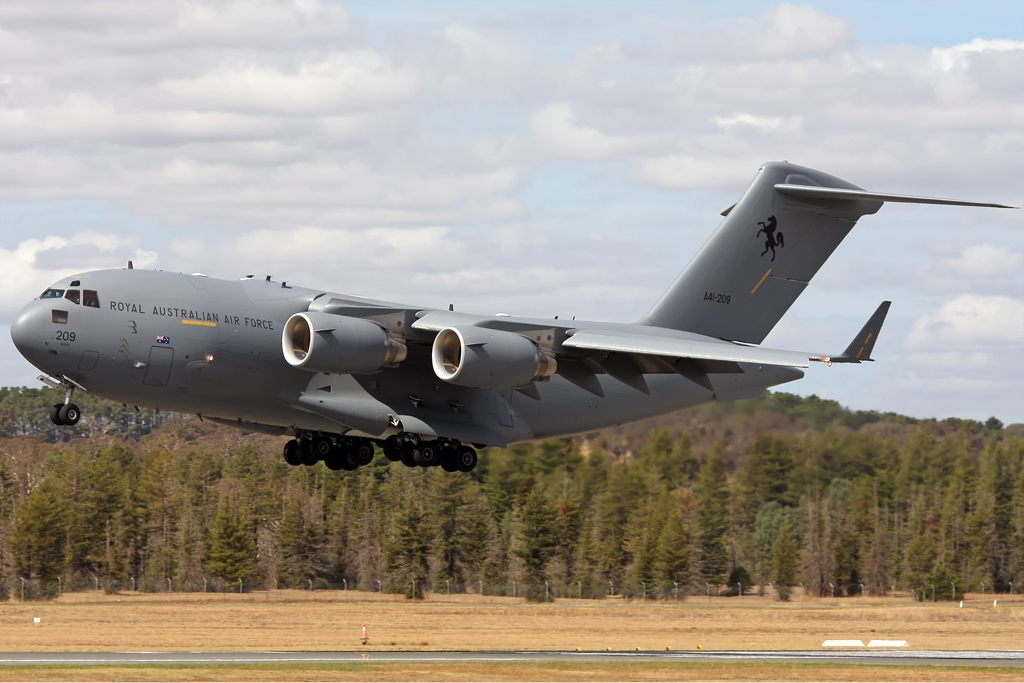
Air Force Studies C-17 Restart That Could Cost Billions Before Delivery
The Boeing C-17 Globemaster III remains valuable because it combines heavy-cargo capacity with access to relatively short or rough airfields. Yet the system that built it has been dormant since 2015. Congress has now directed the Air Force to assess whether restoring that production capability makes more sense than supporting the existing fleet or developing a replacement.

The resulting choice is not simply between an old airplane and a new one. It is a public-cost and force-structure decision involving roughly 220 Air Force C-17s, a production network closed for 11 years and a replacement effort that would carry its own development schedule and expense. The detailed analysis is due by March 1, 2027, according to the congressional report tied to the 2027 defense appropriations process. No restart has been approved.
Restarting production means rebuilding a system
An aircraft assembly line is only the visible center of a much larger manufacturing network. Before another C-17 could be completed, Boeing would have to determine which tooling survives and whether it remains usable. Missing or unsuitable jigs and dies would need to be rebuilt, while manufacturing processes would have to be requalified.
The supplier problem may be harder. Hundreds of companies contributed parts, materials and specialized work to the original program. Some may retain the necessary capability, while others may have left the business, retired equipment or stopped making relevant components. Unavailable parts could require redesign rather than simple reordering, adding engineering, testing and qualification work before production reached a stable rhythm.
Labor is another constraint. C-17 production depended on workers with experience in large-aircraft structures, systems installation, quality control and final assembly. Recruiting a new workforce does not instantly restore the practical knowledge accumulated on an active line. Training and process validation would become part of the restart bill, even before the first revived aircraft generated useful capacity.
That is why the cost cannot be treated as the price of an additional airplane. Estimates developed in 2006 put stopping and restarting production at about $918 million to $2 billion under a much shorter interruption. Those figures are historical, not a current Air Force estimate. After an 11-year shutdown, however, the work required across tooling, suppliers, components and labor supports the possibility of a bill reaching several billion dollars before the first new aircraft is delivered.
A small order would make the economics harder
Once the line was reconstructed, order quantity would shape the cost of each aircraft. Fixed restart expenses spread poorly across a small production run, leaving every new C-17 carrying a large share of the industrial-reconstitution bill. More orders from existing foreign operators such as the United Kingdom, Australia or Canada could improve that arithmetic, but none of those countries is confirmed here as having committed to additional aircraft.
The case for accepting that cost rests on what the C-17 already provides. Each aircraft can carry roughly 77.5 tonnes, including troops, helicopters, tanks and oversized cargo. It can refuel in flight, perform airdrops and operate from relatively short or rough airfields. A replacement would need to preserve the useful parts of that mission set while justifying the time and expense of a new development program.
Sustainment buys availability, not a much larger fleet
The Air Force’s lower-risk option is to extract more service from aircraft it already owns. The C-17 fleet could remain in service until 2075, operating alongside 52 larger C-5Ms. Work on discontinued parts, avionics, computers and maintenance systems could reduce support problems and keep more aircraft ready for use.
Predictive maintenance could also help planners identify developing problems earlier and schedule work more efficiently. Even a few percentage points of improved availability could put a handful of additional C-17s into service without reopening a production line. That would be meaningful operationally, but it would not create a substantial expansion of the fleet. Maintenance can recover capacity lost to downtime; it cannot manufacture dozens of new airframes.
A clean-sheet replacement presents the opposite trade. It allows requirements and technology to be reconsidered rather than forcing modern systems into a decades-old production design. But development introduces technical, schedule and procurement risk, while the current fleet must still be supported during the transition. With C-17s potentially flying until 2075, sustainment is necessary under almost any path.
The March 2027 analysis therefore has to compare three different kinds of spending: rebuilding dormant industrial capacity for more C-17s, investing in the availability and longevity of roughly 220 existing aircraft, or funding a successor whose benefits arrive later. The decisive issue is not whether another C-17 can theoretically be built. It is how much industrial capability must be reconstructed and how many new aircraft taxpayers would receive after paying to reconstruct it.
| More aerospace and engineering stories, right in your MSN feed. Follow AMI on MSN |
By David Whitaker — Associate editor for AMI’s aerospace and drone systems desk, translating flight systems, aircraft programs, spaceflight, and UAV developments into accessible technical stories.