Ukraine’s Defense Ministry Authorizes 81 Companies to Counter Drones Under Military Command
Eighty-one companies now have Ukrainian government authorization to help defend their employees and facilities against drone attacks. The number is significant not only because it rose from 51 participants in mid-July, but because these privately staffed groups remain under military command rather than becoming independent armed units.
As of mid-September, 92 companies from different industries and regions had applied to the pilot program, according to the Ministry of Defence. The authorized participants include private businesses and critical-infrastructure operators. The program was established in late 2025 to protect workplaces and infrastructure while adding another layer to Ukraine’s national air-defense network.
The expansion from 51 to 81 participating companies in roughly two months indicates strong demand for localized protection. It does not mean that all 81 have deployed groups, received equipment or recorded interceptions. Authorization is better understood as permission to enter a controlled system whose operations still must be coordinated with the Armed Forces.
Private staffing does not mean private command
The program’s defining boundary is centralized control. Participating groups operate under the Air Command of the Armed Forces of Ukraine, with operating areas and assigned targets coordinated through the military command structure. That distinction matters in crowded airspace, where several military and civilian organizations may be observing or responding to the same airborne object.
From a systems perspective, adding more operators can increase coverage around workplaces and infrastructure, but it also increases the need for common identification, communications, authorization and safety procedures. Military control provides a framework for coordinating those activities and limiting fragmented responses. The companies supply additional personnel and local capacity; the state retains command authority and sets operational boundaries.
This arrangement also separates site-level protection from control of the wider air-defense mission. A business may have a direct interest in protecting its workers, production lines or utility assets, but those priorities must fit within national airspace management and defense requirements. Central coordination is therefore not a minor administrative condition. It is the mechanism intended to prevent privately organized groups from acting solely according to company priorities.
Expansion shifts some burden toward exposed businesses
The pilot allows companies to form and finance groups staffed by trained and certified civilian employees. Eligible participants include providers of electricity, water, transportation and communications, as well as security companies protecting other businesses. Rules introduced in March also allow participating companies, with Air Force approval, to receive certain military air-defense equipment and ammunition temporarily when it is not being used by combat units.
That model offers a practical way to add capacity without staffing every protected site entirely with military personnel. It may also reduce pressure on the broader military network by assigning some facility protection to authorized local groups. The tradeoff is that access may depend partly on whether an organization can finance, staff and sustain such a group. Large infrastructure operators may be better positioned to participate than smaller businesses facing similar exposure.
The available information does not establish how costs are divided, how authorization standards are applied across industries, or what continuing certification and safety reviews are required. Those details will determine whether the program develops into a consistently governed national layer or remains a collection of unevenly resourced company units operating within a common command framework.
Ukraine is pairing distributed production with distributed defense
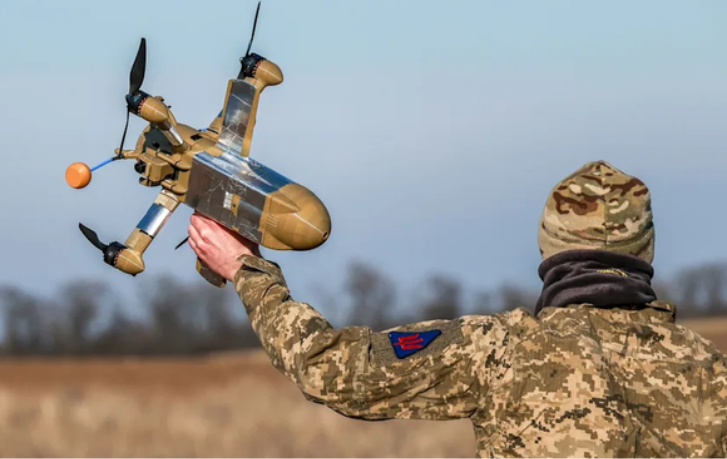
The private air-defense initiative sits alongside a much broader effort to involve domestic industry in unmanned systems. In April, the Defense Ministry said it had contracted for 8,000 Octopus interceptor drones, with 29 Ukrainian companies and the UK government participating in production efforts. The DOT-Chain Defence procurement marketplace separately includes products from more than 200 Ukrainian manufacturers.
Those figures describe different programs and should not be treated as one pool of equipment or operators. Together, however, they show an industrial approach built around multiple suppliers and distributed capacity rather than dependence on a single production organization. The private-defense pilot applies a similar distributed model to staffing, while imposing a tighter institutional boundary: companies may contribute personnel and resources, but military authorities coordinate their role in the air-defense network.
Ukrainian authorities have attributed several drone interceptions to participating company groups, although those results have not been independently substantiated here and do not apply to every authorized participant. The more consequential measure of the pilot will be whether its rapid numerical growth can be matched by consistent training, equipment control, communications reliability and safety oversight. With 81 of 92 applicants already authorized, those governance questions are now more important than the enrollment count alone.
| More aerospace and engineering stories, right in your MSN feed. Follow AMI on MSN |
By Stephen Wallace — Editor for AMI’s aerospace integration and unmanned mobility coverage, focused on drone manufacturing, VTOL systems, autonomous networks, and air-ground mobility links.