

Fire Point Targets 100,000 Drones as Missile Funding Lags
More than 100,000 drones in a single year: that is the production level Ukrainian manufacturer Fire Point says it can exceed by the end of 2026. CEO Iryna Terekh described the goal as realistic, although no independently verified 2026 production total has been provided.
The scale becomes clearer against the company’s starting point. Fire Point says it produced approximately 200 drones in 2022, when the Kyiv-headquartered business was founded following Russia’s full-scale invasion. Exceeding 100,000 units in 2026 would represent more than a 500-fold increase from that reported first-year output.
Fire Point’s workforce has expanded just as sharply, from three founding members to more than 7,000 employees. That growth illustrates a central requirement of mass drone production: rapid prototyping is not enough. A manufacturer must also recruit, train and organize enough people to fabricate parts, assemble airframes, manage quality and maintain the production flow at thousands of units per month.
Fast fabrication supports the production target
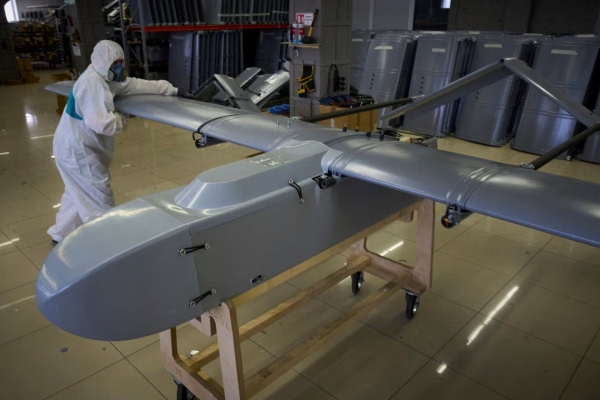
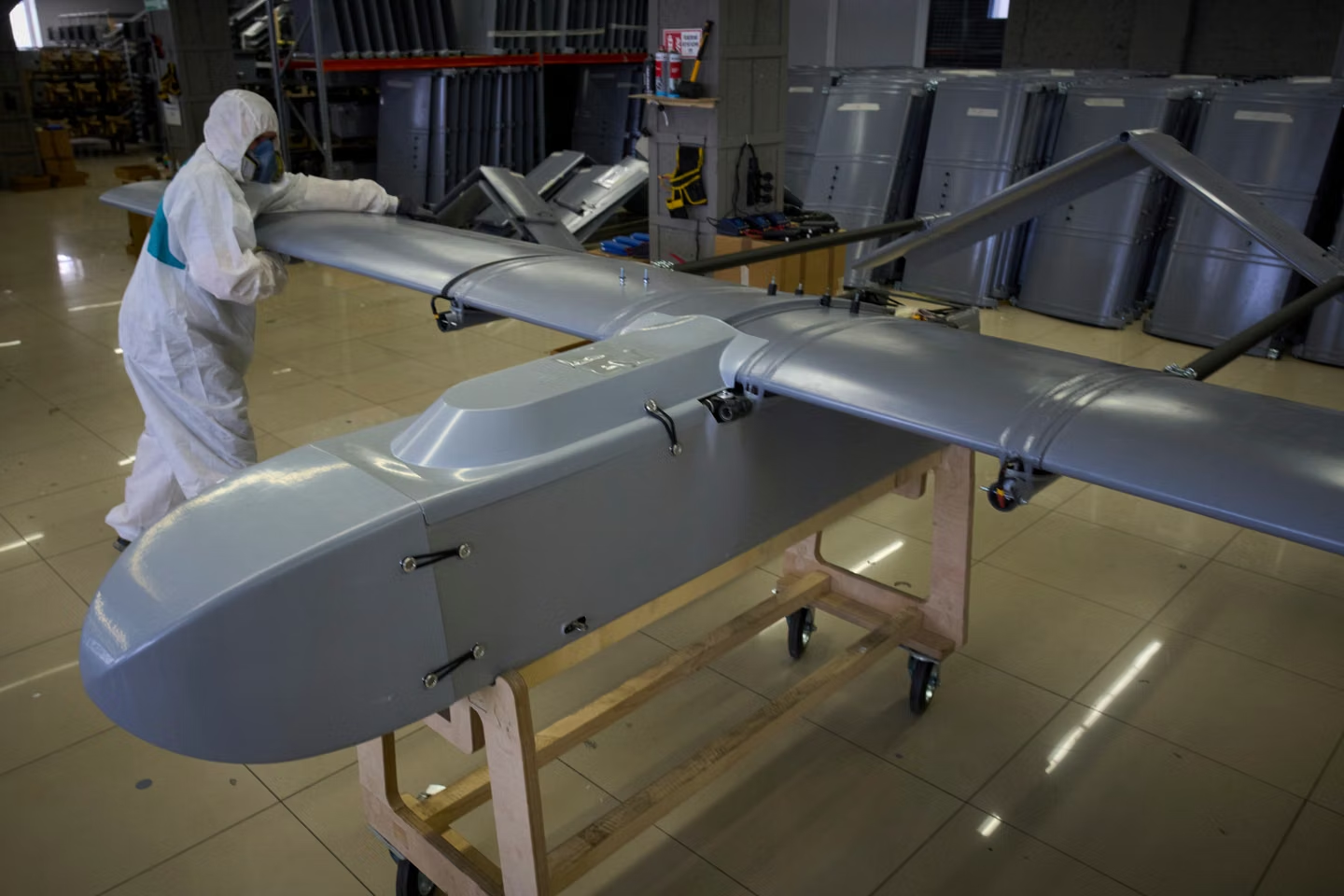
Fire Point uses carbon fiber and 3D printing to manufacture and fit wings, fuselages and other components for its FP-2 drones. These methods can support rapid design changes and distributed fabrication without requiring every component to pass through conventional high-volume tooling.
That does not make industrial scaling automatic. Additive manufacturing still requires machines, feedstock, inspection and repeatable process controls. Carbon-fiber structures likewise depend on controlled fabrication and consistent workmanship. As output rises, the challenge shifts from making an individual airframe work to ensuring that large batches conform to the same production standard.
The company’s reported headcount indicates that its expansion is not based on automation alone. Labor remains essential for fitting components, assembling structures and moving products through the factory. Fire Point’s 100,000-unit target therefore reflects a combination of workforce scale and rapid fabrication rather than a single manufacturing breakthrough.
The figure is a target, not a completed result. Fire Point has not released a detailed production schedule, monthly output data or an independently audited 2026 total. Its separate claim that it facilitates more than 60% of Ukraine’s long-range campaign also remains a company assertion rather than an independently verified measure.
Financing limits the missile side of the expansion
Fire Point’s growth has not removed its dependence on outside financing. Terekh said delayed funding associated with a European loan has prevented production of the FP-5 Flamingo cruise missile from operating at full capacity. She expects output to increase after the money arrives, but no revised production total or funding date was provided.
That distinction matters: the funding constraint was specifically linked to Flamingo production, not presented as proof that the drone target will be missed. It nevertheless shows how factory capacity can sit partially unused when financing does not arrive on the schedule assumed in an industrial plan. Materials, equipment and workers must be funded before nominal production capacity becomes delivered hardware.
Terekh has also argued that European regulation would make it difficult to reproduce Ukraine’s manufacturing pace with the same people, money and factories. That is the company’s assessment, but it points to a broader industrial tension. Rules intended to manage safety, procurement and accountability can lengthen development cycles, while wartime manufacturers are under pressure to change designs and raise output quickly.
An interceptor remains the harder engineering test
Fire Point is pursuing an anti-ballistic missile system intended to cost substantially less than a U.S.-made Patriot interceptor. The company has acknowledged that it is attempting within a few years work that normally takes two to three decades.
The program has moved into supplier integration, but it has not demonstrated an operational interceptor. Terekh told Breaking Defense that Fire Point had signed more than 12 agreements with European companies for radar, guidance and other systems, with a preliminary “zero test” planned by year-end. No test result was available, and that milestone should not be confused with fielded capability.
This is a fundamentally different challenge from scaling relatively compact unmanned aircraft. An interceptor must combine propulsion, sensing, guidance, command-and-control and system integration with extremely high reliability. Fire Point can set an aggressive cost objective, but proving performance will require testing that cannot be replaced by workforce growth or faster airframe fabrication.
The company’s proposed leap from roughly 200 drones to more than 100,000 remains a striking measure of wartime industrial acceleration. Its next constraints are equally concrete: converting headcount and fabrication speed into repeatable output, obtaining financing on time, and showing through testing whether its far more demanding interceptor ambition can progress beyond integration.
| More aerospace and engineering stories, right in your MSN feed. Follow AMI on MSN |
By Stephen Wallace — Editor for AMI’s aerospace integration and unmanned mobility coverage, focused on drone manufacturing, VTOL systems, autonomous networks, and air-ground mobility links.