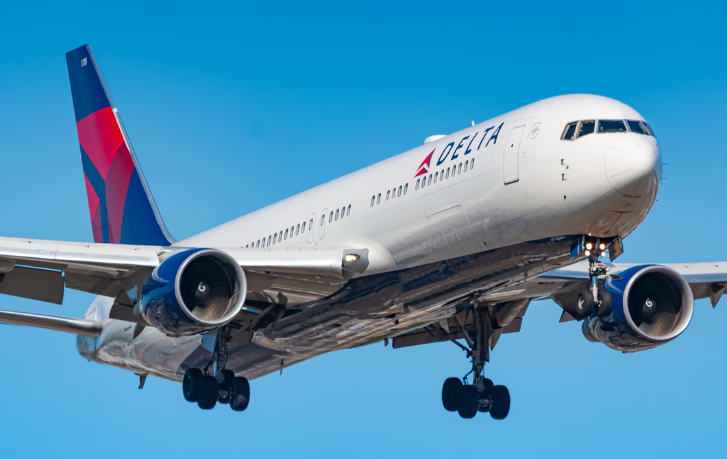
Delta Picks Amazon Leo Wi-Fi for 500 Planes, but Service Waits Until 2028
Delta Air Lines has selected Amazon Leo to provide satellite Wi-Fi on an initial 500 aircraft, but passengers are not expected to receive the new service until 2028. That schedule creates the central tension in Delta’s connectivity strategy: the airline is pursuing claimed cost and integration advantages while competitors put SpaceX’s Starlink into service sooner.
Delta previously tested Starlink but declined to adopt it. The airline is not going without broadband in the interim; it currently uses Viasat and Hughes Network Systems and says most of its aircraft already provide “streaming quality” connectivity. The 2028 date therefore represents a future network transition rather than the beginning of onboard internet across Delta’s fleet.
Delta CEO Ed Bastian has said Amazon Leo should be as fast as Starlink and more cost-effective. Those are forward-looking claims, not demonstrated results from Delta passenger operations. Amazon remains far behind Starlink in deploying the satellites needed to support the planned service, making constellation availability a key dependency between the agreement and its eventual rollout.
Delta is buying an ecosystem as well as a connection
Bastian has also pointed to Delta’s existing use of Amazon Web Services and the possibility of drawing on Amazon’s retail, gaming and video capabilities. That helps explain why the airline might evaluate the deal as more than a comparison of satellite download speeds.
From a systems-integration perspective, the value of an onboard network depends on how reliably it connects aircraft hardware, satellite capacity, ground infrastructure, authentication, content services and airline applications. A closer relationship with a large cloud and consumer-services provider could simplify parts of that digital architecture or create new service options. The available information does not establish which integrations Delta will deploy, however, or how much they contributed to the provider decision.
The tradeoff is timing. Starlink is already available on nearly half of United Airlines’ daily flights, and United expects to complete its fleet installation by the end of 2027. American Airlines plans to begin installing Starlink on hundreds of aircraft in 2027, while Frontier says it will also receive the service that year. Delta’s planned Amazon Leo launch follows those milestones.
That gap matters because airline Wi-Fi is no longer judged only by whether a passenger can send a message. Streaming, video calls and cloud-based work place higher and less predictable demands on capacity and latency. As travelers encounter newer systems elsewhere, their expectations can rise before Delta’s selected replacement is ready.
A satellite deal is only one part of an aircraft rollout
Installing a connectivity system across 500 aircraft is also an aviation modification program. Antennas, external structures, power requirements, cabin-network equipment and software must be engineered for the relevant aircraft configurations, approved and fitted without unnecessarily disrupting scheduled service. The agreement’s scale does not mean all 500 aircraft can be converted at once.
The broader market illustrates the certification requirement. In a separate business-aircraft example, the Federal Aviation Administration issued a supplemental type certificate covering a Starlink installation for Hawker 700, 800 and 900 aircraft before operators could schedule the upgrade through Textron Aviation’s service network. Delta’s airliner program will have its own engineering and approval path, but the same underlying distinction applies: satellite availability and approved aircraft integration are separate readiness gates.
Public criticism from SpaceX CEO Elon Musk has added noise around the decision, while United and American have used the dispute to promote loyalty-status matches. Unverified remarks attributed to Bastian do not clarify the procurement and should not be treated as established fact.
The consequential comparison will come from operations, not executive exchanges. By 2028, Delta will need Amazon Leo’s constellation, aircraft installations and service integration to mature together and to deliver enough cost or passenger-service benefit to justify arriving after rival Starlink deployments.
| More aerospace and engineering stories, right in your MSN feed. Follow AMI on MSN |
By Thomas Caldwell — AMI’s senior editor for mechanical and mobility engineering, covering vehicle electronics, systems integration, electrification, chassis systems, propulsion, and safety policy.