Luxor Will See More Than Six Minutes of Totality on August 2, 2027
Six minutes and 19 seconds: That is the projected duration of totality in Luxor, Egypt, during the total solar eclipse on August 2, 2027. The interval is more than twice the roughly three-minute duration associated with many total eclipses, giving observers near the Egyptian city an unusually long period in which the Moon will completely cover the Sun’s bright face.

Luxor sits close to the point of greatest eclipse, where the maximum total phase is projected to reach 6 minutes and 23 seconds. The city’s position turns an international astronomical event into a particularly long observation window for residents, visitors, photographers and scientists but only if local weather and viewing conditions cooperate on the day.
A shadow crossing several countries
The Moon’s central shadow will begin over the Atlantic Ocean before passing through the Strait of Gibraltar and southern Spain. It will then continue through Morocco, Algeria, Tunisia, Libya, Egypt, Saudi Arabia, Yemen and Somalia before moving into the Indian Ocean. The National Solar Observatory has published an August 2027 eclipse map showing the countries crossed by the totality corridor.
The path will be roughly 160 to 170 miles wide, depending on the mapping reference and the point along the route. That may sound broad, but totality is highly location-dependent. People outside the central corridor will see only a partial eclipse, even where the Moon covers nearly all of the solar disk.
Southern Spain illustrates how quickly duration changes with position. Málaga is projected to receive about 1 minute and 52 seconds of totality, while Cádiz is expected to get about 2 minutes and 51 seconds. Farther south, Tarifa approaches 4 minutes and 39 seconds. Across North Africa, durations generally increase toward the eclipse’s central section: Benghazi is projected to receive just over six minutes, while locations around Luxor and Egypt’s Red Sea coast approach the event’s maximum.
The shadow will remain substantial after crossing Egypt. Jeddah is projected to experience approximately six minutes of totality, while Makkah is expected to receive a little more than five minutes. Parts of southern Italy and Lampedusa will remain outside the totality path and see a partial eclipse instead.
Why this total eclipse lasts so long
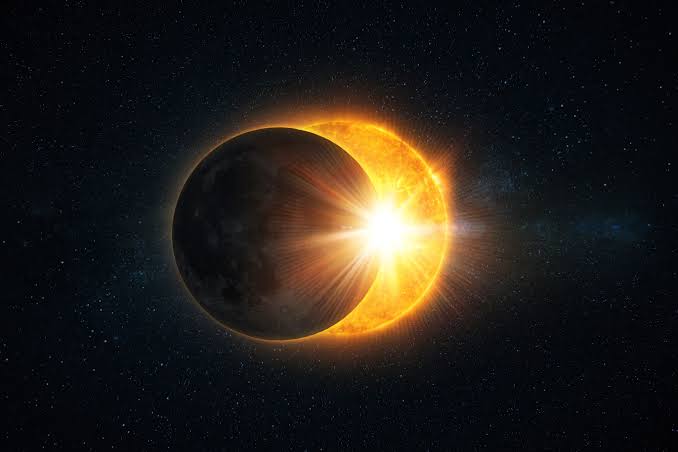
A total solar eclipse occurs when the Moon moves directly between Earth and the Sun and appears large enough to cover the Sun’s bright disk. The August 2027 event benefits from two geometric conditions: the Moon will be near its closest point to Earth, increasing its apparent size, and the shadow track will pass near the equatorial region.
Together, those conditions allow the Moon’s shadow to produce an extended period of complete coverage near the center of the path. Duration still varies from place to place because observers encounter different portions of the moving shadow. Being inside the path is therefore not enough to guarantee six minutes; the longest intervals are concentrated near its center and near the point of greatest eclipse.
That distinction matters for both casual viewing and instrument planning. An extra minute or two provides more time for photography and scientific observations during the only phase when the Sun’s bright surface is completely obscured. It also gives observers more time to experience the sudden daytime darkness without the total phase ending almost immediately.
Totality does not remove the safety requirement
Eye protection remains essential during every partial phase before and after totality. According to NASA’s eclipse-viewing safety guidance, it is safe to look directly at the Sun without specialized protection only during the brief total phase, when the Moon completely blocks the bright solar face.
Ordinary sunglasses are not adequate. Direct viewers should use eclipse glasses or handheld solar viewers that comply with the ISO 12312-2 international standard. Cameras, telescopes and binoculars require suitable solar filters mounted over the front of their optics; eclipse glasses worn by the user do not make an unfiltered optical device safe.
More detailed local maps, timing tables and observation guidance are expected as the date approaches. Those updates will be important because the defining feature of this eclipse is not merely its broad international route. It is the narrow section near Luxor where daytime darkness is projected to persist for more than six consecutive minutes.
| More aerospace and engineering stories, right in your MSN feed. Follow AMI on MSN |
By David Whitaker — Associate editor for AMI’s aerospace and drone systems desk, translating flight systems, aircraft programs, spaceflight, and UAV developments into accessible technical stories.